
Choose Full PU when…
The project prioritizes a premium PU-rich structure, high-end athletics positioning and a specification that justifies the higher material intensity.
Full PU, Sandwich and Spray Coat are three established polyurethane running-track system families, but they are not interchangeable. Each uses a different material architecture, serves a different performance-and-budget position and places different demands on the base, drainage, installation and long-term maintenance.
Sport Floor manufactures its own polyurethane sports-flooring materials, uses them in sports applications and supplies complete material packages for international projects. German raw materials are used within applicable Sport Floor PU formulations, allowing buyers to source primers, binders, elastic layers, pore sealers, self-leveling polyurethane, EPDM/SBR components and line-marking materials through one coordinated route.
This guide compares the three systems from a buyer, consultant and contractor perspective so the final specification is based on project needs rather than on a generic “best track” claim.
Full PU uses a polyurethane-rich build-up with dense liquid-applied PU layers and embedded/broadcast rubber granules according to the selected design. It is generally positioned as the premium, high-performance route.
Sandwich uses a PU-bound SBR or recycled-rubber resilient base, then closes the pores before a dense PU top layer with EPDM granules. It combines a cost-efficient rubber base with a higher-density PU wearing structure.
Spray Coat commonly uses a PU-bound SBR resilient base with a sprayed polyurethane/EPDM surface coating. It reduces the amount of dense PU used in the upper construction and is often selected where training, school or general athletics performance and budget efficiency are both important.
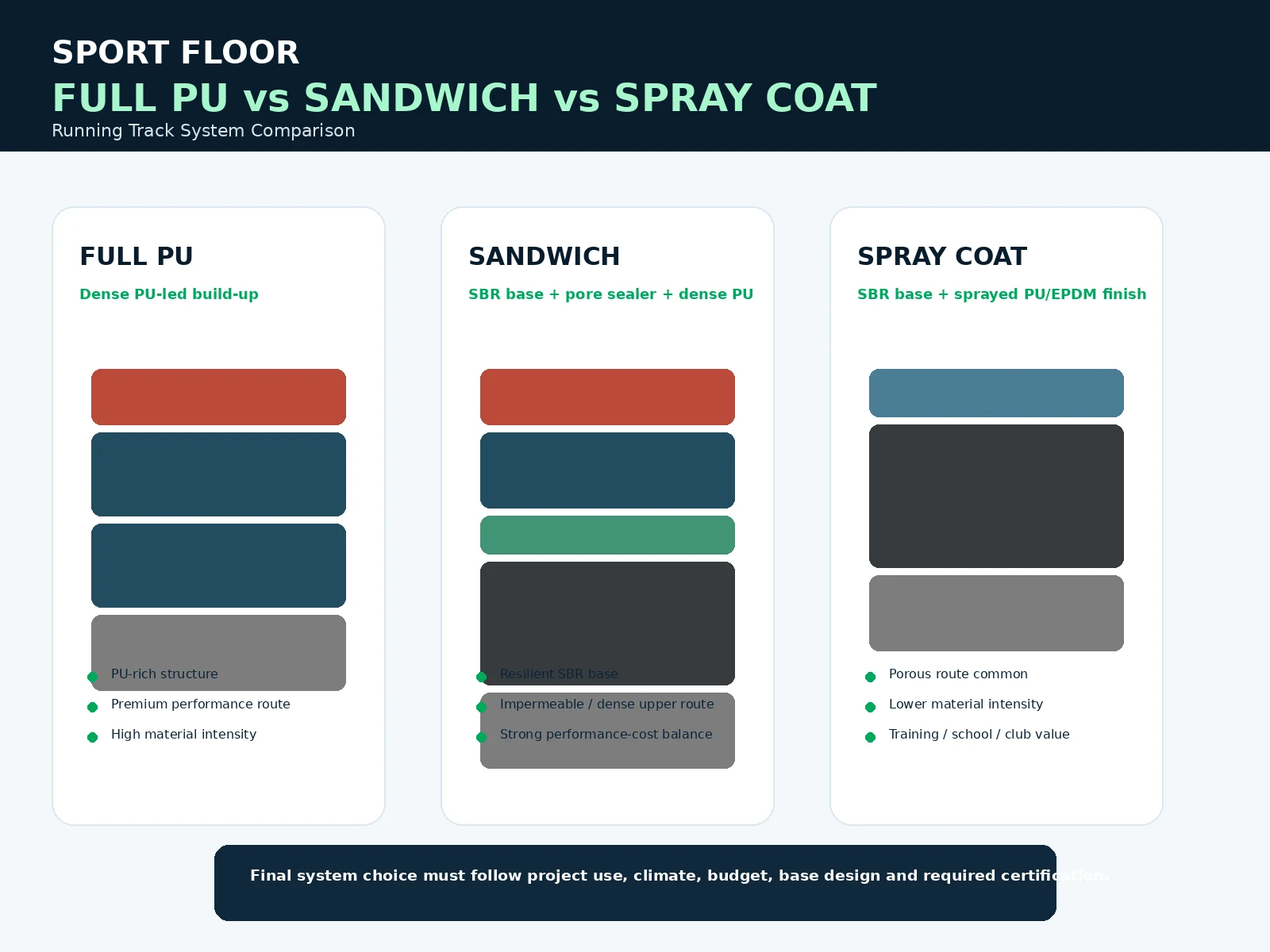
| Decision factor | Full PU | Sandwich | Spray Coat |
|---|---|---|---|
| Core construction | PU-rich dense liquid-applied system. | PU-bound SBR base + pore sealer + dense PU/EPDM upper layer. | PU-bound SBR base + sprayed PU/EPDM wearing coat. |
| Material intensity | Highest of the three in typical configurations. | Medium-high. | Lower dense-PU material demand. |
| Commercial position | Premium. | Balanced performance/value. | Economical / efficient. |
| Typical project intent | Premium stadiums, high-performance athletics and projects prioritizing dense PU construction. | Clubs, schools, stadiums and multi-level athletics facilities seeking strong performance at balanced cost. | Schools, clubs, training facilities and projects prioritizing value and practical athletics use. |
| Resilient base | Created primarily through PU-rich structural layers according to system design. | PU-bound SBR / recycled-rubber base. | PU-bound SBR / recycled-rubber base. |
| Pore sealer | Depends on exact system architecture. | Characteristic transition stage between porous rubber base and dense PU top. | May be absent in a direct porous spray route or present in sealed-spray variants. |
| Wearing surface | Dense PU with embedded/broadcast granules according to system. | Dense PU layer with EPDM granules. | Sprayed PU/EPDM coating. |
| Permeability | Depends on exact tested system. | Commonly impermeable/non-porous in classic sandwich architecture. | Commonly porous in classic spray-coat architecture; sealed spray variants also exist. |
| Base/drainage sensitivity | Requires correctly engineered base and drainage. | Requires controlled base, falls and drainage strategy. | Porous configurations still require a drainage route through the civil build-up. |
| Repair / renewal | System-specific resurfacing route. | Upper layers can be assessed for compatible resurfacing. | Spray surface can be a practical resurfacing route where the base remains serviceable. |
| Sport Floor page | Full PU Running Track System | Sandwich Running Track System | Spray Coat Running Track System |
The project prioritizes a premium PU-rich structure, high-end athletics positioning and a specification that justifies the higher material intensity.
You need a strong balance between resilient base economics, dense PU upper performance and broad suitability for clubs, schools or stadium facilities.
The facility prioritizes training, school or general athletics use and wants a lower-material, cost-efficient synthetic track route.
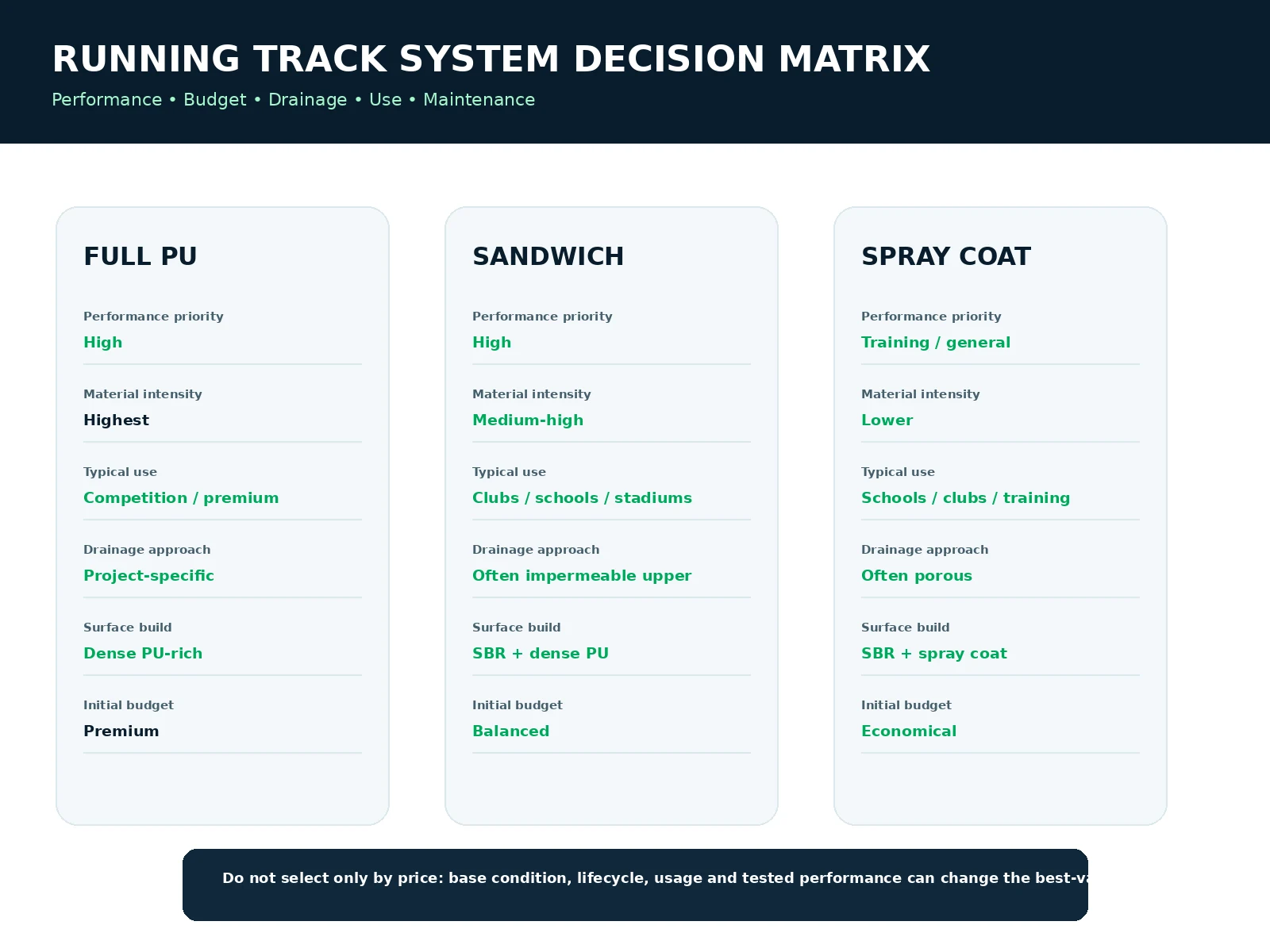
Initial material cost is only one part of the decision. Existing base condition, drainage, climate, installation quality, usage intensity, spike traffic, maintenance planning and resurfacing strategy can all change lifecycle value.
A premium Full PU track can be commercially justified where performance and competition positioning are central. A Sandwich system can provide an excellent balance where a resilient recycled-rubber base and dense upper layer meet the project need. Spray Coat can be a strong value choice where the intended use does not require the material intensity of a denser system.
Sport Floor quotations should therefore compare the actual proposed build-ups—not only a price per square metre without layer definition.
Connects the selected asphalt/concrete interface to the track build-up where required by the system.
Forms the resilient rubber base used in Sandwich and Spray Coat configurations.
Converts an open rubber base into a suitable transition for dense PU upper layers in Sandwich-type construction.
The upper architecture differs most clearly here: dense PU in Full PU/Sandwich versus sprayed PU/EPDM in Spray Coat.
Provide the exposed textured athletics surface within compatible systems and color selections.
Completes lane and event geometry after the surface is ready for marking.
Flatness, strength, gradients and drainage remain critical regardless of surface family.
TDS, SDS, system test data and project submittals should match the exact materials supplied.
Sport Floor uses German raw materials within applicable polyurethane formulations for primers, binders, PU layers and finishing products.
Sport Floor manufactures primers, PU binders, rubberized/base products, pore sealers, self-leveling PU, top coats, additives and line marking materials.
Sport Floor combines material manufacturing, sports-project application experience and direct international material supply.
Full PUR, Sandwich and Spray Coat are all recognized surface categories found among certified track surfacing products internationally. However, certification belongs to the exact tested proprietary product/system—not automatically to every surface using the same generic construction name.
For a project requiring World Athletics certification or other formal compliance, the consultant and buyer should verify the current certified product, tested build-up, approved materials, laboratory evidence and facility-certification requirements.
| Base issue | Why it matters | Selection implication |
|---|---|---|
| Flatness | Track geometry and surface consistency depend on a controlled base. | Correct before applying any of the three systems. |
| Gradients | Influence water movement and facility geometry. | Must match civil and athletics requirements. |
| Cracking / instability | Movement can reflect into the synthetic surface. | Investigate and repair before surfacing. |
| Drainage | Water must leave the surface and/or supporting construction. | Especially important when choosing porous vs non-porous routes. |
| Asphalt / concrete condition | Primer and bonding depend on a sound, clean substrate. | Select the compatible primer and preparation method. |
| Existing track renovation | A sound existing resilient base may change the resurfacing strategy. | Inspect before deciding on complete reconstruction. |
For an international buyer, the most useful quotation is not simply “Full PU”, “Sandwich” or “Spray Coat”. It should define the proposed system route, the materials included, required quantities, packaging, technical documentation and delivery basis.
Sport Floor can coordinate the PU product family with compatible SBR/EPDM materials and prepare a project-specific commercial package for contractors, distributors and importers.
Where available, the international supply process can be supported by real packing/loading evidence, shipment documentation and origin documentation according to the actual order and export route.
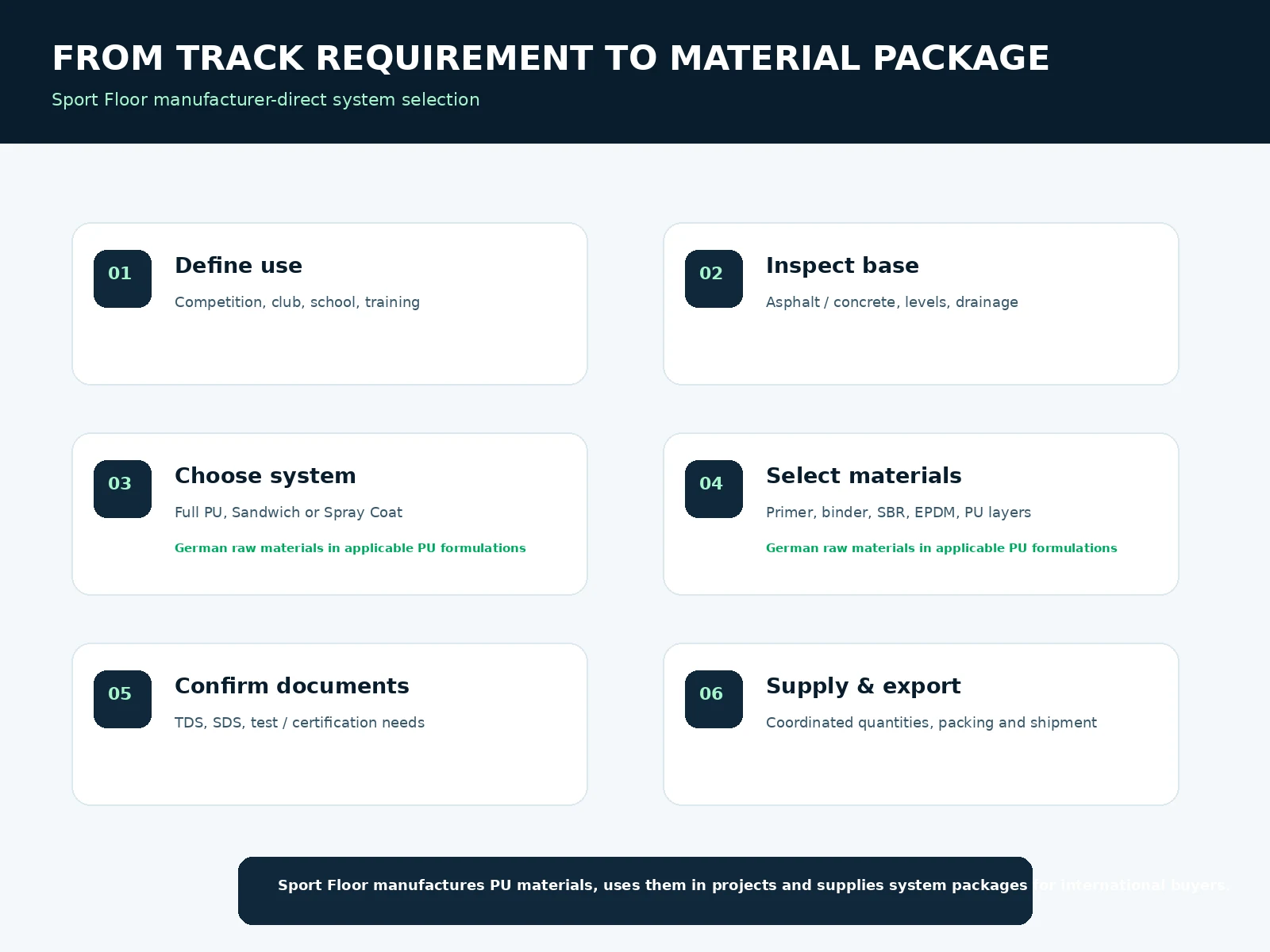
Total square metres, lane count, track type and event zones.
School, club, training, stadium, competition or community facility.
New asphalt/concrete, existing synthetic track or renovation condition.
Current drainage design and whether a porous/non-porous route is specified.
Consultant specification, federation requirement or target facility standard.
Premium performance, balanced value or economical training route.
Country, city and preferred port or delivery point.
TDS, SDS, test evidence, packing or tender-submittal requirements.
There is no universal best system. Full PU is commonly positioned as the premium PU-rich route, Sandwich provides a strong performance/value balance, and Spray Coat is often selected for economical training, school and club facilities.
Full PU uses a more polyurethane-rich structural build-up. Sandwich uses a PU-bound SBR or recycled-rubber resilient base beneath pore-sealed dense PU/EPDM upper layers.
Sandwich generally closes the porous rubber base and adds a dense PU/EPDM upper layer. Spray Coat typically finishes a resilient rubber base with a sprayed PU/EPDM coating, using less dense polyurethane in the wearing construction.
Classic spray-coat systems are commonly porous, but sealed/non-porous spray variants also exist. The exact Sport Floor build-up should state the intended drainage architecture.
Classic sandwich systems commonly use an impermeable/non-porous upper construction, but waterproofing claims should only be made for the exact system and detail design.
No, but its higher material intensity is most easily justified where the project prioritizes premium athletics performance, competition positioning or a dense PU-rich specification.
Spray Coat is commonly positioned as the most economical of the three, but actual project cost depends on area, base condition, material specification, logistics, labor and required documents.
Sandwich and Spray Coat are both common school/club routes internationally. The final choice should depend on expected use, budget, drainage, lifecycle and performance requirement.
All three categories appear among internationally certified products, but certification belongs to a specific tested proprietary system. A generic Full PU, Sandwich or Spray Coat system is not automatically certified.
Yes. Sport Floor manufactures its own polyurethane sports-flooring materials, including primers, binders, intermediate layers, top coats and related products.
Yes. German raw materials are used within applicable Sport Floor polyurethane formulations.
Yes. Sport Floor can coordinate compatible EPDM, SBR/rubber and polyurethane materials as part of a running-track material package.
Yes. International contractors, distributors, importers and project buyers can request direct material supply at info@sportfloor-m.com.
Send the track area, facility level, base condition, drainage design, performance requirement, budget position and destination. Sport Floor can recommend the appropriate material route and prepare a coordinated running-track supply package.