
Competition Facilities
Where the exact specified product has the required current certification and the project team can deliver the required substrate and installation standard.
A prefabricated running track is manufactured as a controlled rubber sports surface in a factory, supplied in rolls or sheets, then bonded to a precisely prepared asphalt or concrete base using an approved adhesive system. It is fundamentally different from Full PU, Sandwich and Spray Coat tracks that are built from liquid polyurethane and rubber materials directly on site.
Sport Floor manufactures and exports sports-flooring systems and running-track materials for international project buyers. German raw materials are used within relevant Sport Floor sports-flooring formulations. Where a project requires a prefabricated roll system, the exact product manufacturer, manufacturing location, country of origin, certification, roll dimensions and adhesive package should be stated clearly in the technical and commercial offer.
This page helps consultants, contractors and owners decide when prefabricated athletics surfacing deserves consideration, what must be checked before purchase and how to compare it fairly with in-situ PU track systems.
World Athletics recognizes Prefabricated as a distinct track-surfacing description alongside Full PUR, Sandwich and Spray Coat. Current and historical certified-product lists include multiple prefabricated track products with product-specific absolute thicknesses and certificate numbers.
Leading manufacturers such as Mondo build their athletics portfolio around prefabricated rubber track surfaces supplied for professional stadiums and major competition venues. The construction logic differs from in-situ polyurethane systems: the athletics surface arrives largely formed, while the site team focuses on substrate acceptance, adhesive installation, alignment, seams and final detailing.
This factory-made approach can provide strong production consistency, but it does not remove the need for specialist site installation.
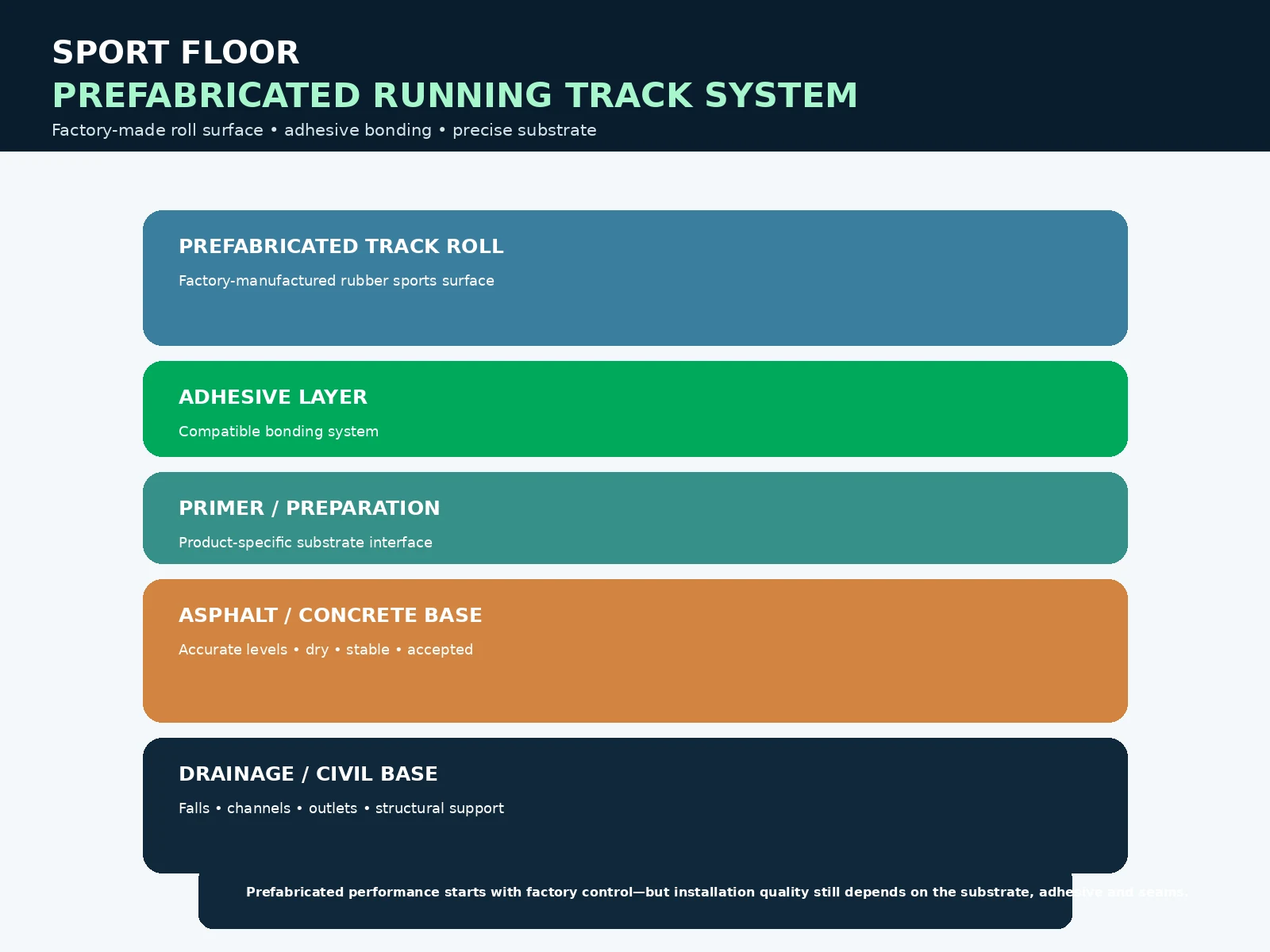
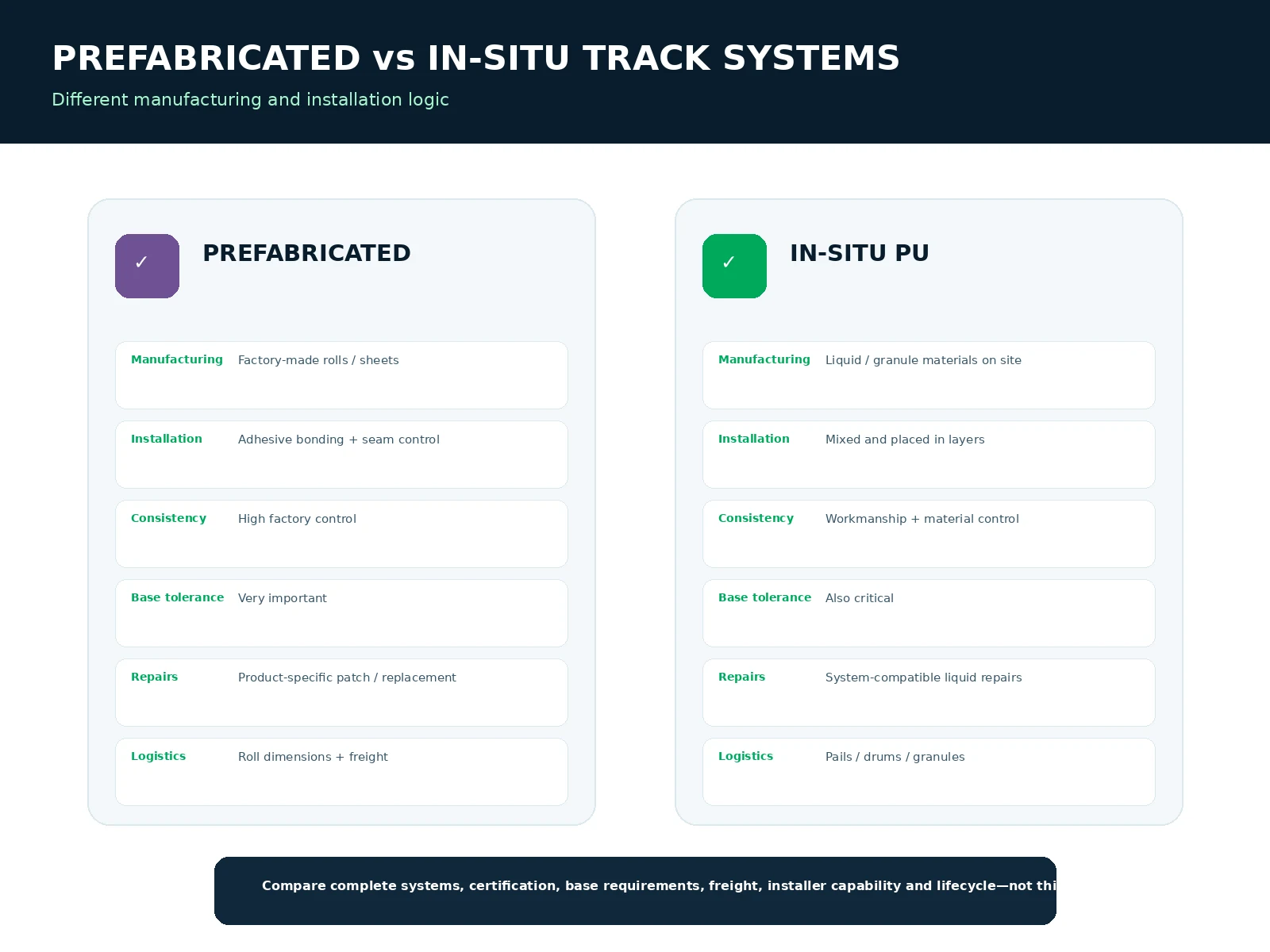
Prefabricated systems arrive as factory-produced rolls or sheets and are bonded to the substrate. The key site risks are substrate tolerances, adhesive application, roll alignment and seams.
In-situ systems such as Full PU, Sandwich and Spray Coat are constructed layer by layer on site using polyurethane, SBR, EPDM and related materials. Their site risks include mixing, consumption, thickness control, cure, weather and workmanship.
Neither approach is automatically superior. The right selection depends on certification, project level, installer capability, climate, base condition, freight, programme and lifecycle strategy.
Where the exact specified product has the required current certification and the project team can deliver the required substrate and installation standard.
Projects that prefer the main athletics layer to be manufactured under controlled factory conditions rather than built wet on site.
Where roll delivery and specialist bonding can be coordinated efficiently once civil works and base acceptance are complete.
Consultant-led projects naming a specific certified prefabricated surface and installation system.
In-situ systems can be commercially attractive where PU, SBR and EPDM materials are readily supplied and qualified installation teams are available.
Some renovation zones, repairs or complex junctions may be easier to address with compatible liquid-applied materials.
Roll dimensions, handling and container planning can make prefabricated logistics materially different from drums, bags and granules.
Prefabricated surfacing is relatively thin compared with the civil structure below it. It cannot permanently bridge settlement, correct major levels or repair a weak asphalt layer.
The base should be stable, smooth, dry within the product limits, correctly sloped and dimensionally accurate. Local high spots, depressions and abrupt transitions can telegraph through the installed roll or create bonding problems.
Base acceptance should therefore be documented before adhesive work begins.
Prefabricated track rolls rely on a compatible adhesive system to transfer the factory-made surface into a stable installed track. Adhesive selection, substrate preparation, coverage, open time, temperature, moisture and curing conditions should follow the exact product method.
Do not substitute an adhesive because it is “also polyurethane” without written compatibility. The prefabricated-surface manufacturer should define the approved bonding route.
Sport Floor manufactures polyurethane sports-flooring materials using German raw materials within applicable formulations, but a prefabricated roll project should use the adhesive explicitly approved for that exact roll system.
Plan orientation and laying sequence before adhesive application begins.
Keep seams controlled and consistent with the product installation method.
Curves, runways and junctions require careful cutting and detailing.
Track edges and drainage interfaces should be protected from water ingress and mechanical damage.
World Athletics publishes a current Certified Track Surfacing Products list that identifies the manufacturer, product name, system description, absolute thickness and certificate number.
A prefabricated surface should therefore be purchased by exact product identity. Do not accept a quotation that only says “13 mm prefabricated track – World Athletics” without the exact certified product and current evidence.
Completed-facility certification is a separate process from product certification. A certified roll product does not automatically make the completed stadium a certified athletics facility.
Sport Floor manufactures sports-flooring systems and running-track materials, including polyurethane-based products used in compatible in-situ track systems.
German raw materials are used within relevant Sport Floor sports-flooring formulations according to the specific product and application.
Sport Floor supplies and exports sports-flooring products and track materials for contractors, distributors and project buyers according to product, quantity and destination.
For prefabricated rolls: the exact manufacturing origin, producing factory, certificate, product specification and country of origin should be stated in the quotation and technical submittal. This keeps the supply chain transparent and allows consultants to verify the offered product.
| Export item | What should be confirmed | Why it matters |
|---|---|---|
| Roll dimensions | Width, length, diameter and gross weight. | Controls container loading and handling equipment. |
| Packaging | Roll protection, wrapping, pallets/cradles and moisture protection. | Protects edges and surface during transit. |
| Container plan | Number of rolls, loading orientation and unloading method. | Prevents handling damage and site delays. |
| Adhesive shipment | Product classification, pack size, storage limits and compatibility. | May affect transport and site storage requirements. |
| Storage | Temperature, stacking and protection before installation. | Prevents deformation or contamination. |
| Incoterms | Agreed Incoterms® 2020 rule and named place/port. | Defines freight and risk responsibilities. |
Verify levels, smoothness, dryness, drainage and substrate condition.
Define sequence, orientation, curves, seams and transitions before adhesive application.
Clean, repair approved local defects and apply the defined primer where required.
Use the exact product, coverage and workable time defined by the system.
Control alignment, adhesion, air removal and pressure across the installation.
Complete joints and edges according to the approved installation method.
Apply lane and event markings only after the surface is ready and geometry is confirmed.
Complete the defined field testing, inspection and maintenance documentation.
Local damage may be repaired through a manufacturer-approved patch or section-replacement method. The repair should match the exact surface product, thickness, texture and bonding method.
Old prefabricated tracks should be assessed for seam condition, adhesive failure, substrate movement, drainage and overall surface performance before deciding between local repair, larger replacement or complete renewal.
Do not assume that liquid PU resurfacing can be applied directly over any prefabricated roll without compatibility testing and an approved renovation method.
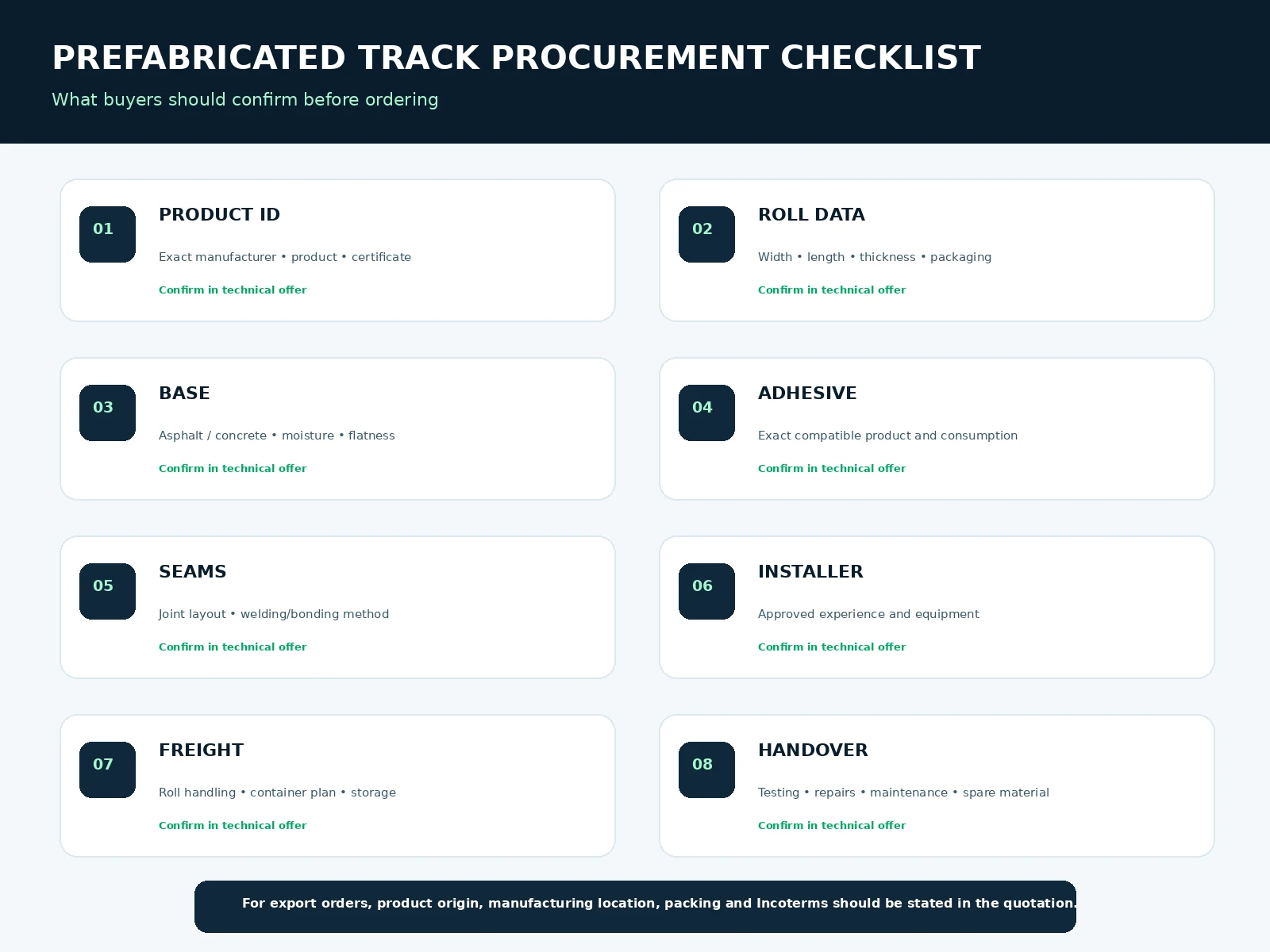
| Quotation item | What should be stated |
|---|---|
| Manufacturer | Exact legal manufacturer of the offered prefabricated surface. |
| Product | Exact product name and current technical data. |
| Manufacturing origin | Factory location and country of origin. |
| Certification | Current product certificate and required facility-testing scope. |
| Thickness | Exact product thickness—not a generic system label. |
| Roll data | Width, length, weight and packaging. |
| Adhesive | Exact approved adhesive, primer and consumption. |
| Substrate | Required flatness, moisture and preparation limits. |
| Installation | Installer, equipment, seams and site responsibilities. |
| Freight | Container plan, Incoterms rule and named place/port. |
| Spares | Recommended spare roll/repair material for future local interventions. |
Thickness alone does not prove product performance or certification.
Do not accept a generic “World Athletics prefabricated” description.
Rolls can reproduce base irregularities and local level defects.
Bonding chemistry must be approved for the exact roll product.
Joint defects can become visible and functional failures.
Long rolls require deliberate loading, unloading and site handling.
Future repairs are harder when matching material is unavailable.
Certified surface product and certified completed facility are separate.
It is a factory-manufactured athletics surface supplied as rolls or sheets and bonded to a prepared substrate using an approved adhesive system.
No. Full PU is constructed in situ from liquid polyurethane and rubber materials. Prefabricated surfacing is manufactured before it arrives on site.
Yes. World Athletics lists prefabricated products as a distinct certified track-surfacing description. Certification belongs to the exact product.
No. Confirm the exact manufacturer, product name, current certificate and required thickness.
No. Certified Track Surfacing Products and Certified Athletics Facilities are separate scopes.
The exact product may be installed over a suitable asphalt or concrete substrate when levels, smoothness, moisture and preparation comply with the system requirements.
Prefabricated rolls create joints that require accurate alignment, cutting, bonding and edge detailing.
No. Use the adhesive and primer explicitly approved for the exact prefabricated product.
No. The best route depends on certification, base, climate, installer capability, freight, repair strategy, programme and lifecycle budget.
Yes, subject to the exact manufacturer's repair method and availability of compatible matching material.
Potentially, but only through a compatible renovation method after condition assessment. Do not apply a generic liquid coating without approval.
Yes. Sport Floor manufactures sports-flooring systems and polyurethane-based running-track materials for compatible applications.
Yes. Sport Floor supplies and exports sports-flooring products and track materials to international buyers according to the product, quantity and destination.
German raw materials are used within relevant Sport Floor sports-flooring formulations according to the specific product and application.
The exact manufacturer, factory and country of origin for a prefabricated roll should be stated in the quotation and technical submittal. This allows the buyer to verify the specific offered product rather than relying on a generic company-level statement.
Send facility level, total area, lane count, base type and condition, required certification, preferred product if specified, destination, installation scope and delivery terms.
Send the facility level, track area, base, required certification, product preference, installation scope and destination. Sport Floor can review the appropriate track route and prepare the technical and commercial supply requirements.