
Contamination
Dust, oil, laitance, loose material or dirt can prevent reliable adhesion.
Cracks, peeling, bubbles and loose areas are symptoms—not diagnoses. A synthetic running track can fail at the wearing surface, between PU layers, at the SBR base, at the primer/substrate interface or inside the civil base itself. The correct repair depends on where the failure began and whether the surrounding construction is still sound.
Sport Floor manufactures and exports polyurethane running-track materials and compatible sports-flooring systems for international projects. German raw materials are used within applicable Sport Floor polyurethane formulations, giving contractors and owners a manufacturer-direct route for compatible primers, binders, pore sealers, PU layers, top coats and repair materials.
This guide explains the most common running-track defects, their likely causes, how to inspect them and when local repair, retopping, resurfacing or reconstruction is the technically responsible solution.
Running tracks are exposed to repeated foot strike, spikes, abrasion, UV, water, temperature movement and operational loads. Over time, wear is normal; premature failure is not.
International athletics guidance treats bubbles, fissures, delamination and uncured areas as serious imperfections because they can affect safety, durability and dynamic performance.
The first task is therefore to map the defect: where it occurs, how large it is, whether it changes after rain or heat, whether the surface sounds hollow, whether the crack continues into the base and whether adjacent material remains firmly bonded.
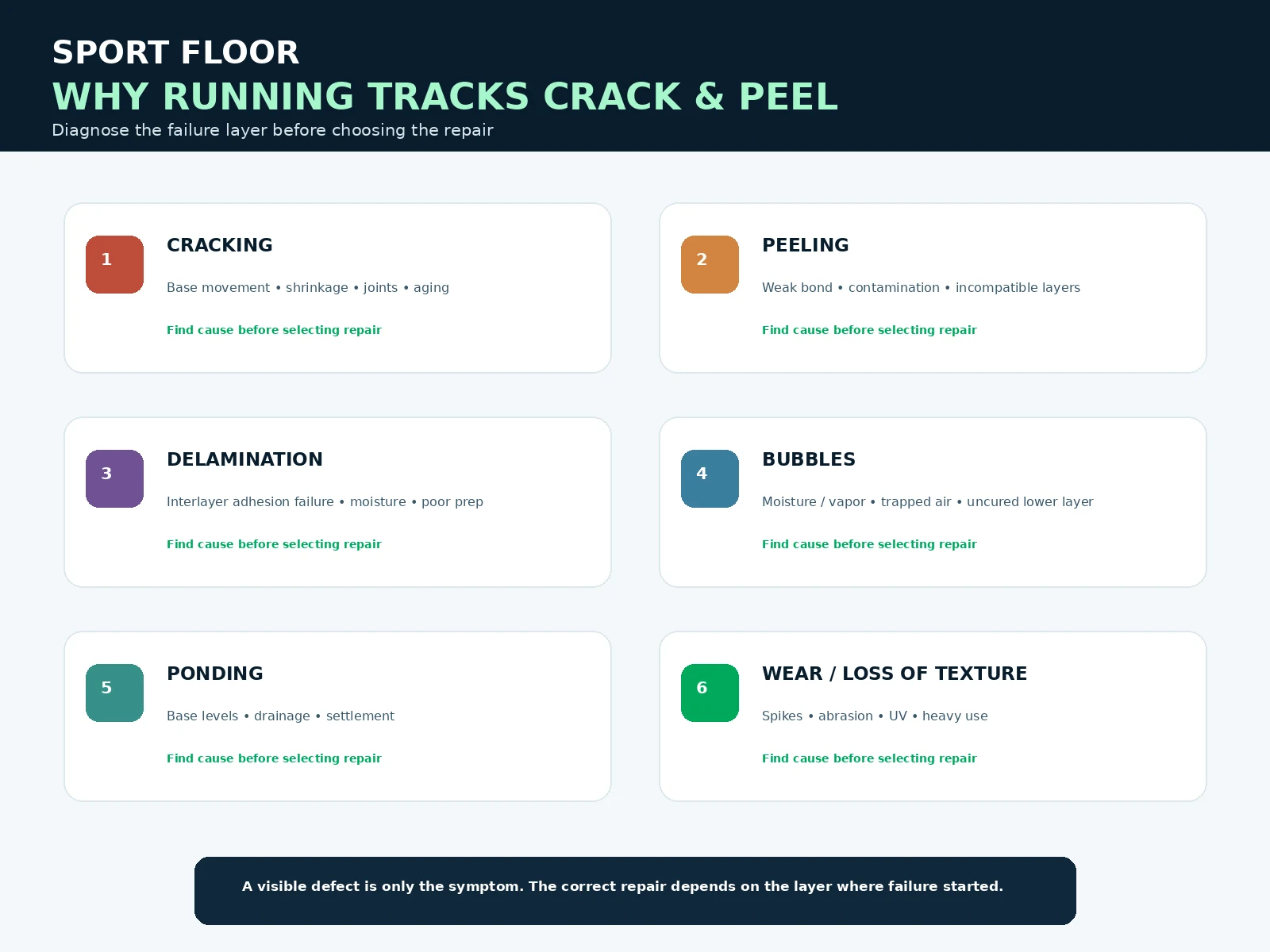
A crack in the synthetic surface may begin in the wearing layer, but it may also reflect an asphalt crack, concrete joint, settlement line or structural movement below the sports surface.
| Crack pattern | Likely investigation | Repair implication |
|---|---|---|
| Fine isolated surface crack | Age, localized wear, coating movement or minor local defect. | May be suitable for compatible local repair after confirming stable surroundings. |
| Straight recurring crack | Joint or crack in asphalt/concrete below. | Repairing only the PU surface may not stop recurrence. |
| Network / widespread cracks | Base aging, thermal movement, brittle surface or multiple construction defects. | Requires broader condition assessment before resurfacing. |
| Crack with vertical movement | Settlement, structural movement or base failure. | Civil/base repair is required before synthetic-surface renewal. |
| Crack with water entry | Drainage, open joints or damaged edge/interface. | Correct water source and failed materials together. |
Delamination can occur between the substrate and primer, between primer and resilient layer, between SBR base and pore sealer, or between PU upper layers. The visible loose area may be small even when the weak interface extends farther.
Dust, oil, laitance, loose material or dirt can prevent reliable adhesion.
Primer/substrate incompatibility can weaken the entire following system.
Water or vapor can interfere with bonding or build pressure below dense layers.
Applying the next layer outside the approved timing can reduce intercoat adhesion.
Mixing unrelated systems can create chemical or mechanical incompatibility.
An uncured lower layer can appear hidden beneath a sound-looking upper finish.
New material bonded over a deteriorated surface can detach with the old layer.
Edges, joints and drainage defects can introduce water into vulnerable interfaces.
A dense PU layer can trap pressure when moisture or vapor moves from the substrate or lower construction. Blisters can also form where trapped air, contamination or uncured material prevents stable bonding.
Do not puncture and refill a bubble without diagnosing why it formed. If the moisture source remains active, a cosmetic patch can fail again.
Ponding may result from poor original levels, settlement, blocked drainage, deformed base construction or local repair build-up. The synthetic surface should not be used as a thick leveling compound to hide major depressions.
For porous systems, water must still be received and discharged by the lower construction. A permeable Spray Coat surface over a water-trapping base is not a complete drainage solution.
Outdoor athletics surfaces face abrasion, repeated spike use, UV radiation, water and temperature variation. High-traffic zones such as sprint starts, lane 1, hurdle positions, take-off areas and runways can wear faster than the rest of the facility.
Loss of texture, color change and localized wear may be suitable for resurfacing or re-topping when the lower structure remains well bonded and resilient.
This is why condition assessment matters: a worn upper layer over a sound base is a very different renovation project from widespread delamination or structural cracking.
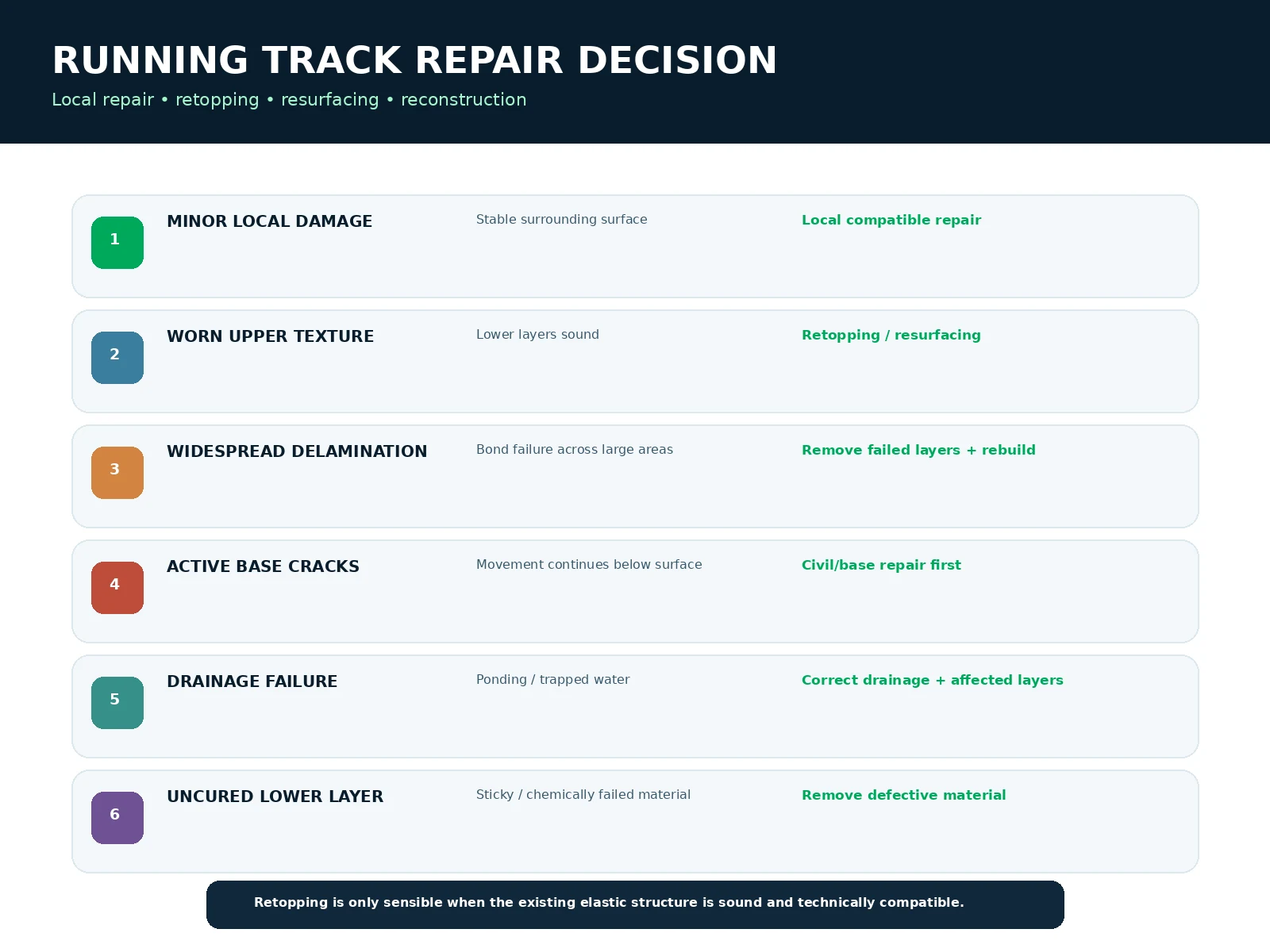
Local repair is appropriate for limited damage when surrounding materials and the base are sound.
Retopping / resurfacing can be economical when the existing resilient structure remains technically suitable and compatible with the new upper system.
Reconstruction is the correct route when widespread bond failure, uncured material, severe drainage defects or structural base movement makes reuse unreliable.
| Inspection item | What to check | Why it matters |
|---|---|---|
| Cracks | Location, width, length, movement, pattern and recurrence. | Separates surface defects from base movement. |
| Loose / hollow areas | Sounding, edge condition and extent of delamination. | Shows whether failure extends beyond visible peeling. |
| Bubbles | Timing, weather relation, moisture and lower-layer condition. | Helps identify vapor/moisture or cure problems. |
| Ponding | Depth, duration, location and drainage condition. | Indicates level or water-management problems. |
| Wear | Lane 1, sprint starts, runways, take-off zones and spike damage. | Identifies normal high-use deterioration versus system failure. |
| Edges / drains | Water ingress, open edges, blocked channels and damaged interfaces. | Water often enters at vulnerable perimeter details. |
| Existing system | Full PU, Sandwich, Spray Coat, prefabricated or unknown build-up. | Controls repair-material compatibility. |
| Base | Asphalt/concrete cracks, movement, settlement and level defects. | Determines whether resurfacing alone is technically reasonable. |
Investigate dense PU adhesion, embedded granule layer, substrate moisture, intercoat bonding and base movement.
Check SBR base, pore sealer, dense PU layers, EPDM wearing surface and each interlayer bond.
Check SBR base integrity, spray-layer wear, permeability, drainage and binder cohesion.
Investigate roll seams, adhesive bond, substrate condition, local lifting and compatible patch/replacement methods.
Acrylic coating, generic industrial PU, unknown rubber adhesive and athletics-track polyurethane are not automatically interchangeable. Repair chemistry must match the substrate, existing system, exposure and next layer.
Sport Floor manufactures compatible polyurethane sports-flooring products including primers, binders, pore sealers, self-leveling PU, top coats, adhesives and line-marking materials. German raw materials are used within applicable Sport Floor PU formulations.
For a repair project, the recommended product schedule should follow the identified existing system and current Sport Floor TDS/SDS.
| Condition | Likely route | Key condition |
|---|---|---|
| Small cut / isolated local damage | Local repair | Surrounding system remains sound. |
| Widespread top-layer wear | Resurfacing / retopping | Existing resilient structure and bond remain suitable. |
| Repeated local peeling | Investigate adhesion/moisture before repair | Cause must be removed first. |
| Large-area delamination | Remove failed layer(s) + rebuild | Extent determined by inspection/testing. |
| Active structural cracks | Civil/base repair + synthetic reconstruction | Movement must be stabilized. |
| Major settlement / drainage failure | Base/drainage reconstruction first | Synthetic surface cannot solve civil failure. |
| Uncured material | Remove defective uncured layer(s) | Do not encapsulate chemically failed material. |
Sport Floor manufactures polyurethane sports-flooring products for compatible track systems and renovation work.
German raw materials are used within applicable Sport Floor polyurethane formulations as a material-quality differentiator.
Sport Floor exports sports-flooring materials for contractors, distributors and project buyers according to system, quantity and destination.
Repair and resurfacing packages can be prepared around the identified defect and existing track type, including compatible primers, binders, sealers, PU layers, EPDM/SBR materials, finishes and line-marking products where applicable.
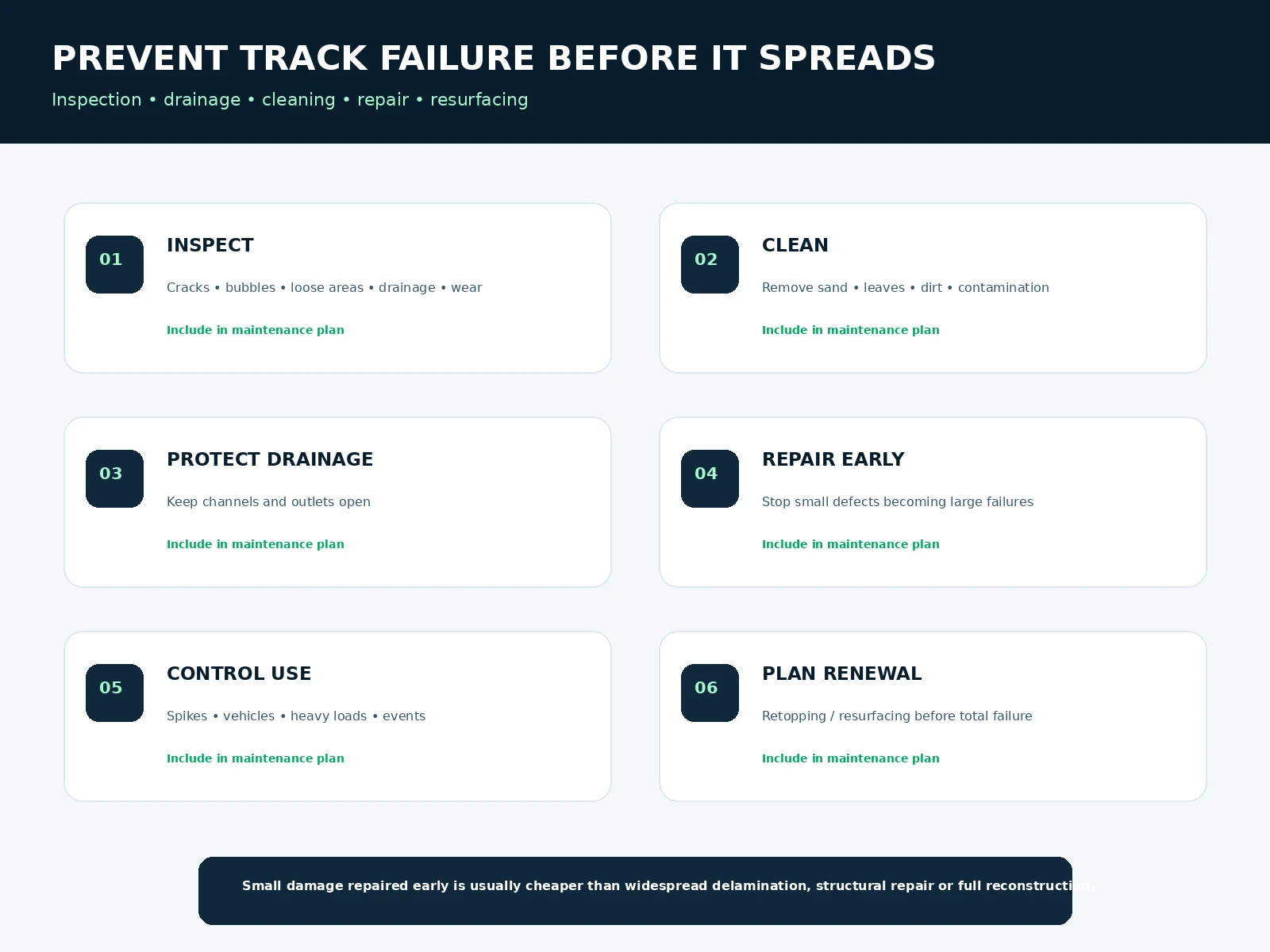
Regular inspection, cleaning and drainage maintenance are part of synthetic-track ownership. Sand, leaves and debris should not be allowed to remain on the surface or block water outlets.
Small cuts, loose areas and localized defects should be repaired before traffic and water enlarge them. Facility managers should also control spikes, vehicles, maintenance machinery and temporary heavy loads.
A planned resurfacing intervention can extend the useful life of a sound track structure, while waiting until the surface and base fail together can force much more expensive reconstruction.
New coating will not strengthen a weak layer below it.
Movement can reopen the repair unless the cause is stabilized.
Moisture/vapor can repeat bubbling and bond failure.
Repeated water exposure can undermine otherwise correct repairs.
Generic materials can create adhesion and cure incompatibility.
A new surface is only as reliable as the old layer supporting it.
Uncertain existing systems may require compatibility testing before full work.
Future local repairs become harder when matching materials are unavailable.
Close-up and wide views of every defect type.
Full PU, Sandwich, Spray Coat, prefabricated or unknown.
Installation date and previous repairs/resurfacing.
Asphalt, concrete or known civil construction.
Ponding, blocked channels or water ingress locations.
Lane, zone, size and approximate affected area.
Heat, rain, UV and seasonal conditions.
Local repair, resurfacing, certification renewal or complete reconstruction.
Cracks may come from surface aging, thermal movement, asphalt/concrete cracks, joints, settlement or structural movement below the synthetic surface.
Peeling usually indicates adhesion failure caused by contamination, moisture, incompatible layers, incorrect primer, poor cure or a weak old surface.
Common causes include moisture or vapor pressure, trapped air, contamination, uncured lower layers or poor interlayer adhesion.
Only after the cause is identified. A patch can fail again if moisture or vapor remains active below.
Potentially, if cracks are stable and the existing base and resilient layers remain suitable. Active structural movement should be repaired first.
Retopping is appropriate when the existing elastic structure is sound, compatible and capable of supporting the new upper system.
Reconstruction may be required for widespread delamination, uncured material, major base movement, severe settlement or drainage failure.
No. Drainage and base-level problems should be corrected before the synthetic surface is renewed.
Lane 1 and high-use sprint/runway zones commonly receive heavier traffic, spike wear and repeated loading than less-used areas.
Only when compatibility is established. Generic mixing of unrelated primers, PU layers or adhesives can create new failures.
Yes. Sport Floor manufactures polyurethane sports-flooring materials for compatible track construction, repair and resurfacing applications.
Yes. Sport Floor exports sports-flooring materials to contractors, distributors and project buyers according to the selected system, quantity and destination.
Yes. German raw materials are used within applicable Sport Floor polyurethane formulations. This does not mean the finished products are manufactured in Germany.
Recurring cracks, vertical movement, settlement, widespread level changes and repeated surface failure along the same lines are reasons to investigate the civil base.
Send defect photos, track system if known, age, base type, drainage condition, affected area, climate and whether you need local repair, resurfacing or reconstruction.
Send photos, system type, track age, base, drainage condition, affected area and project goal. Sport Floor can help define whether the correct next step is local repair, resurfacing, material supply or deeper reconstruction.