
Prepared Base
Concrete, asphalt or another approved base should be stable, correctly drained and suitable for the selected wet-pour construction.
Sport Floor manufactures and supplies EPDM Wet Pour Flooring System materials for seamless resilient surfaces built from compatible rubber granules and polyurethane binder, with single-layer or two-layer configurations selected according to project use.
For many two-layer systems, a resilient SBR or recycled-rubber base provides the lower shock-absorbing layer, while colored EPDM granules form the exposed wearing surface above. Both layers are mixed with compatible polyurethane binder and installed in situ.
Sport Floor manufactures its own polyurethane sports-flooring materials and supplies EPDM and rubber components for complete projects and international orders. German raw materials are used within applicable Sport Floor PU binder formulations, creating a strong technical and commercial route for contractors, playground specialists, landscape contractors, distributors and importers.
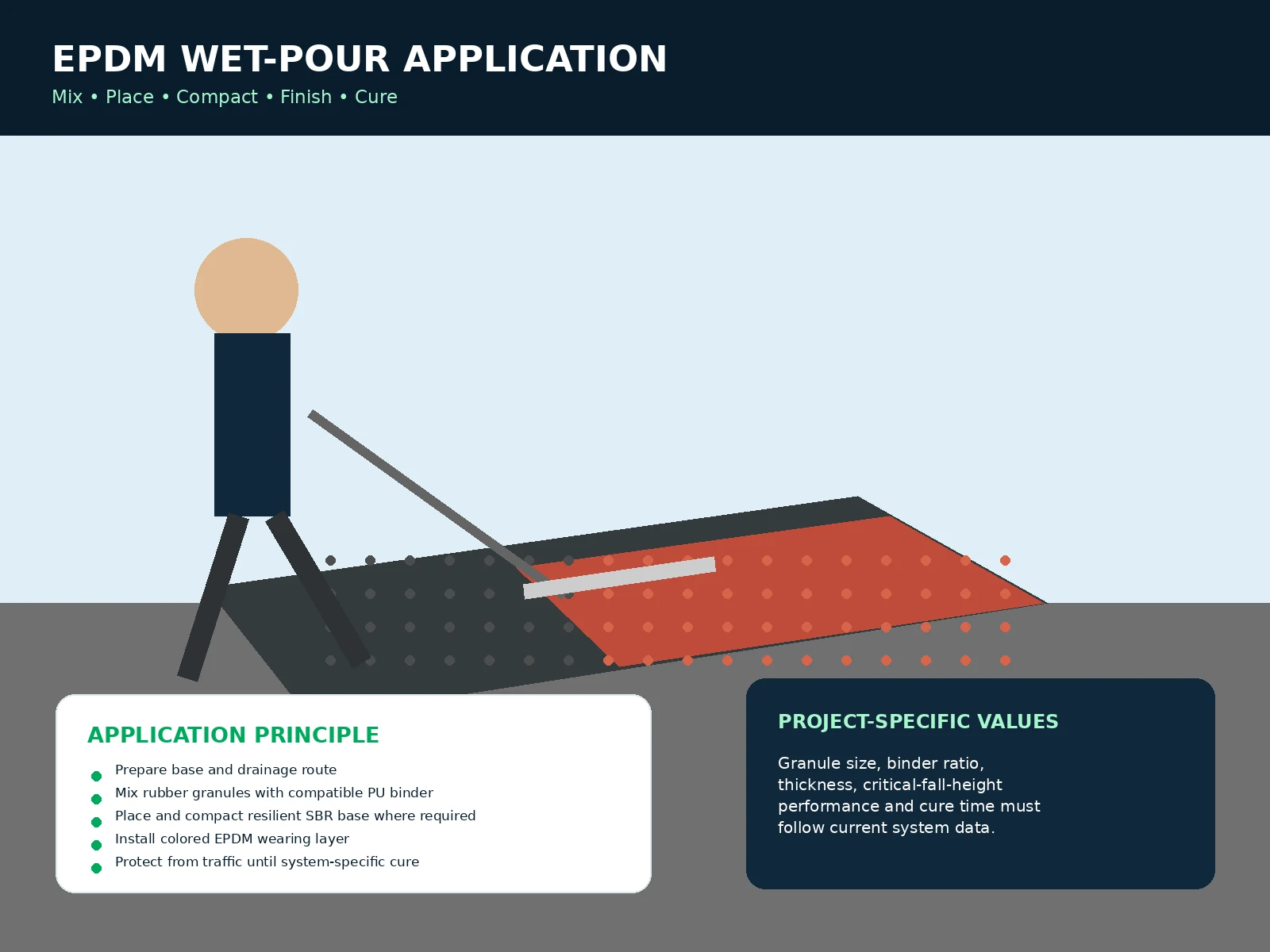
Wet-pour flooring is installed in situ rather than delivered as factory-made tiles or rolls. Rubber granules are mixed with a compatible PU binder, placed over the prepared base, compacted and finished as a continuous resilient surface.
In a common two-layer construction, the lower layer uses SBR or compatible recycled rubber to provide resilient depth, while the upper layer uses colored EPDM granules to create the visible wearing surface and project design.
Single-layer EPDM systems can also be used where the project does not require a separate shock-absorbing base. The correct build-up should be determined by application, expected loading, safety requirement, drainage and the selected technical specification.
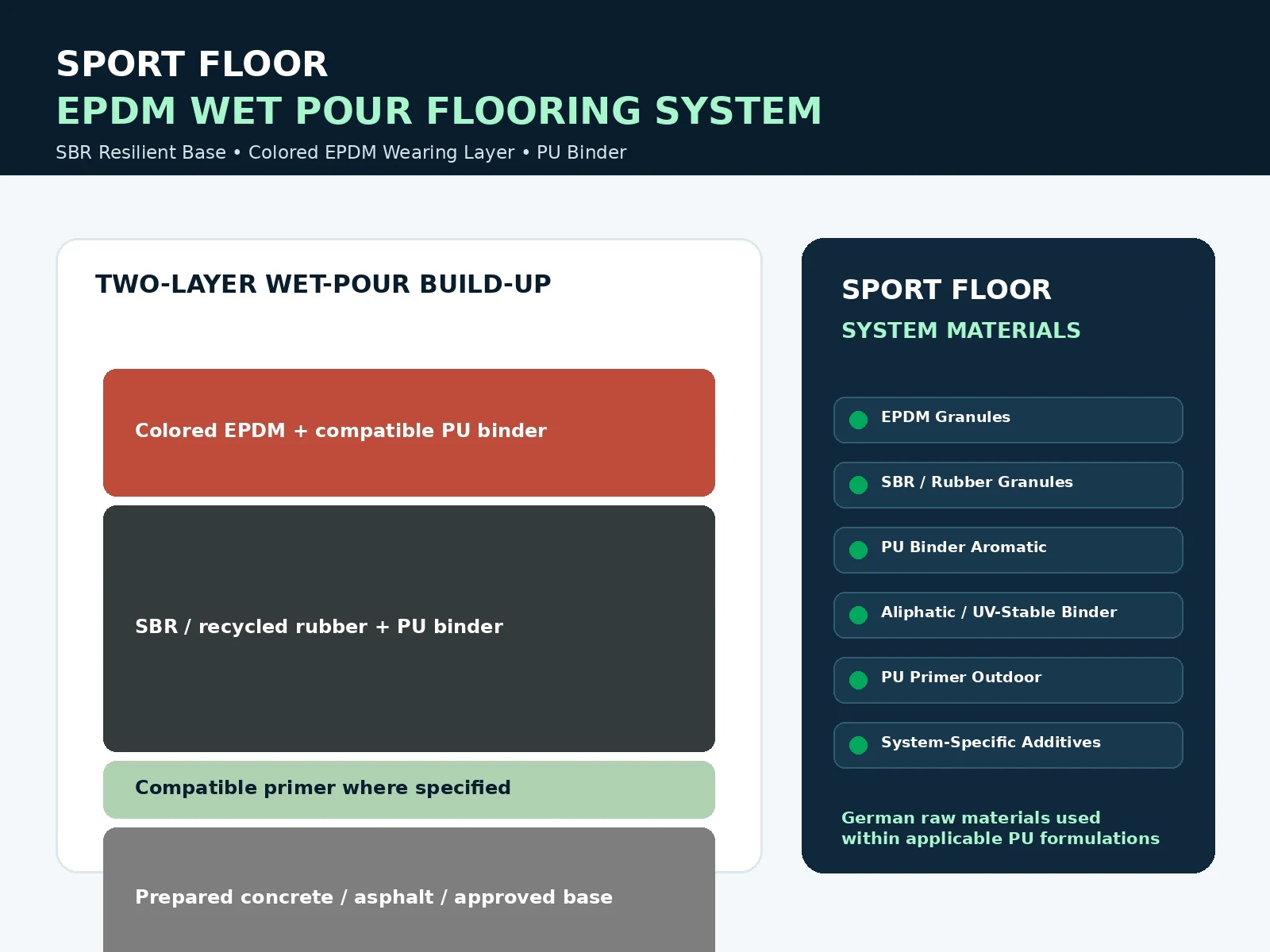
Concrete, asphalt or another approved base should be stable, correctly drained and suitable for the selected wet-pour construction.
Selected SBR or rubber granules mixed with compatible PU binder form the lower resilient zone where required.
Colored EPDM granules mixed with compatible binder create the exposed decorative and functional surface.
Final texture, colors, patterns and detailing are selected around the project and current system data.
The polyurethane binder must wet and connect the granules sufficiently to create a coherent resilient layer. Rubber type, particle shape, granule size and climatic conditions can change binder demand, so a generic ratio should not be copied from another manufacturer's system.
Uniform mixing is equally important. Poor binder distribution can create weak areas, loose granules or inconsistent appearance. Placement and compaction should be controlled to create an even layer without overworking the surface.
For the exposed EPDM layer, the installer must also control color distribution, joints between design zones and finishing quality. Exact binder ratio, consumption, granule size, working time and curing should follow current Sport Floor technical documentation.
Single-layer EPDM: suitable where the exposed colored EPDM surface is required but a separate shock-absorbing base layer is not part of the specification.
Two-layer SBR + EPDM: separates resilience and aesthetics. The lower SBR/rubber layer creates resilient depth, while the upper EPDM layer provides the exposed colored wearing surface.
Playground safety flooring: the lower resilient depth is selected around the required tested impact performance and equipment fall conditions. A generic thickness should never be assumed from another project.
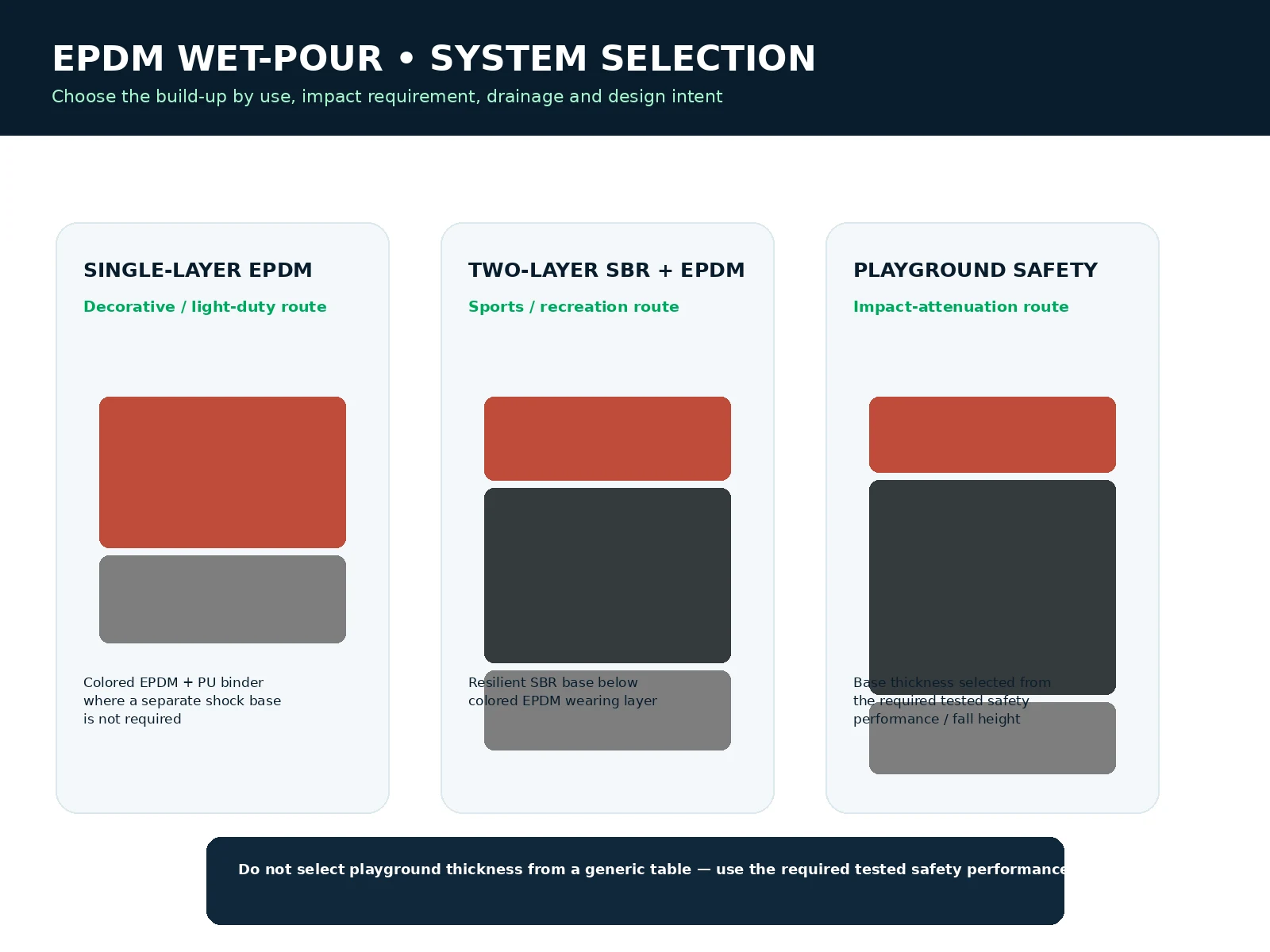
Two-layer impact-attenuating systems can be designed around project-specific safety requirements.
Seamless colored surfaces for active zones, pathways and recreation spaces.
Resilient EPDM/rubber surfacing for compatible outdoor exercise and training areas.
Continuous resilient surfacing can support compatible paths where the base and drainage are correctly designed.
Color flexibility allows activity zones, graphics and design-led public spaces.
Wet-pour EPDM can integrate with landscape projects requiring resilient colored surfacing.
Possible where the selected binder, surface design and project requirements are suitable for the wet environment.
Rubber/EPDM surfacing can be configured for compatible non-competition recreational activity routes.
Sport Floor uses German raw materials within applicable polyurethane binder formulations used in wet-pour systems.
Sport Floor manufactures aromatic and aliphatic/UV-resistant polyurethane binder products for compatible flooring applications.
Sport Floor combines PU manufacturing, real flooring-application knowledge and direct international supply.
| Selection point | Aromatic PU binder route | Aliphatic / UV-stable binder route |
|---|---|---|
| Typical commercial role | Common binder route for resilient rubber layers and compatible applications. | Selected where greater color/UV stability is required in the exposed surface system. |
| Where it may fit | SBR base layers and project-specific EPDM applications. | Exposed colored EPDM layer where the selected system calls for this binder type. |
| Color considerations | Exact visible effect depends on formulation and exposure. | Designed around improved color stability in suitable applications. |
| Sport Floor product | PU Binder Aromatic | PU Binder Aliphatic UV Resistant |
| Final selection | Use current Sport Floor TDS and project requirements for the actual binder supplied. | |
A permeable surface does not make poor civil construction disappear. Water passing through the rubber layers still needs somewhere to go. The sub-base, gradients, drainage and perimeter detailing should therefore be designed with the selected system.
Where the full construction is designed to drain vertically, the supporting base should allow the water-management strategy to continue below the wet-pour surface.
Concrete or other impermeable bases require suitable falls, drains or edge detailing so water does not remain trapped.
Surface levels, drainage outlets and finished transitions should be resolved before rubber installation begins.
Colored granules for the exposed wearing layer according to the selected project specification.
Resilient lower-layer material for two-layer and safety-oriented wet-pour systems.
Compatible aromatic or aliphatic binder selected for the actual layer and exposure requirement.
Current TDS, SDS, packing information and available supporting documents can be coordinated with international orders.
| Selection point | EPDM Wet Pour | Rubber Tiles | Rubberized PU Sports Flooring |
|---|---|---|---|
| Installation format | Mixed and installed in situ. | Factory-made modular tiles. | In-situ rubberized base under dense PU layers. |
| Visible surface | Colored EPDM granules. | Rubber tile surface. | Polyurethane top surface. |
| Joints | Seamless across continuous installation zones. | Tile joints are present. | Seamless upper PU surface. |
| Shock-base strategy | SBR/rubber lower layer where required. | Driven mainly by tile construction/thickness. | PU-bound rubber base hidden below dense PU. |
| Design flexibility | High for color zones, patterns and shapes. | Driven by available tile formats/colors. | High through PU finishing system. |
| Sport Floor route | Current system | Rubber Tiles | Rubberized PU Sports Flooring |
| Item | Sport Floor approach | Why it matters |
|---|---|---|
| EPDM granule size | Use current project/system specification. | Influences texture, packing and binder demand. |
| SBR / rubber size | Use current project/system specification. | Influences resilience, porosity and base structure. |
| Binder type | Select compatible aromatic or aliphatic/UV-stable route. | Important for cohesion, exposure and color strategy. |
| Binder ratio | Follow current Sport Floor TDS. | Formulation- and granule-specific. |
| Layer thickness | Project-specific. | Controls resilience, safety performance and material quantity. |
| Critical fall height / HIC | Use current tested system evidence when required. | Safety performance cannot be inferred from thickness alone. |
| Drainage | Coordinate surface permeability with civil base and outlets. | Prevents trapped water and standing-water problems. |
| Cure / traffic opening | Follow current product and climatic requirements. | Protects the surface during binder development. |
| Colors | Confirm current Sport Floor EPDM color availability. | Avoid specifying colors not available for the order. |
| Documents | Request current TDS, SDS and available supporting data. | Supports consultant approval and international procurement. |
Confirm stability, levels, falls, drainage route and compatibility before rubber work begins.
Where required, mix the selected rubber granules with compatible PU binder and install the resilient lower layer.
Mix colored EPDM with the selected binder, place uniformly and finish the exposed wearing surface.
Protect the new surface from traffic and contamination until the applicable curing requirement is satisfied.
Do not use another supplier's binder percentage for a different granule or formulation.
The exposed EPDM layer and hidden SBR base may have different binder-selection priorities.
A permeable rubber surface still requires a functional route for water below and around it.
Safety-oriented thickness should be linked to the actual tested project requirement.
Uneven binder distribution can create weak zones and inconsistent appearance.
Wet pour is an in-situ seamless installation, not a prefabricated modular rubber product.
Total square metres and zone dimensions.
Playground, sports zone, pathway, recreation area or other use.
Concrete, asphalt, compacted/permeable base or planned civil construction.
Single-layer EPDM or two-layer SBR + EPDM.
Provide critical fall height, HIC or EN 1177 requirement where applicable.
Provide required colors, graphics, zoning or pattern concept.
Country, city and preferred port or delivery point.
TDS, SDS, test data, packing or consultant-submittal requirements.
It is a seamless in-situ surface created by mixing rubber granules with compatible polyurethane binder and installing the mixture directly on a prepared base.
SBR or compatible recycled rubber is commonly used in the lower resilient layer, while colored EPDM is commonly used as the exposed wearing layer.
No. Some applications can use a single EPDM layer, while playgrounds and other resilient applications may require a separate lower rubber layer.
There is no universal thickness. The required build-up depends on project use, equipment, tested safety performance and critical-fall-height requirements where applicable.
Compliance should only be claimed for an exact system when current system-specific test evidence supports it. Contact Sport Floor for available technical documentation.
Many open-granule wet-pour systems are designed to be permeable, but actual drainage depends on the complete surface, base and civil water-management design.
Yes. Sport Floor manufactures polyurethane binders and related sports-flooring PU materials.
Yes. German raw materials are used within applicable Sport Floor polyurethane binder formulations.
Yes. A coordinated quotation can include colored EPDM granules, SBR/rubber granules and compatible polyurethane binders.
Selection depends on layer position, exposure, color-stability requirement and the selected system. Use current Sport Floor technical guidance for the actual products supplied.
It can be considered where the selected binder, surface design and project specification are suitable for the wet environment. Do not assume chemical or chlorine resistance without product-specific confirmation.
Yes. Contractors, distributors, importers and project buyers can request international B2B supply at info@sportfloor-m.com.
Yes. Request current TDS, SDS, packing information and available supporting data for the exact materials included in your quotation.
Send the project area, application, base, single- or two-layer requirement, safety requirement, colors and destination. Sport Floor can prepare a complete EPDM wet-pour material package covering compatible rubber granules, polyurethane binder and supporting technical documents.