
Prepared Substrate
Concrete or another approved base should be sound, level and suitable for the selected resilient system.
Sport Floor manufactures and supplies PU Cushioned Sports Flooring System materials for sports halls, courts and training facilities that require a resilient lower layer beneath a seamless polyurethane playing surface.
The key difference between a cushioned sports floor and a standard dense PU surface lies below the visible finish. A correctly selected elastic layer deforms under impact and works with the polyurethane surface above it to influence shock absorption, vertical deformation, athlete comfort and the overall feel of the floor.
Sport Floor manufactures its own polyurethane sports-flooring products and supplies them directly for project and international B2B requirements. German raw materials are used within applicable Sport Floor PU formulations, giving contractors, distributors and buyers one coordinated route from primer and adhesive to cushion layer, pore sealer, self-leveling PU, top coat and line marking.
Cushioned PU sports flooring is a multi-layer system in which a resilient mat, rubber layer, foam layer or compatible liquid-applied cushion is installed below the dense polyurethane upper surface.
The elastic layer changes how the floor responds when an athlete lands, runs, stops or changes direction. Instead of the entire impact being transmitted immediately through a rigid surface, part of the load is managed by the resilient layer and the full system response.
The system remains visually seamless above this cushion. Pore sealer, self-leveling polyurethane and top coat create the playable surface, while the lower layers determine much of the comfort and deformation behavior.
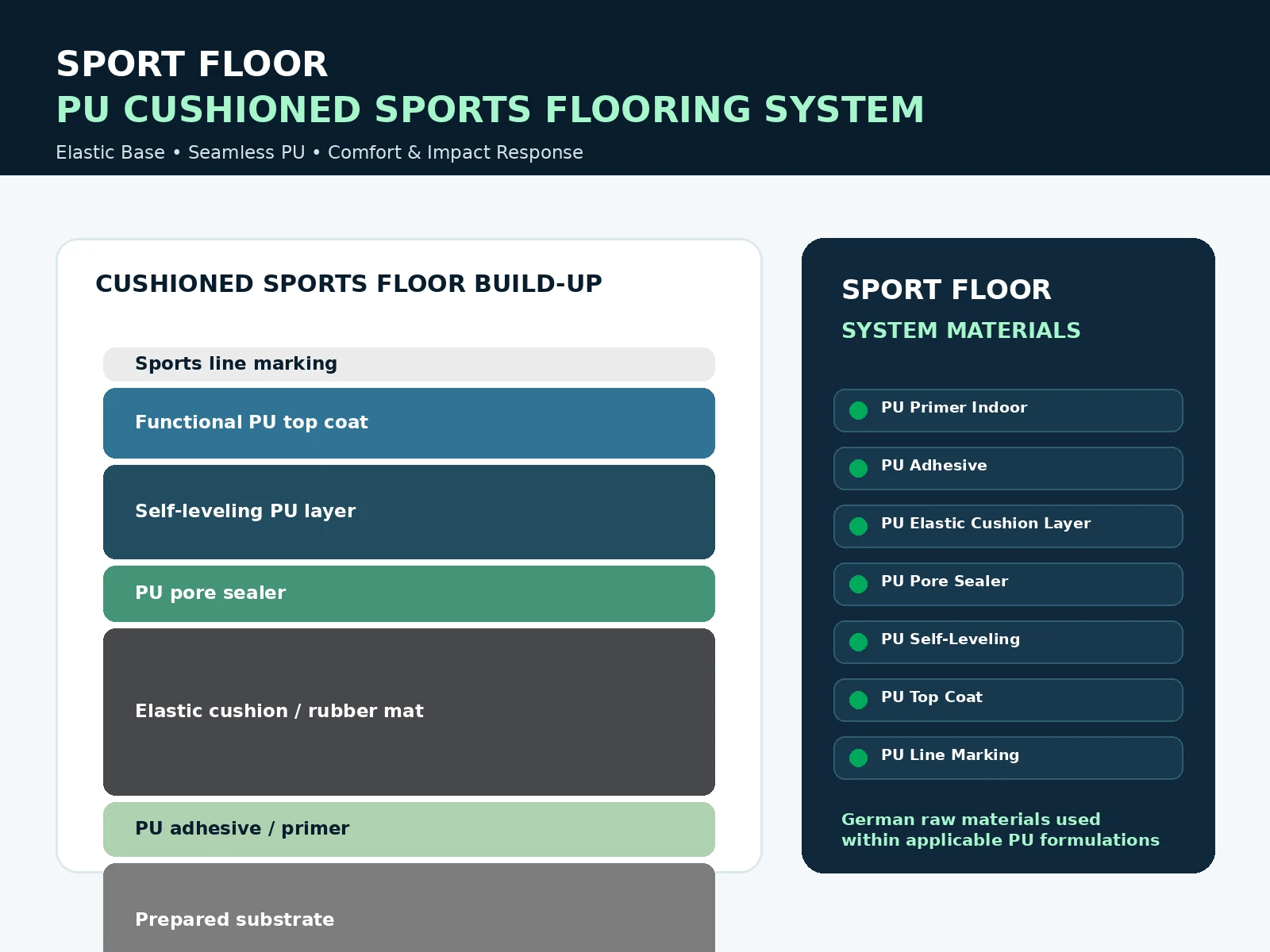
Concrete or another approved base should be sound, level and suitable for the selected resilient system.
Rubber mat, foam, rubberized PU or compatible elastic material provides the resilient response.
Pore sealer and self-leveling polyurethane close the resilient base and create the seamless sports surface.
Top coat and line marking create the final playing surface according to project use.
When an athlete lands on the floor, the visible polyurethane finish transfers load into the layers below. The cushion layer compresses or deforms within its design range and then returns as the load is removed.
This response can influence shock absorption, vertical deformation and athlete comfort. However, these properties must be measured for the complete system. A thick cushion does not automatically mean a better sports floor, and a softer floor is not always the correct choice.
Sport, athlete age, ball behavior, equipment loads, facility scheduling and the desired balance between comfort and stability should all influence system selection.
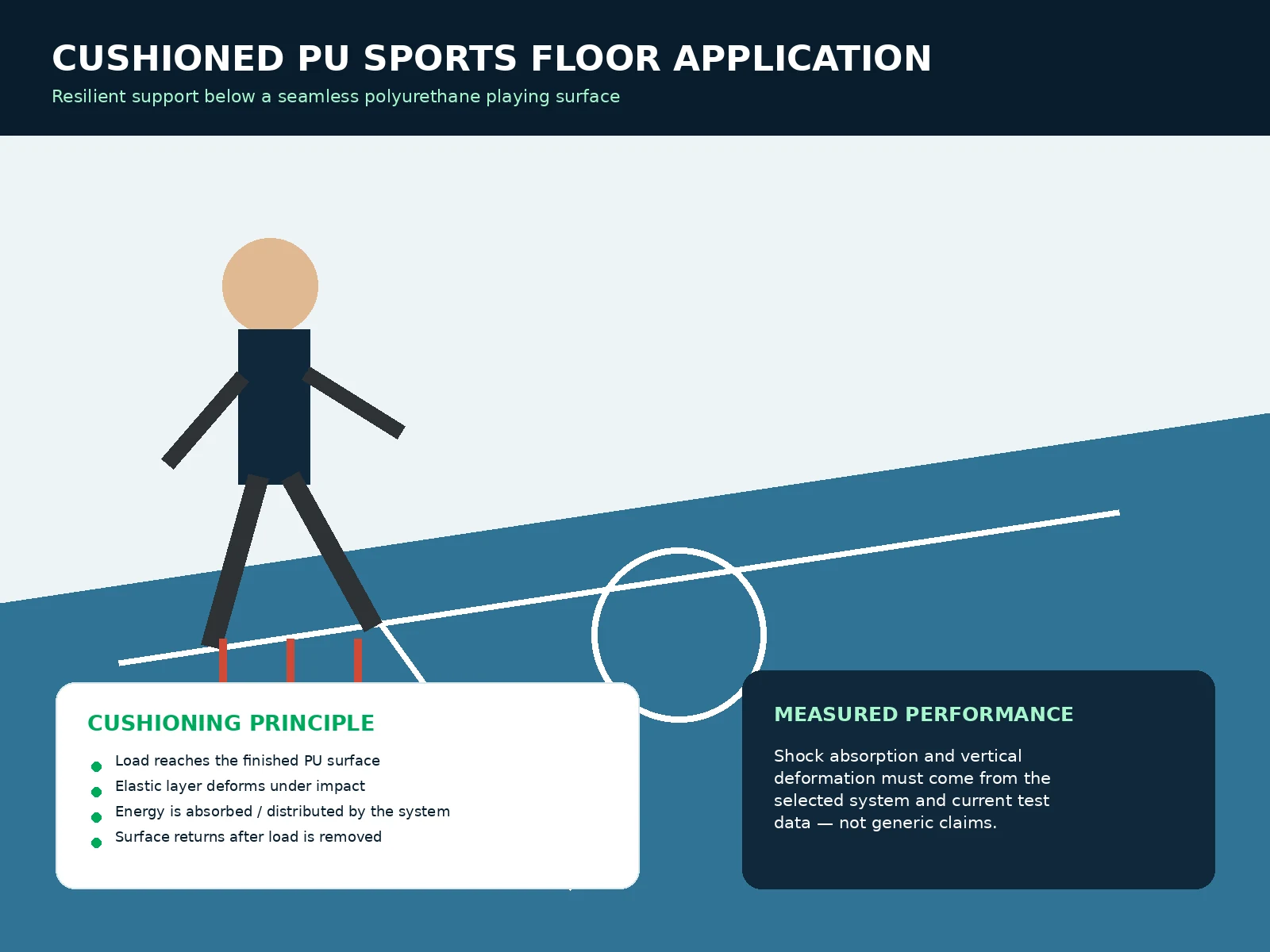
A firmer cushioned system can suit facilities that need a stable response, high ball activity or multipurpose use. A more resilient system may be selected where athlete comfort and impact reduction carry greater priority.
The correct balance should consider the sport mix, frequency of use, user profile, equipment traffic and the required sports-performance standard.
For this reason, Sport Floor does not present one generic shock-absorption percentage or one universal cushion thickness for every project. The final specification should come from the selected system and current technical data.
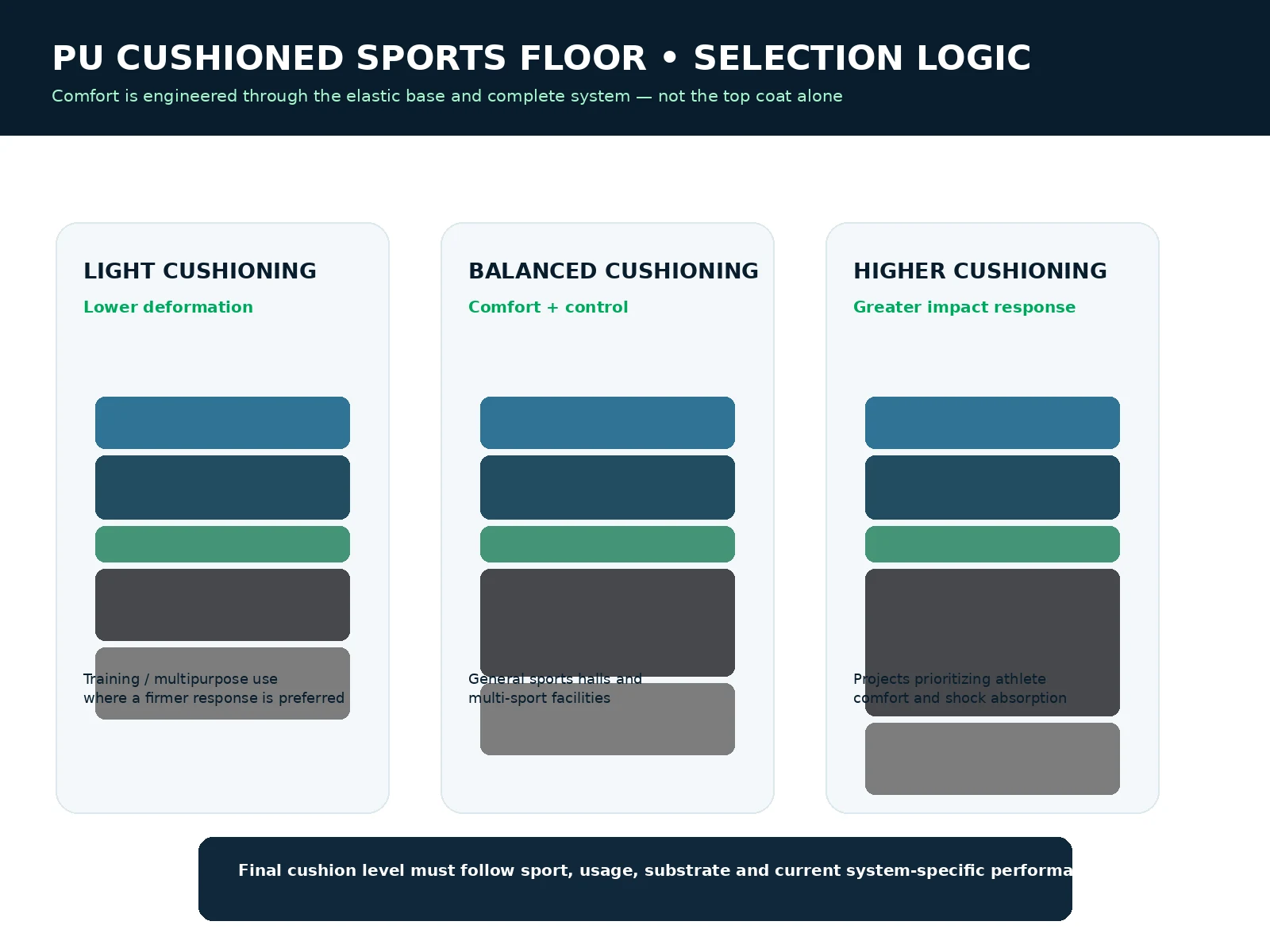
Repeated running, jumping and landing make cushion selection an important part of the floor design.
High-frequency jumping and lateral movement can benefit from a correctly specified resilient system.
Running, stopping and directional changes require a balance of stability, grip and cushioning.
Cushioning can be selected to balance several sports and user groups on one floor.
Physical education floors can prioritize comfort for frequent use across multiple age groups.
Sports halls may need to support teaching, recreation, club training and competition.
High repetition makes athlete comfort and predictable surface response commercially important.
Shared-use halls can benefit from a resilient system selected for mixed traffic and sports use.
Sport Floor uses German raw materials within applicable polyurethane formulations used across the cushioned sports-flooring range.
Sport Floor manufactures primers, adhesives, cushion products, pore sealers, self-leveling PU, top coats and line marking materials.
Sport Floor combines manufacturing, project application knowledge and direct international B2B supply.
| System stage | Sport Floor product route | Function |
|---|---|---|
| Substrate preparation | PU Primer Indoor or selected primer route. | Prepares compatible substrate before upper layers. |
| Bonding | PU Adhesive | Bonds compatible resilient mat or layer where required. |
| Cushioning | PU Elastic Cushion Layer / Rubberized PU Base Layer | Creates the resilient load-response zone. |
| Pore closing | PU Pore Sealer | Closes porous cushion/rubber surfaces before dense PU. |
| Dense seamless layer | PU Self-Leveling Compound | Creates continuous polyurethane playing surface. |
| Functional finish | PU Matt Anti-Slip Top Coat or another compatible finish. | Creates final sports surface characteristics. |
| Sports markings | PU Line Marking Paint | Completes sport boundaries and court geometry. |
| Component | Main role | What it should not be confused with |
|---|---|---|
| Cushion / elastic layer | Provides the principal resilient response below the playing surface. | It is not the final exposed wear surface. |
| PU Pore Sealer | Closes the porous cushion base before dense polyurethane layers. | It is not a substitute for cushioning. |
| Self-Leveling PU | Creates the smooth, dense seamless structural sports layer. | It does not alone define the full cushion performance. |
| PU Top Coat | Creates the final functional finish, color, surface feel and protection. | It is not the main shockpad. |
| Line Marking | Defines court geometry and sport zones. | It does not change the cushioning class. |
Check flatness, soundness, moisture and compatibility with the selected cushioned system.
Bond or apply the approved resilient layer according to the selected system design.
Seal pores where required and apply the dense self-leveling polyurethane surface.
Apply the compatible top coat, allow full cure and complete sports line marking.
| Performance area | Why it matters | Sport Floor approach |
|---|---|---|
| Shock absorption | Shows how the complete system manages impact energy. | Use current system-specific test data where required. |
| Vertical deformation | Describes the amount of surface movement under load. | Match cushion system to sport and facility requirements. |
| Ball rebound / response | Critical for ball sports and a potential trade-off with softness. | Verify on the selected system rather than assuming from cushion thickness. |
| Slip / friction | Influences stopping, turning and controlled movement. | Determined primarily by the final surface and full system. |
| Load resistance | Important where equipment, seating or multipurpose loads may occur. | Balance cushion response with required load-bearing capability. |
| Recovery | Resilient layer should recover appropriately after normal sports loading. | Follow current product/system data. |
| Standards / certification | May be required by consultants or sports authorities. | Only claim compliance when current system-specific evidence supports it. |
| Selection point | Cushioned PU | Dense / Self-Leveling PU | Rubber Flooring |
|---|---|---|---|
| Primary design intent | Seamless PU surface plus engineered resilience below. | Dense seamless PU surface with less emphasis on separate cushioning. | Resilient rubber tiles or rolls. |
| Surface joints | Seamless upper surface. | Seamless. | Joints between tiles/rolls depending on product. |
| Cushion control | High flexibility through selected elastic layer. | Depends on system formulation and base. | Driven by rubber thickness/density and installation. |
| Color / line customization | High through PU finishes and line marking. | High. | Product-color dependent with possible surface markings. |
| Sport Floor route | Current system | Self-Leveling PU System | Rubber Flooring |
Sport Floor manufactures a dedicated family of polyurethane sports-flooring materials.
Primer, adhesive, cushion layers, pore sealer, self-leveling PU, top coat and markings can be coordinated.
System decisions are supported by real sports-flooring installation and facility requirements.
Material packages can be prepared for contractors, importers and distributors in overseas markets.
Total square metres and room/court dimensions.
Basketball, volleyball, handball, multi-sport or other use.
Concrete, existing floor or planned construction.
Firm, balanced or higher cushioning preference where known.
Send shock-absorption, deformation or standard requirements where available.
School, club, university, training, competition or multipurpose use.
Country, city and preferred delivery point.
TDS, SDS, test data or consultant-submittal requirements.
It is a seamless polyurethane sports-flooring system built over an elastic cushion, rubber or foam layer designed to influence impact response and athlete comfort.
The cushion layer contributes strongly, but measured shock absorption belongs to the complete tested system rather than one layer alone.
No. Cushion level should balance comfort, deformation, ball response, load resistance and the intended sports use.
Compatible systems can serve basketball, volleyball, handball, multi-sport halls, schools, universities and training facilities.
Yes. Sport Floor manufactures primers, adhesives, cushion products, pore sealers, self-leveling PU, top coats, line-marking products and other PU sports-flooring materials.
Yes. German raw materials are used within applicable Sport Floor polyurethane formulations.
Yes. A coordinated quotation can include substrate preparation, adhesive, cushion layer materials, pore sealer, self-leveling PU, top coat and markings.
Yes, depending on the selected build-up and verified performance. Formal classification should only be stated when current system-specific test evidence supports it.
No. Cushioned PU has a seamless polyurethane upper surface over a resilient base. Rubber flooring generally uses rolls or tiles as the exposed surface.
Yes. International contractors, distributors, importers and project buyers can request direct supply at info@sportfloor-m.com.
Yes. Request current technical documentation for the exact products included in the proposed system.
Send area, sports, substrate, desired cushioning level, performance specification, usage level, destination and required documentation.
Send the facility area, sports, substrate, desired cushioning level, performance requirements and destination. Sport Floor can prepare a cushioned PU sports-flooring package covering compatible substrate preparation, adhesive, elastic layers, pore sealer, self-leveling PU, top coat and line marking.