
Prepared Substrate
Concrete or asphalt should be sound, level and compatible with the selected sports-floor system.
Sport Floor manufactures and supplies Rubberized PU Sports Flooring System materials for projects that require an in-situ resilient rubber layer bonded with polyurethane beneath a dense, seamless PU sports surface.
Unlike a prefabricated rubber mat, the rubberized base is created on site by combining selected rubber granules with compatible polyurethane binder. This allows the resilient layer to be formed directly over the prepared substrate before pore sealing and the upper polyurethane sports-floor build-up.
Sport Floor manufactures its own polyurethane sports-flooring materials, uses them in sports applications and supplies them directly for international B2B projects. German raw materials are used within applicable Sport Floor PU formulations, while the system can combine Sport Floor PU binder, rubber granules, pore sealer, self-leveling polyurethane, top coats and line marking through one coordinated supply route.
Rubberized PU sports flooring combines the resilience of rubber granules with the bonding and system-integration function of polyurethane. Rubber granules are mixed with compatible PU binder and installed as a continuous resilient base over a prepared substrate.
After the rubberized layer cures, its open surface is prepared for the upper polyurethane layers. Depending on the system, this normally includes pore sealing before a dense self-leveling PU layer and final top coat are applied.
The exposed finished floor is therefore polyurethane, while the rubberized layer works beneath it as the resilient support zone. This is fundamentally different from rubber tiles or rolls, where rubber remains the visible finished surface.
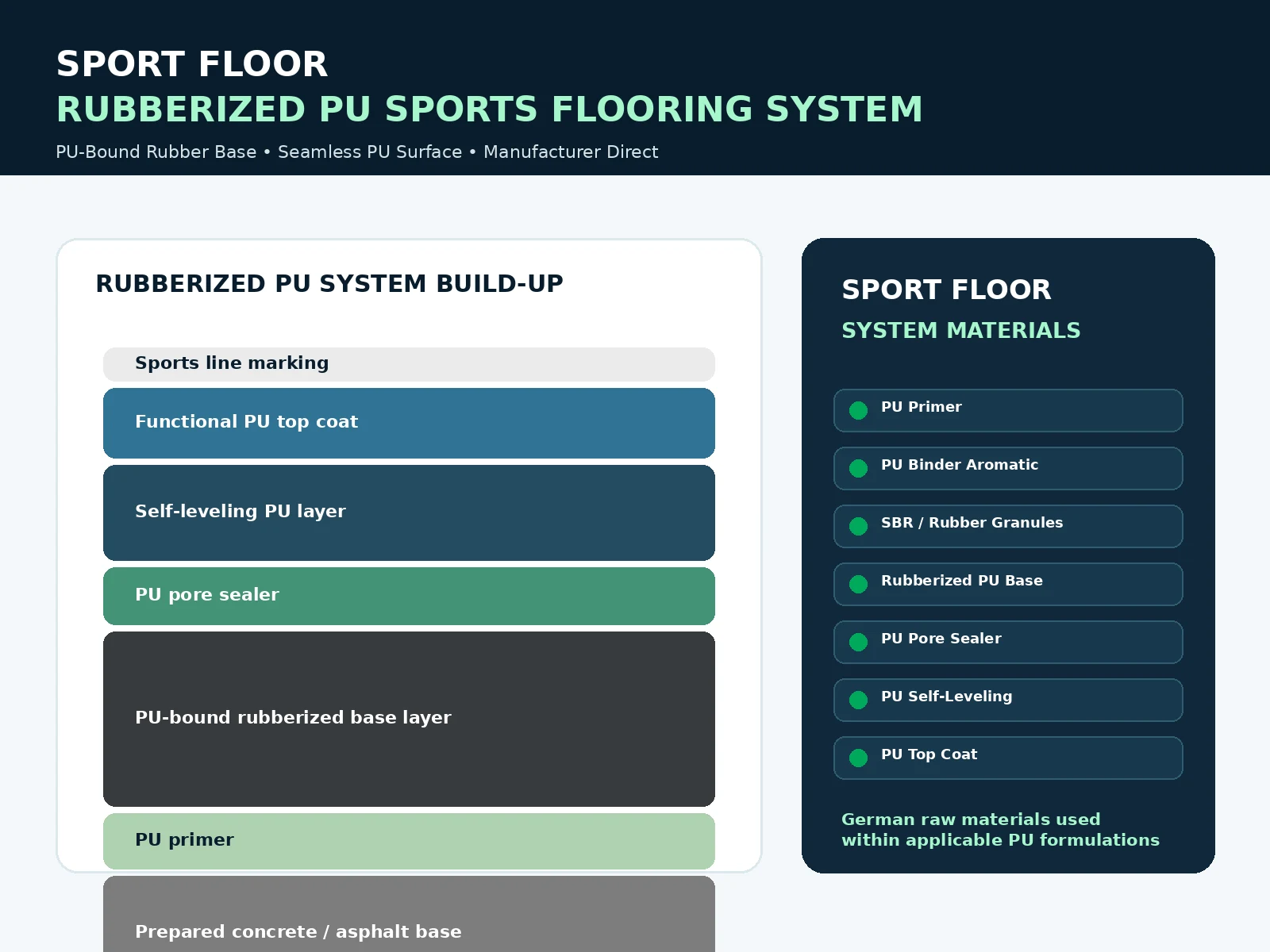
Concrete or asphalt should be sound, level and compatible with the selected sports-floor system.
Selected rubber granules are mixed with compatible polyurethane binder and installed as the resilient layer.
The rubber layer is sealed before a dense self-leveling polyurethane layer is applied above it.
The selected functional finish and sports markings complete the playing surface.
The rubberized layer should not be treated as loose rubber covered later by polyurethane. The granules and binder must work as a coherent resilient matrix.
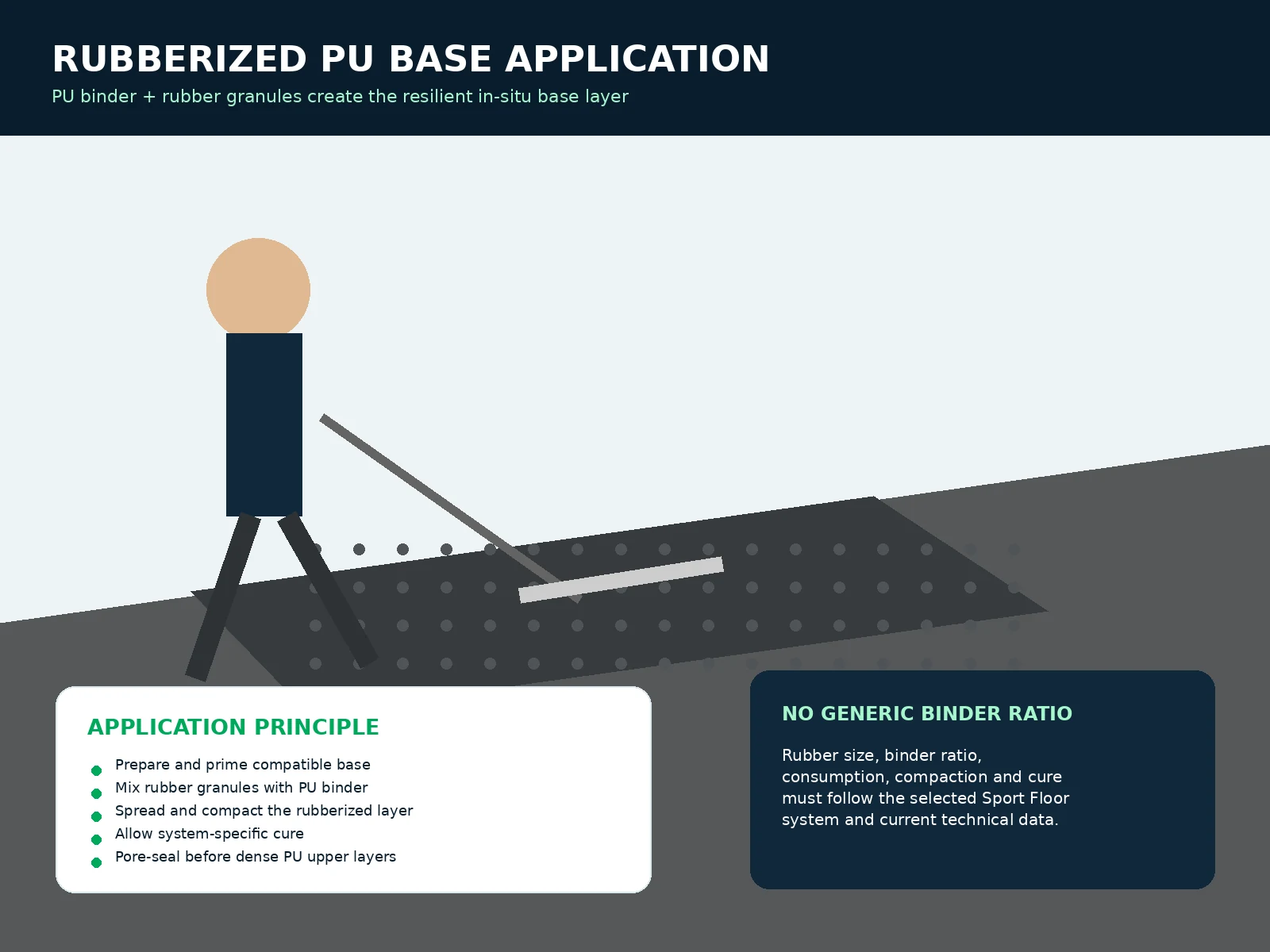
Rubber size, binder dosage, mixing method, working time, placement thickness and compaction affect the behavior and integrity of the base. These parameters are product- and project-specific and should come from the selected Sport Floor system documentation.
After curing, the rubber base must be sufficiently stable and prepared before pore sealing. Applying dense self-leveling PU directly over an open, unsealed rubber surface can create unnecessary material loss and poor surface formation.
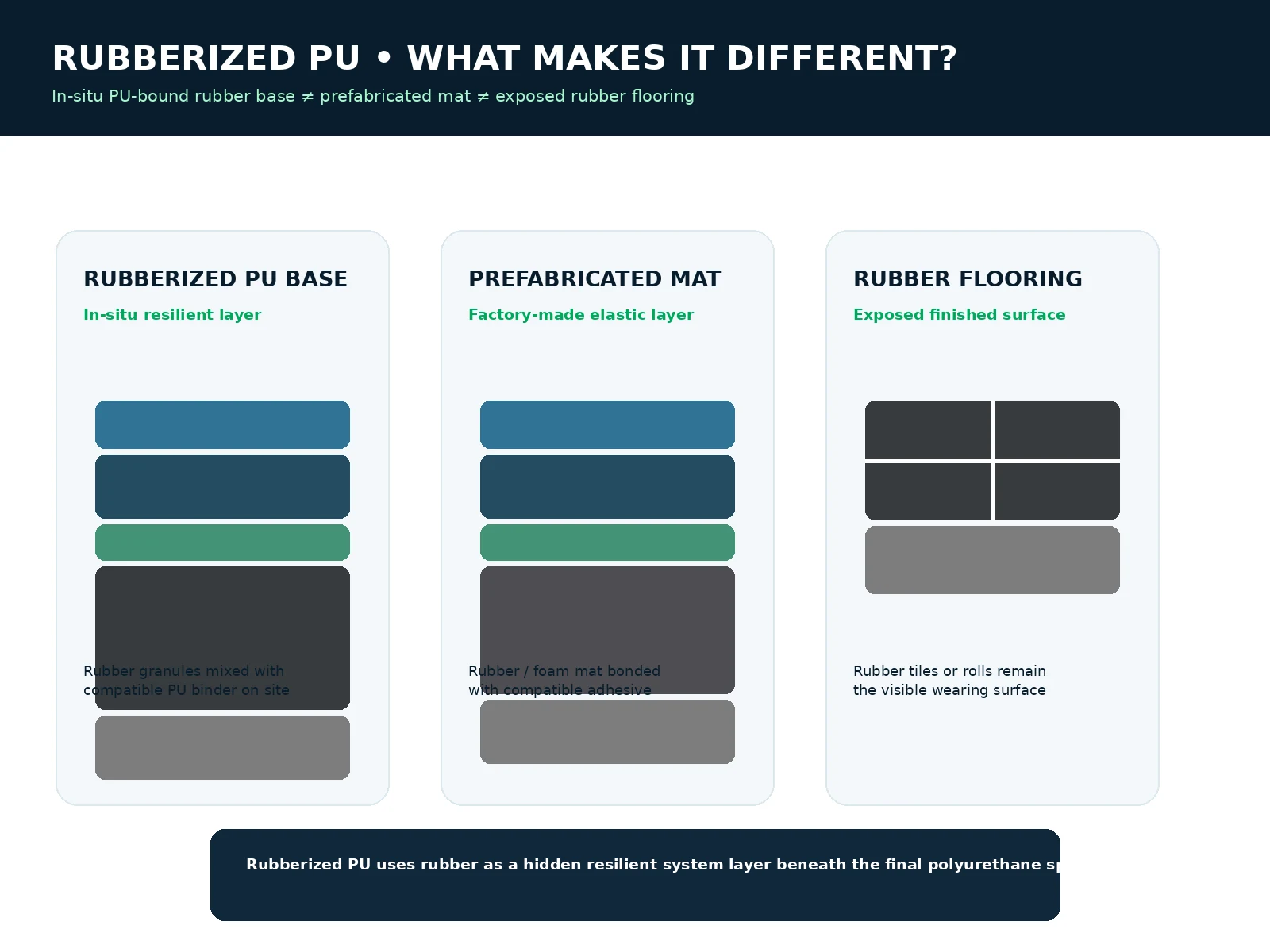
Rubberized PU base: rubber granules are mixed with PU binder on site to create the resilient underlayer.
Prefabricated rubber mat: the resilient layer arrives from the factory as a roll or sheet and is bonded to the substrate with compatible adhesive.
Rubber flooring: rubber tiles or rolls themselves remain the final exposed surface rather than being hidden under dense PU layers.
The correct option depends on installation strategy, project logistics, target resilience, required seamlessness and the finished surface the client wants.
The resilient layer is formed directly on site rather than relying on factory-made mat dimensions.
Polyurethane binder connects the rubber granules into a cohesive sports-flooring base.
The installed base can follow the geometry of the sports area without sheet joints within the rubber layer.
After pore sealing, the base can support dense polyurethane upper layers in compatible systems.
Rubber type, layer design and upper finish can be selected around the intended project where supported by technical data.
Sport Floor can supply the polyurethane and rubber components through one commercial route.
Sport Floor uses German raw materials within applicable polyurethane binder, sealing and finishing formulations.
Sport Floor manufactures primers, binders, rubberized PU materials, pore sealers, self-leveling PU, top coats and line marking.
Sport Floor combines product manufacturing, sports-flooring application experience and direct international supply.
| System stage | Sport Floor product route | Function |
|---|---|---|
| Substrate preparation | PU Primer Indoor / PU Primer Outdoor | Select according to environment and prepared base. |
| Rubber binding | PU Binder Aromatic | Binds compatible rubber granules into the resilient base. |
| Rubber component | Rubber Granules | Creates the resilient granular body of the base layer. |
| Rubberized layer | Rubberized PU Base Layer | Dedicated system component for resilient rubber/PU construction. |
| Pore closing | PU Pore Sealer | Closes the rubber base before dense PU application. |
| Dense PU layer | PU Self-Leveling Compound | Creates the smooth, seamless polyurethane upper surface. |
| Functional finish | PU Matt Anti-Slip Top Coat or compatible finishing route. | Creates the final exposed sports-floor finish. |
| Sports markings | PU Line Marking Paint | Completes court geometry and multi-sport layouts. |
Rubberized resilient bases can support seamless PU upper surfaces in compatible indoor systems.
Compatible exterior systems can use rubberized bases beneath weather-resistant PU upper layers.
Resilience can be built into a shared court before the final multi-sport surface and markings.
Can form part of a cushioned seamless basketball-floor build-up when correctly specified.
Supports resilient sports-floor construction for repeated jumping and lateral movement.
Can provide a resilient underlayer beneath a dense PU surface for repeated team-sport use.
Useful where a site-installed resilient base is preferred for multi-use sports flooring.
Can support high-frequency sports areas requiring comfort beneath a durable seamless finish.
Confirm base condition, flatness, moisture and compatibility, then apply the selected primer.
Combine the selected granules and Sport Floor PU binder according to current technical data.
Install the rubberized base uniformly, then allow the required cure before upper-layer work.
Apply pore sealer, dense PU layer, top coat and sports markings according to the selected system.
| Item | Sport Floor approach | Why it matters |
|---|---|---|
| Rubber type | Selected SBR / compatible rubber granules according to system. | Influences resilience, pore structure and material quantity. |
| Rubber size | Use selected system specification. | Affects packing, surface texture and binder demand. |
| PU binder | Compatible Sport Floor binder selected for the rubberized base. | Creates cohesion between granules. |
| Binder ratio | Follow current Sport Floor TDS / system specification. | Too little or too much binder can change base behavior. |
| Base thickness | Project-specific. | Influences resilience, quantities and completed system response. |
| Compaction | Controlled during installation. | Influences density and uniformity of the resilient layer. |
| Cure interval | Follow current product documentation. | Required before pore sealing and upper layers. |
| Pore sealer | Selected Sport Floor pore-sealing product. | Prepares open rubber layer for dense PU. |
| Upper system | Self-leveling PU + compatible top coat where specified. | Creates the finished seamless playing surface. |
| Performance claims | Use complete-system test data only. | Shock absorption and sports standards cannot be inferred from rubber thickness alone. |
The binder should be compatible with the rubber type, environment and selected sports-floor system.
Do not copy consumption or ratio values from another manufacturer's formulation.
Variable density can create an inconsistent resilient base beneath the PU surface.
Dense PU should not simply be poured into an open rubber structure without the required transition layer.
The rubberized layer remains hidden below the seamless PU finish.
Sports performance belongs to the full system, not one rubber layer dimension.
Sport Floor manufactures the binders and PU products surrounding the rubberized system.
Compatible SBR / rubber granules can be coordinated with the polyurethane material package.
Material selection is informed by sports-flooring installation and project requirements.
System packages can be prepared for contractors, distributors and importers in overseas markets.
Total square metres and facility dimensions.
Confirm environmental condition and exposure.
Concrete, asphalt or planned civil base.
Provide specified rubber type, size and base thickness where available.
Basketball, volleyball, handball, multi-sport, training or another application.
Confirm required self-leveling, top coat and finish where known.
Country, city and preferred delivery point.
TDS, SDS, packing or consultant-submittal requirements.
It is a sports-flooring build-up that uses rubber granules mixed with compatible polyurethane binder to create an in-situ resilient base beneath pore sealer, dense PU and the final sports finish.
No. In rubberized PU systems, the rubber layer remains hidden beneath the seamless polyurethane surface. Rubber flooring uses rubber tiles or rolls as the visible final surface.
No. A rubberized base is created on site from granules and PU binder. A prefabricated mat is factory-made and bonded to the substrate.
Compatible SBR or other specified rubber granules can be used according to the selected Sport Floor system. Exact type and granule size should follow the current specification.
Use the current Sport Floor TDS or project-specific system specification. Do not copy a generic ratio from another manufacturer's product.
The rubberized base has an open structure. Pore sealer prepares it for the dense self-leveling polyurethane layer installed above.
Yes. Sport Floor manufactures polyurethane binders and a broader range of sports-flooring PU materials.
Yes. German raw materials are used within applicable Sport Floor polyurethane formulations.
Yes, where the complete selected sports-flooring system is designed for indoor use.
Yes, where the complete build-up, primer, PU layers and finishing route are specified for exterior exposure.
Yes. A coordinated quotation can include compatible rubber granules, PU binder, primer, pore sealer, self-leveling PU, top coat and line marking.
Yes. Contractors, distributors, importers and project buyers can request international supply at info@sportfloor-m.com.
Yes. Request current technical documentation for the exact binder and PU products included in your proposed system.
Send the project area, indoor/outdoor condition, substrate, rubber type, required resilient-base thickness, upper PU system and destination. Sport Floor can prepare a rubberized PU sports-flooring material package covering compatible primer, binder, rubber granules, pore sealer, self-leveling PU, finishing and line marking.