
Prepared Track Base
Correct civil works, levels, drainage and asphalt/concrete quality form the foundation of the synthetic surface.
Sport Floor manufactures and supplies Sandwich Running Track System materials for athletics tracks that combine a resilient PU-bound SBR base with a pore-sealed, dense polyurethane upper surface finished with EPDM where specified.
The Sandwich concept sits between Full PU and Spray Coat in construction logic. It uses a rubber-rich resilient base for cushioning and material efficiency, but unlike a simple spray system it receives a pore sealer and dense polyurethane wearing layer above the base.
Sport Floor manufactures its own polyurethane sports-flooring materials, uses system materials in project activity and supplies them directly for international orders. German raw materials are used within applicable Sport Floor PU formulations, creating a strong material-quality platform for contractors, distributors and project buyers.
Sandwich running tracks are in-situ synthetic athletics surfaces built around two distinct functional zones: a resilient lower layer made from rubber granules bound with polyurethane, and a dense polyurethane upper zone that creates the final running surface.
The lower SBR/rubber layer provides resilience and reduces the volume of dense polyurethane required compared with a Full PU system. A pore sealer then closes the open rubber structure so the dense upper polyurethane layer can be installed continuously above it.
The exposed surface is completed with a compatible PU layer and EPDM granules or equivalent approved finish according to the selected system. This combination gives the Sandwich family its characteristic balance between resilience, dense surface construction and material efficiency.
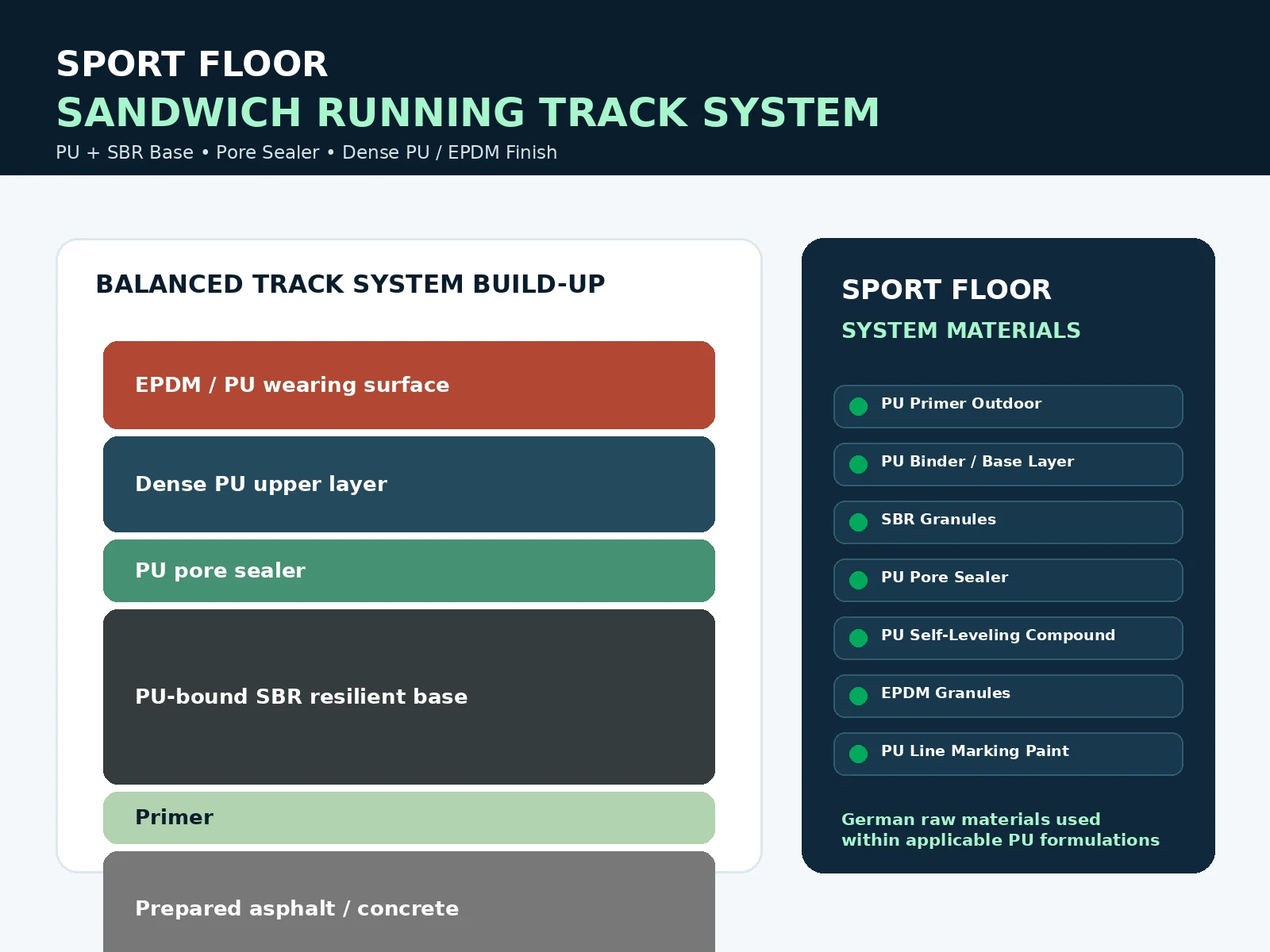
Correct civil works, levels, drainage and asphalt/concrete quality form the foundation of the synthetic surface.
A resilient rubber-granule layer is installed using compatible polyurethane binder according to the selected system.
The open rubber surface is sealed so the dense polyurethane upper layer can be applied continuously.
The track receives a dense polyurethane wearing layer with EPDM granules or approved finish according to project specification.
The rubber base should be uniform, correctly compacted and compatible with the binder. Excessive open texture, weak granule bonding or inconsistent base thickness can affect the pore-sealing stage and the dense polyurethane layer above.
The pore sealer is a critical transition product. Its job is to close the rubber base sufficiently for the self-leveling or dense PU layer that follows. It should not be treated as an optional cosmetic coat.
Exact binder consumption, SBR size, pore-sealer consumption, PU thickness, EPDM requirement and cure intervals should follow the selected Sport Floor system and current technical documents.
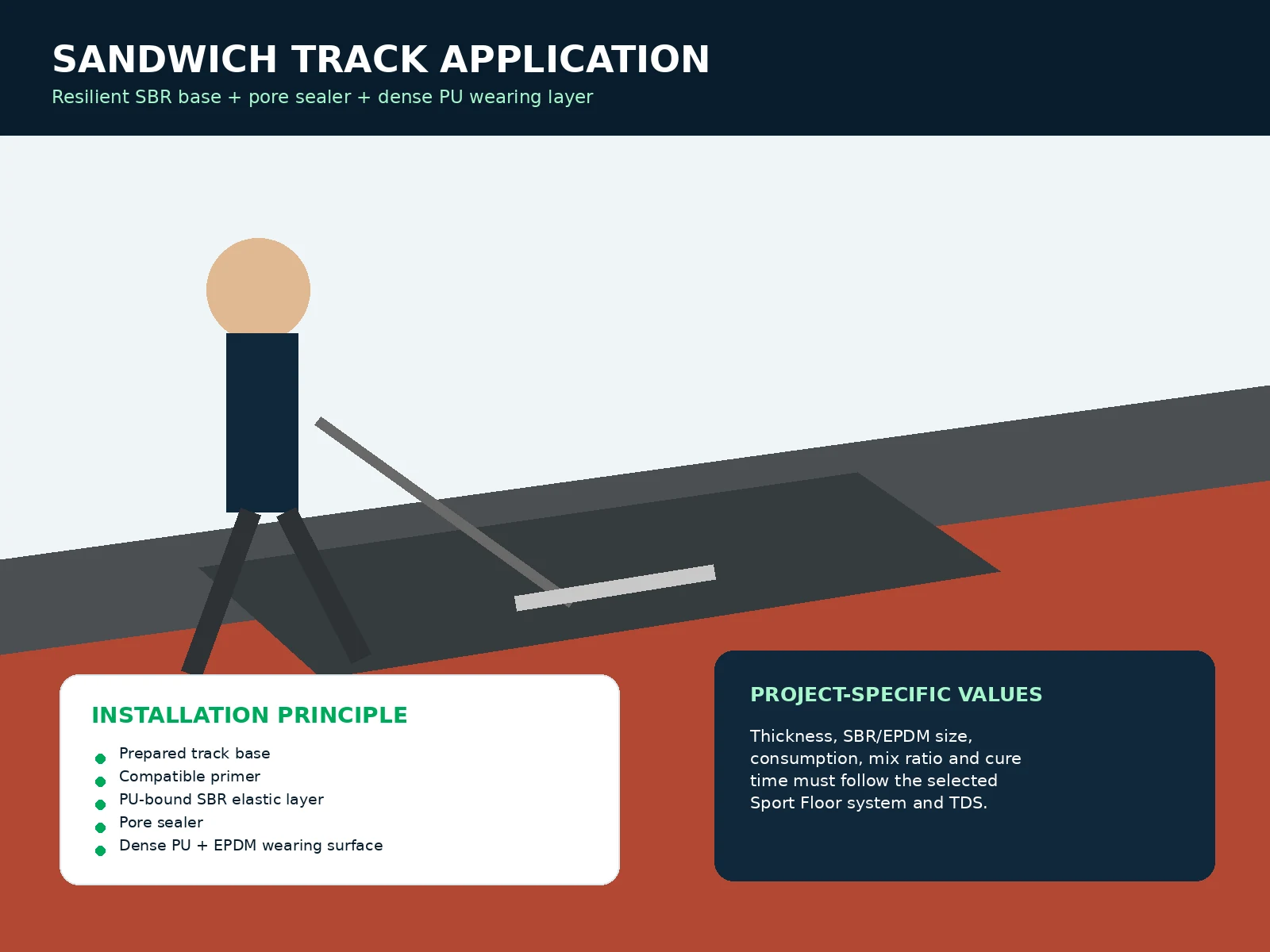
International Sandwich systems commonly use a PU-bound SBR resilient layer, followed by a pore sealer and a dense self-leveling polyurethane upper layer incorporating or receiving EPDM granules.
This structure is what separates Sandwich from Spray Coat: the top is not simply a sprayed finish over a porous base. Instead, the base is sealed and covered by a denser PU wearing layer.
The diagram explains the system logic only. Final layer thicknesses, products, rubber sizes and quantities remain project-specific.
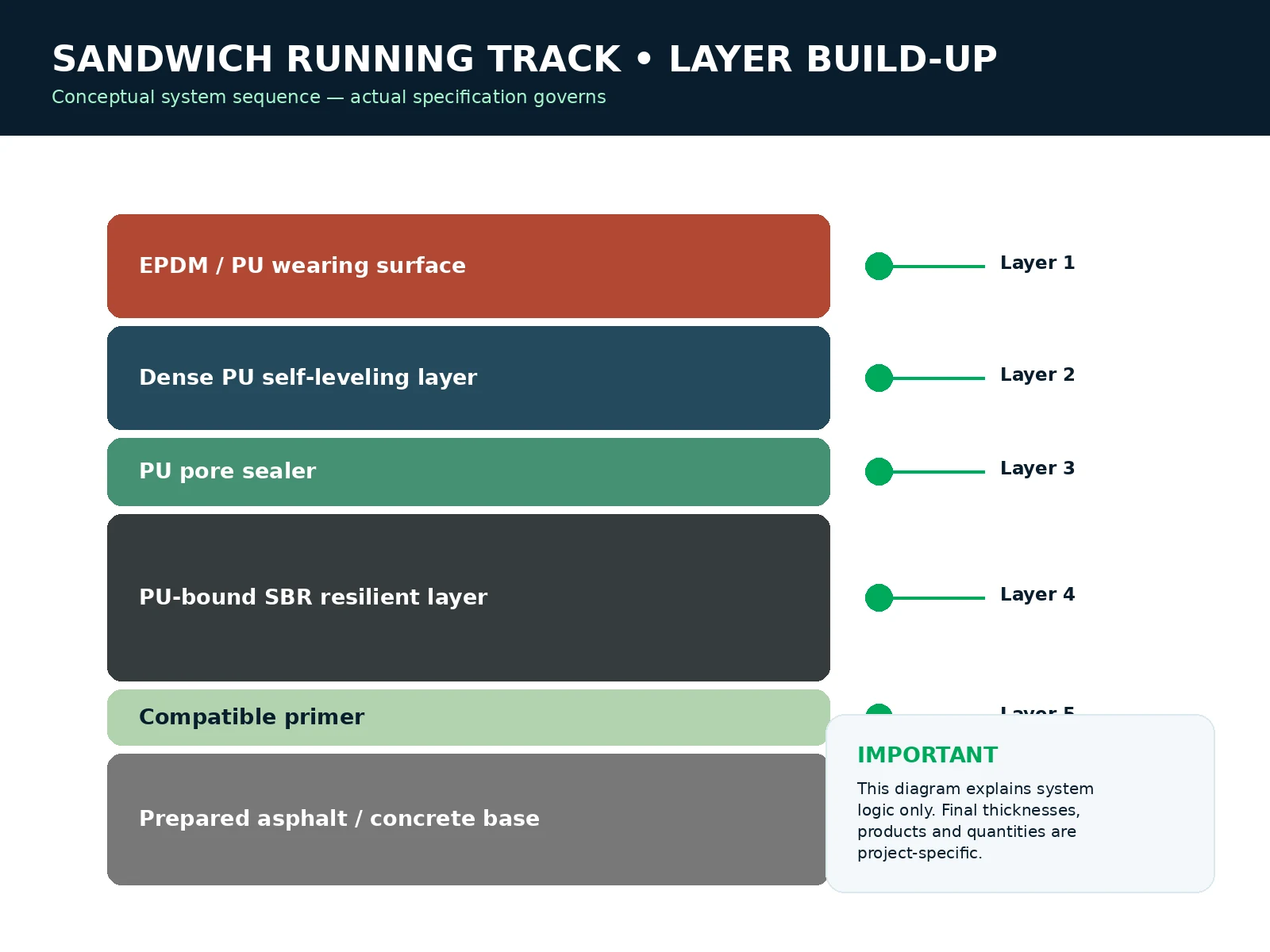
The PU-bound SBR base provides the resilient foundation beneath the denser athletics surface.
The pore-sealed base receives a dense PU upper layer rather than only a thin sprayed coating.
The rubber base reduces the need for a fully dense PU build-up through the entire system depth.
Sandwich is a recognized international athletics-surface system family used by major track manufacturers.
The system has clearly defined base, sealing and upper-surface zones that can be assessed separately during maintenance.
Sport Floor can supply the SBR, PU materials, pore sealer, EPDM and markings as a single commercial package.
Binder, pore sealer and dense upper polyurethane layer must work together as one system rather than unrelated materials.
Sport Floor uses German raw materials within applicable PU formulations used across the Sandwich system.
Sport Floor manufactures binders, pore sealers, self-leveling PU, primers, line marking and related materials.
Sport Floor combines manufacturing, project application knowledge and direct international material supply.
| Selection point | Sandwich | Full PU | Spray Coat |
|---|---|---|---|
| Lower resilient layer | PU-bound SBR/rubber base. | Dense polyurethane-rich layers. | PU-bound SBR/rubber base. |
| Pore sealer | Core transition layer. | Usually not the defining system feature. | Usually not required in basic open spray-coat logic. |
| Upper surface | Dense PU wearing layer with EPDM. | Dense PU / EPDM system through the upper build-up. | Sprayed PU/EPDM finish over porous base. |
| PU intensity | Medium to high. | Highest of the three typical families. | Lower due to thinner sprayed finish. |
| Commercial positioning | Balanced performance and material efficiency. | Premium dense polyurethane route. | Economical / training-oriented route where suitable. |
| Dedicated page | Current system | Full PU Running Track System | Spray Coat Running Track System |
World Athletics maintains current certification documentation for track-surfacing products, and its certified-product records include systems described as Sandwich alongside Full PUR, Spray Coat and prefabricated systems.
This confirms Sandwich as a genuine athletics-surface category. However, the category itself does not mean that every Sandwich product is World Athletics certified.
For any project requiring World Athletics certification, the exact surfacing product, facility construction, geometry, installed system and testing route should be confirmed against current World Athletics procedures and product certificates.
Primer for the base and polyurethane binder for the resilient SBR layer.
Rubber granules for the resilient lower track layer according to system specification.
Intermediate pore-closing material plus the dense polyurethane upper layer.
Final colored granules and compatible athletics marking materials where specified.
Contractors installing complete track systems and requiring coordinated rubber and PU materials.
Companies delivering stadium, school, club and institutional athletics projects.
Buyers developing local stock and supply capability for sports-flooring contractors.
Teams comparing system build-ups, technical documentation, BOQs and export options.
The asphalt or concrete base should be structurally sound, prepared and suitable for polyurethane surfacing.
Track geometry and falls should be established before the synthetic layers are installed.
Water management should be resolved in the track design rather than relying on the Sandwich surface to correct drainage defects.
Confirm base condition, levels, drainage and apply the compatible primer.
Mix and install the polyurethane-bound resilient rubber layer according to the system.
Apply the specified pore sealer to prepare the resilient base for dense polyurethane surfacing.
Install the dense PU/EPDM wearing surface, cure correctly and apply athletics markings.
Sandwich systems are highly layer-dependent. Exact values should come from the actual Sport Floor products and project specification.
| Item | Sport Floor Sandwich System | Why it matters |
|---|---|---|
| System Type | In-situ Sandwich running-track system. | Defines the technical and commercial family. |
| Base | Prepared compatible asphalt or concrete. | Controls long-term surface stability. |
| Primer | Selected according to base and environment. | Creates the interface to the resilient layer. |
| Resilient Layer | PU-bound SBR/rubber granules. | Provides the lower cushioning zone. |
| Pore Sealer | Sport Floor PU Pore Sealer or approved system product. | Closes the rubber base before dense PU surfacing. |
| Upper PU Layer | Dense compatible polyurethane layer. | Creates the continuous wearing zone. |
| EPDM | Selected according to final surface specification. | Defines color and exposed surface texture where used. |
| Thickness | Project-specific; use current system documentation. | Critical to BOQ and specification. |
| Consumption / Mix Ratio | Use current TDS for each supplied material. | Controls installation and quantities. |
| Cure / Application Limits | Follow current Sport Floor technical data. | Important for site quality and scheduling. |
| Certification | Only claim product/facility certification when current evidence supports it. | Prevents unsupported compliance claims. |
The pore sealer is central to creating the dense upper layer over the rubber base.
A Sandwich system has a denser upper PU layer, not only a sprayed PU/EPDM finish.
Poor granule bonding or compaction can affect every layer installed above it.
Layer thickness and quantities should follow the selected Sport Floor system.
The synthetic surface cannot correct defective track levels or civil drainage design.
Certification is product- and facility-specific and must be documented.
Sport Floor can combine the polyurethane products and rubber materials required by international running-track contractors.
Sport Floor manufactures the primers, binders, pore sealers, dense PU products and related materials used around the system.
SBR/rubber granules and EPDM can be coordinated around the track build-up.
System selection is informed by real sports-flooring project activity and installation requirements.
Material packages can be prepared for contractors, importers and distributors in overseas markets.
Total area and project dimensions.
Confirm Sandwich or send consultant specification if system selection is open.
Asphalt, concrete or planned civil track construction.
Stadium, club, school, training, competition or community athletics.
Send required SBR, pore sealer, PU and EPDM information where available.
Provide EPDM or finished track color requirements.
Country, city and preferred port or delivery point.
TDS, SDS, packing, test or consultant-submittal requirements.
It is an in-situ athletics surface built with a PU-bound SBR/rubber resilient base, a pore sealer and a dense polyurethane upper surface finished with EPDM or another approved wearing finish.
Because the finished track is built from distinct functional layers: resilient rubber base below, sealing/intermediate layer in the middle and dense polyurethane wearing surface above.
No. Full PU relies more heavily on dense polyurethane layers throughout the build-up. Sandwich uses a rubber-rich resilient base below a dense PU upper zone.
No. Spray Coat typically finishes a porous rubber base with a sprayed PU/EPDM coat. Sandwich includes pore sealing and a denser polyurethane upper surface.
Yes. Sport Floor manufactures polyurethane primers, binders, pore sealers, self-leveling PU, line marking and other sports-flooring materials.
Yes. German raw materials are used within applicable Sport Floor polyurethane formulations.
It closes the open structure of the resilient rubber base so a dense PU layer can be installed continuously above it.
Yes. A coordinated quotation can include compatible rubber granules together with the required PU system materials.
Thickness depends on the selected system and project specification. Use current Sport Floor system documentation rather than a generic value.
World Athletics certified-product records use Sandwich as a recognized system description. Certification still belongs to specific surfacing products and facilities, not automatically to every Sandwich system.
No. Sport Floor should only make such a claim when current product-specific certification evidence is available.
Yes. International contractors, distributors, importers and project buyers can request direct material supply at info@sportfloor-m.com.
Yes. Request current technical documents for the specific products included in your proposed track build-up.
Send the track area, base, required system, layer specification, target use, surface color and destination. Sport Floor can prepare a Sandwich system material package including compatible primer, binder, SBR, pore sealer, dense PU products, EPDM and line marking materials.