
Artificial Grass Factory Production Process and Quality Control
A practical guide to artificial grass factory production—from yarn and tufting to backing, coating, curing, drainage, cutting, roll inspection, labeling, warehouse staging and export packing. Confirm the exact production scope for every landscape or sports turf model.
What Happens Inside an Artificial Grass Factory?
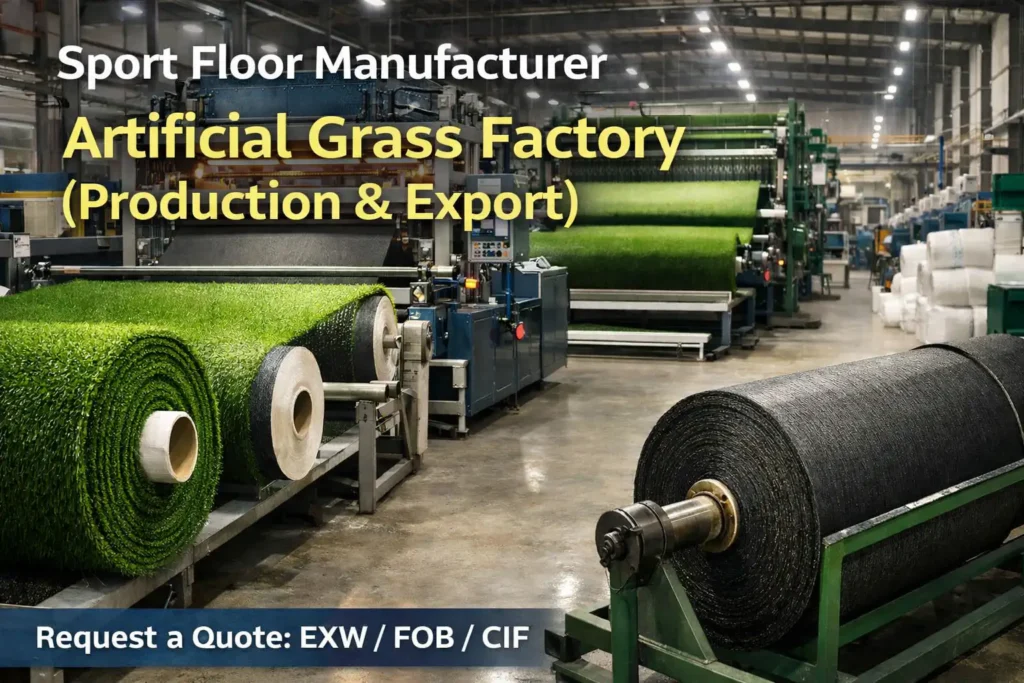
An artificial grass factory converts yarn, backing and coating materials into finished synthetic turf rolls. The production sequence must follow an approved model specification so that the manufactured pile, density, backing, drainage, dimensions and appearance remain connected to the buyer’s order.
Landscape and sports products do not automatically use the same materials or production settings. A garden turf, football turf, padel surface and golf putting product can differ in yarn type, pile height, gauge, stitch rate, backing, coating, drainage and finishing requirements.
Factory capability should therefore be evaluated by the production process, control points, identification system and ability to manufacture the exact approved model—not by general statements about quality or production size.
Controlled Materials
Yarn, backing and coating materials should match the product reference assigned to the production order.
Defined Machine Settings
Tufting and finishing settings should reflect the approved pile, gauge, stitch rate and roll configuration.
Production Checkpoints
Relevant characteristics should be reviewed during production rather than only after every roll is complete.
Finished-Roll Identification
Labels and production references support receiving, inventory, installation and repeat-order control.
Artificial Grass Manufacturing Process from Materials to Packed Rolls
The exact sequence and equipment vary by factory and product, but the following stages describe the principal workflow buyers should understand.
Order and Specification Review
Confirm the model, application, yarn, pile, gauge, density, backing, coating, color and roll requirements.
Material Allocation
Assign the approved yarn, backing and coating materials to the production order.
Yarn Feeding
Prepare and feed the required yarn configuration into the tufting equipment.
Tufting
Insert the yarn into the primary backing using the approved gauge, stitch arrangement and pile setting.
Surface Inspection
Check visible yarn distribution, color, pile condition and manufacturing continuity.
Coating Application
Apply the specified secondary backing or coating to support tuft retention and roll stability.
Drying and Curing
Process the coated turf through the applicable drying or curing stage before further finishing.
Drainage and Finishing
Add product-specific drainage perforations and complete required edge or surface finishing.
Cutting and Rolling
Cut the turf to the approved roll dimensions and wind it onto the selected core.
Inspection, Labeling and Packing
Complete the final checks, identify each roll and prepare it for storage or dispatch.
Preparing Artificial Grass Yarn for Production
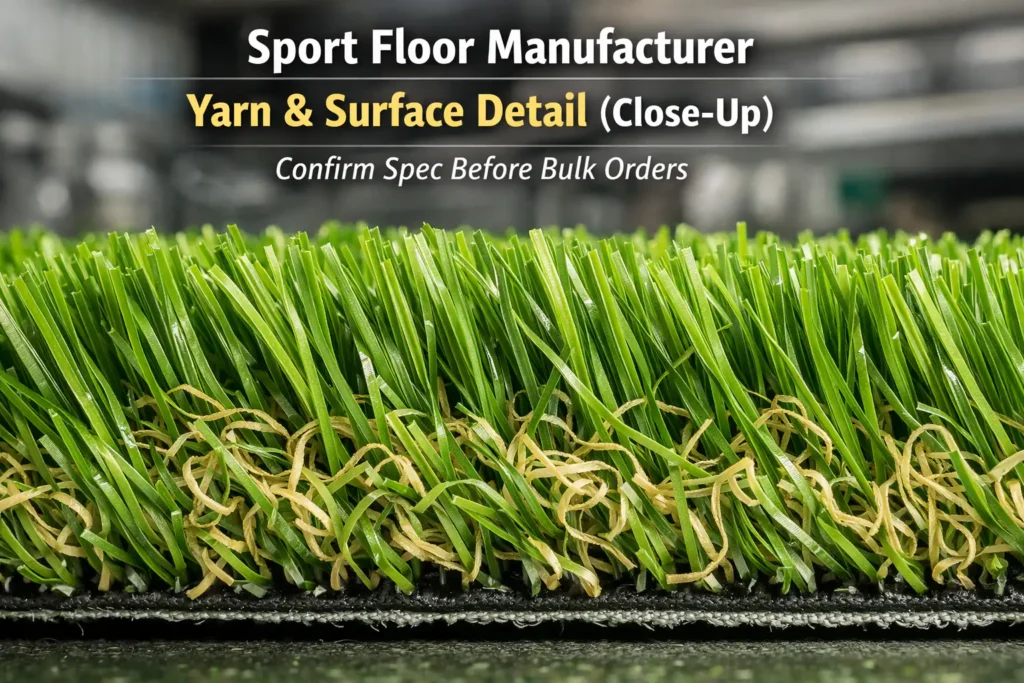
Yarn is the visible component of artificial grass. The product may use straight monofilament blades, textured yarn, fibrillated yarn, curled thatch or a combination selected for the application.
Before tufting, the factory should confirm that the correct yarn material, color combination, blade profile and yarn reference have been allocated to the order.
- Confirm the product and yarn reference.
- Check the required color or color blend.
- Verify the yarn type and blade profile.
- Confirm the declared dtex arrangement.
- Review the primary and thatch-yarn combination.
- Control yarn changes between different production orders.
- Protect yarn materials from contamination and damage.
- Record project-specific yarn requirements where applicable.
How Yarn Is Tufted into the Primary Backing
Tufting creates the rows of artificial grass fibers by inserting yarn through the primary backing according to controlled machine settings.
Gauge Setting
Gauge defines the spacing between tufting rows. It works with stitch rate and yarn construction to determine the distribution of fibers across the turf.
Stitch Rate
The machine setting controls the number of stitches over the stated production length and contributes to the declared surface density.
Pile Height
The tufting and cutting arrangement must produce the nominal pile height defined for the exact landscape or sports model.
Yarn Distribution
The visible surface should be reviewed for missing tufts, irregular rows, unexpected color changes and inconsistent yarn distribution.
Primary Backing Feed
The backing should remain correctly aligned and tensioned as it passes through the tufting stage.
In-Process Verification
Relevant settings and produced samples should be checked during manufacturing so deviations can be identified before the full order is completed.
Securing Artificial Grass Tufts to the Backing
After tufting, the yarn is held mechanically in the primary backing but normally requires a secondary coating or backing treatment to support tuft retention, handling and dimensional stability.
The exact backing construction and coating chemistry vary by model. Buyers should request the declared construction for the exact product rather than assume that every artificial grass roll uses the same backing.
- Confirm the primary-backing construction.
- Confirm the secondary-coating type.
- Review the coating coverage and visible uniformity.
- Check for uncoated or excessively coated areas.
- Verify the condition of the backing after curing.
- Review flexibility for rolling and installation.
- Confirm project-specific reinforced backing where required.
- Request applicable tuft-retention information where needed.
Stabilising the Secondary Coating
The coated turf passes through the applicable drying or curing process before it is perforated, cut, rolled and packed.
Process Conditions
Production conditions should follow the coating-system and product requirements defined for the manufacturing process.
Coating Continuity
The finished backing should be reviewed for areas that appear untreated, damaged or visibly inconsistent.
Roll Stability
The turf should be sufficiently stable for further finishing, rolling, packing and installation handling.
Surface Protection
The yarn face should be protected from contamination or damage during coating and curing operations.
Cooling and Handling
The turf should reach a suitable condition before it is subjected to final cutting, rolling or packing.
Order Segregation
Different product models and production orders should remain identifiable throughout the finishing process.
Adding Product-Specific Drainage to Artificial Grass
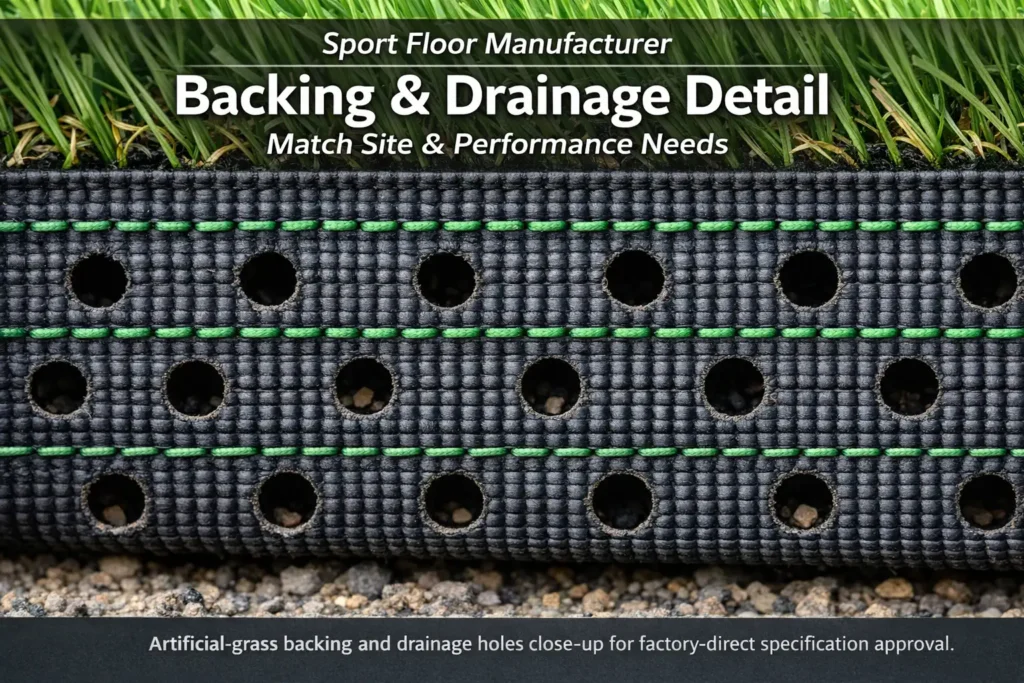
Some artificial grass products use perforations through the backing to allow water to pass into the supporting base. Other products or installations may use different drainage arrangements.
Factory perforation is only one part of the water-management system. The site base, slopes, joints, sub-base and drainage outlets must also be designed and constructed correctly.
- Confirm whether the exact model is perforated.
- Review the intended perforation arrangement.
- Check that holes are formed through the finished backing.
- Inspect for blocked or incomplete perforations.
- Coordinate the product with the project drainage design.
- Do not assume drainage performance from hole appearance alone.
- Request applicable test data when specified by the project.
- Protect the backing from tearing around perforations.
Cutting, Rolling, Core Selection and Edge Inspection
After backing and drainage operations are complete, the turf is finished into rolls that match the approved commercial and installation scope.
Roll Width
Confirm the manufactured width and its permitted tolerance before preparing the cutting or field-layout plan.
Roll Length
The produced length should match the purchase order, roll plan and packing list.
Roll Core
The selected core should support winding, handling and storage of the finished product.
Winding Tension
Rolls should be wound in a controlled manner that supports handling without unnecessary distortion.
Edge Condition
Inspect roll edges for irregular cutting, damage or conditions that may complicate joint preparation.
Pile Direction
Product identification and roll planning should allow installers to maintain the specified pile direction.
Artificial Grass Quality Checkpoints
Factory quality control should verify that the finished rolls correspond with the approved model and purchase order. The exact checks depend on the product, project specification and agreed inspection scope.
- Product code and order identification.
- Yarn type and visible color combination.
- Pile-height measurement.
- Gauge and stitch-arrangement review.
- Declared weight-related checks where applicable.
- Surface appearance and tufting continuity.
- Backing and coating condition.
- Drainage-perforation condition where applicable.
- Roll width and length.
- Edge and winding condition.
- Labels, quantity and packing scope.
- Applicable order or batch records.
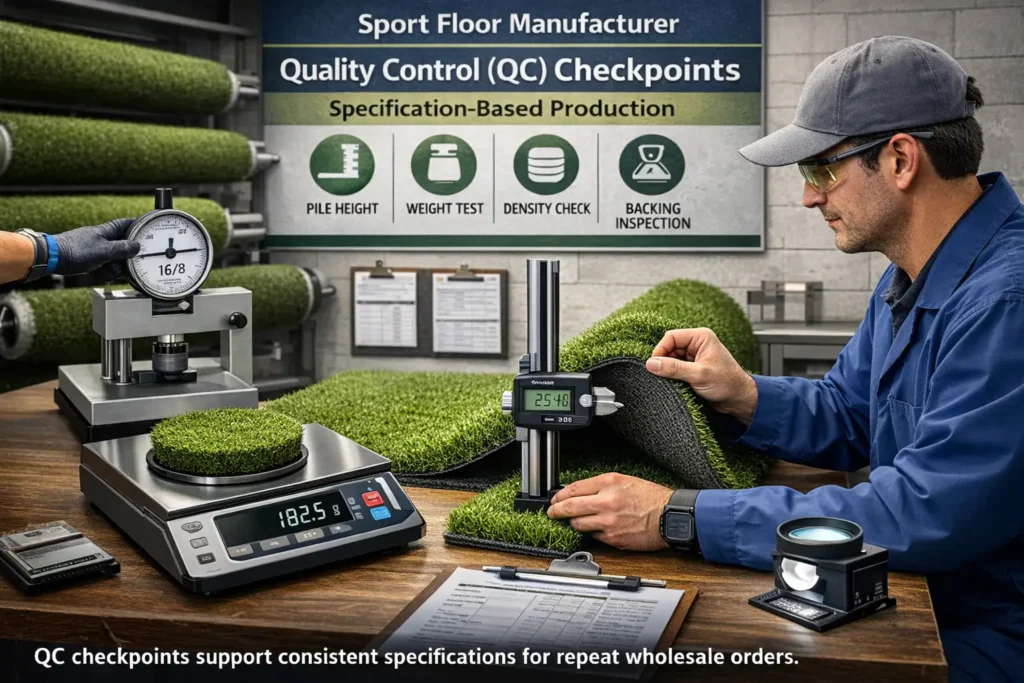
| Factory Check | What Is Reviewed | Why It Matters |
|---|---|---|
| Production Reference | Model, order, yarn, backing and assigned production information. | Helps prevent mixing between different specifications. |
| Surface Appearance | Color, yarn distribution, missing tufts and visible continuity. | Identifies visible defects before packing and installation. |
| Pile Height | Measured yarn height above the backing using the applicable method. | Verifies the nominal product profile. |
| Gauge and Stitching | Row spacing and the produced stitch arrangement. | Supports verification of yarn distribution and declared density. |
| Weight Checks | Relevant yarn, coating or total-weight values where included in the control plan. | Helps identify deviations from the approved construction. |
| Backing Condition | Coating coverage, visible damage, flexibility and surface condition. | Supports handling, joining and installation. |
| Drainage Perforations | Presence, continuity and visible condition of holes where specified. | Confirms that the product received the intended factory finishing. |
| Roll Dimensions | Width, length and related order requirements. | Affects delivered area, roll planning and site installation. |
| Roll Condition | Winding, core, edges, wrapping and visible damage. | Reduces handling and receiving problems. |
| Identification | Labels, model reference, roll number or agreed order information. | Supports receiving, sorting, traceability and repeat orders. |
| Quantity Reconciliation | Roll count, roll sizes and packing-list quantities. | Confirms that the physical shipment matches the commercial records. |
| Additional Tests | Project-specific laboratory or third-party requirements. | Must be confirmed separately from normal production inspection. |
Product Traceability from Production Order to Finished Roll
Traceability helps buyers connect the supplied rolls with the approved model, order, packing list and future repeat purchase.
Model Reference
Use a unique model name, item code or controlled specification reference rather than a generic description.
Production Order
Connect the required product, quantity, roll dimensions and finishing scope with the manufacturing instruction.
Roll Identification
Apply the agreed label or roll reference so the receiving team can distinguish different products.
Packing List Connection
Ensure the commercial packing list reflects the physical roll quantity and dimensions.
Sample Reference
Retain the connection between the approved sample and the specification used for the order.
Repeat-Order Record
Use the retained model and specification to review future orders before production begins.
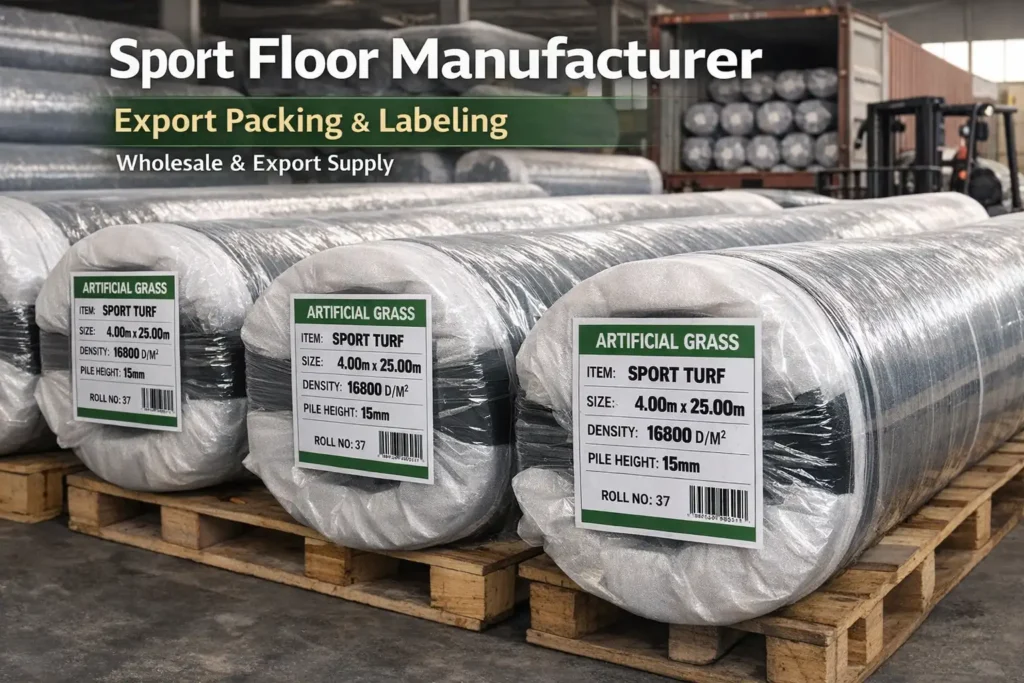
Preparing Artificial Grass Rolls for Storage and Dispatch
Finished rolls should be protected from contamination, moisture, edge damage and uncontrolled handling while remaining easy to identify at the warehouse and destination.
- Confirm the wrapping material and coverage.
- Protect the turf face and roll edges.
- Keep labels visible and securely attached.
- Identify different models within mixed orders.
- Use suitable cores and handling points.
- Confirm whether pallets or supports are required.
- Separate rolls awaiting inspection from released stock.
- Reconcile the roll count before dispatch.
- Prepare packing details that match the shipment.
Staging Artificial Grass Rolls Before Shipment
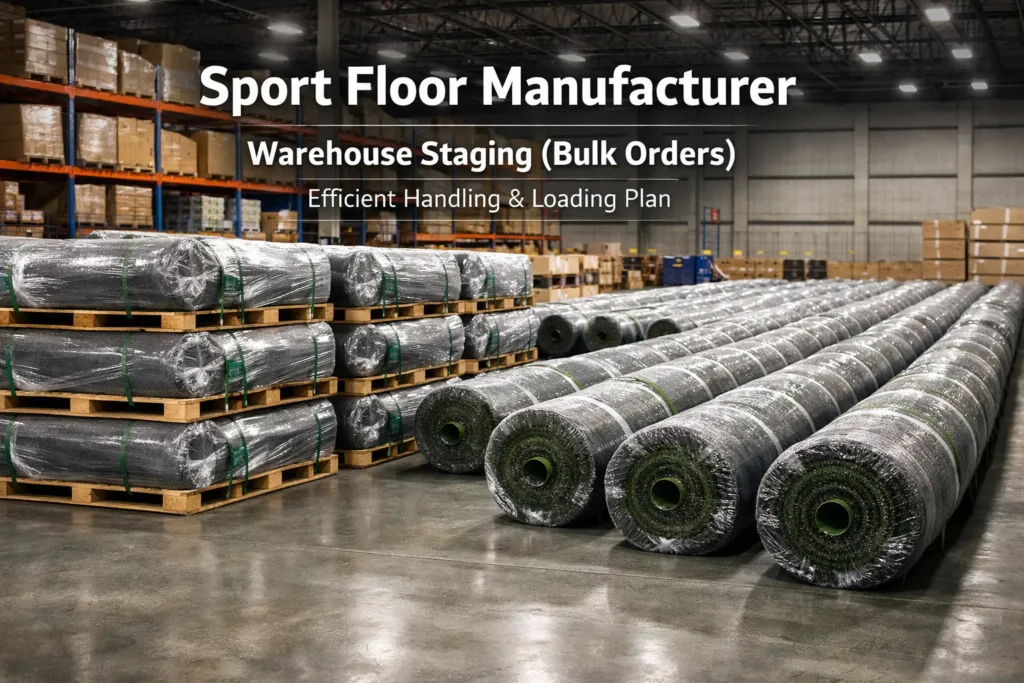
Warehouse Staging
Organise released rolls according to the order, model, quantity and loading sequence while maintaining safe access for handling.
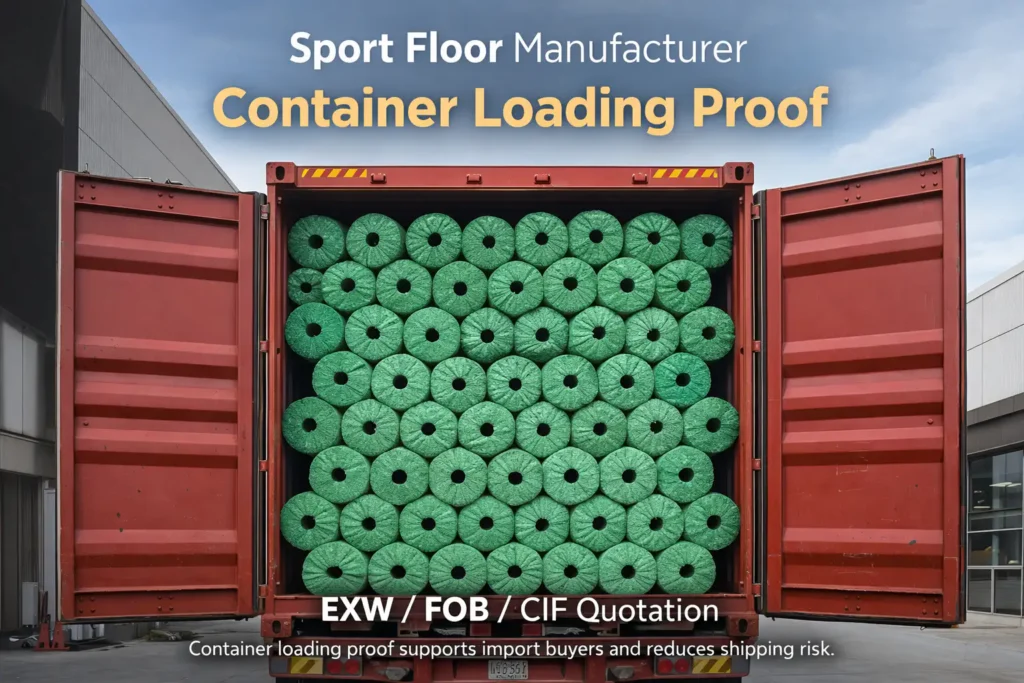
Container Loading
Prepare a project-dependent loading arrangement based on roll dimensions, weights, order mix and safe handling requirements.
Shipment Verification
Compare the loaded rolls with the packing list and agreed order before the shipment is released.
Factory Records and Documents Buyers May Request
Document availability and format depend on the product, project, inspection scope and commercial agreement.
Artificial Grass Factory vs Manufacturer vs Wholesale Supply
Manufacturer
Focuses on product definition, specification control, sample approval, customization and repeat-order consistency.
- Product categories and models.
- Specification approval.
- Sample control.
- Customization.
- Repeat purchasing.
Factory
This page focuses on the physical production process, machine stages, quality checkpoints, finishing, labeling and packing.
- Yarn preparation.
- Tufting.
- Backing and coating.
- Curing and drainage.
- Inspection and packing.
Wholesale Supply
Focuses on bulk purchase planning, product mixes, quantities, private labeling, packing and commercial delivery terms.
- Wholesale buyer types.
- MOQ and quantity planning.
- Mixed-product orders.
- Container planning.
- EXW, FOB and CIF.
What Buyers Should Confirm Before Approving a Factory
Use a consistent checklist when evaluating production capability, inspection, identification and packing.
| Evaluation Area | Questions to Ask | Evidence to Review |
|---|---|---|
| Production Scope | Which landscape and sports categories can be manufactured? | Product specifications, samples and relevant production information. |
| Order Control | How is the approved specification transferred into production? | Model code, production order and material-allocation process. |
| Yarn Control | How are yarn type, color and profile verified before tufting? | Yarn references, production instructions and sample comparison. |
| Tufting Control | How are pile height, gauge and stitch settings managed? | Machine settings, production samples and inspection records. |
| Backing and Coating | Which backing and coating system is assigned to the model? | Technical data, material reference and finished-backing inspection. |
| Drainage | How is the specified perforation or drainage construction produced? | Product samples, backing photographs and relevant test information. |
| Quality Checkpoints | Which characteristics are checked during and after production? | Factory inspection plan and agreed project checkpoints. |
| Measurement Equipment | Is the required measurement equipment available and suitable? | Equipment list and applicable calibration or verification information. |
| Nonconforming Product | How are rolls that do not meet requirements identified and controlled? | Segregation, review and disposition process. |
| Roll Identification | Can each roll be matched to the order and product? | Label examples, roll numbers and packing-list connection. |
| Packing | How are rolls protected and prepared for handling? | Packing specification, photographs and label details. |
| Loading | How is the loading plan based on roll dimensions and order mix? | Project-specific loading arrangement and shipment reconciliation. |
| Repeat Orders | How is a future production run compared with the approved model? | Retained specification, sample reference and change-review process. |
| Technical Claims | Are certification and test claims linked to the exact product? | Applicable certificate or report with product and scope references. |
Artificial Grass Production Mistakes Buyers Should Avoid
Producing from a Generic Description
“40 mm premium grass” does not define the yarn, density, backing, coating or application.
Approving Photos Instead of Samples
Photographs do not accurately control yarn profile, weight, backing or exact color.
Changing Materials Without Review
Any relevant yarn, backing, coating or production change should be reviewed before acceptance.
Checking Only Finished Rolls
In-process checks can identify problems before the full order is manufactured.
Ignoring Roll Dimensions
Incorrect dimensions can affect delivered quantity, seams, waste and container planning.
Mixing Product References
Landscape and sports models should remain clearly separated and identifiable during production and packing.
Using Incomplete Labels
Unclear identification creates receiving, sorting and repeat-order problems.
Claiming Fixed Container Capacity
Loading capacity changes with the physical properties and packing of each order.
Assuming Factory QC Equals Certification
Routine inspection does not replace product-specific laboratory or complete-system testing.
Quality Management and International Delivery Guidance
Continue Reviewing Artificial Grass Production and Supply
Artificial Grass Factory FAQ
How is artificial grass manufactured?
Artificial grass is manufactured by tufting synthetic yarn into a primary backing, applying a secondary coating, curing the backing, adding required drainage, cutting the turf into rolls and completing inspection, labeling and packing.
What is tufting in artificial grass production?
Tufting is the process of inserting artificial grass yarn through the primary backing according to defined gauge, stitch and pile settings.
What materials are used to manufacture artificial grass?
Product constructions may use synthetic yarn, primary backing and a secondary coating or backing treatment. The exact polymers, yarn forms and coatings vary by model.
What is the primary backing?
The primary backing is the sheet through which the yarn is tufted. It supports the yarn arrangement before the secondary coating or backing is applied.
Why is a secondary coating applied?
The secondary coating supports tuft retention, handling and dimensional stability. Its exact construction depends on the artificial grass model.
How are drainage holes added?
Where specified, perforations are formed through the finished backing after coating and curing. Product drainage must still be coordinated with the complete site system.
How is pile height controlled in the factory?
Pile height is controlled through the tufting and cutting arrangement and is checked using the applicable factory measurement method.
How is artificial grass density controlled?
Density is influenced by gauge, stitch rate, tufting arrangement and the way the specification is declared. These values should be reviewed together.
What quality checks are carried out?
Depending on the product and inspection plan, checks may cover yarn, pile height, stitching, weight-related values, backing, drainage, dimensions, appearance, roll condition and labels.
Does factory quality control mean the turf is certified?
No. Routine factory inspection is different from product, laboratory or complete-system certification. Verify the scope of every certificate or test report.
Can buyers request additional factory inspection?
Project-specific inspections or documents may be agreed before production, subject to the product, test, timing and commercial scope.
How are artificial grass rolls identified?
Rolls may use agreed labels, product references, roll numbers or order information to support receiving and traceability.
Can different turf models be produced in one order?
Multiple models may be included subject to production and commercial conditions. Each model should remain separately identified in the order, labels and packing list.
How are rolls prepared for export?
Rolls are inspected, wrapped, labeled and staged according to the agreed packing and handling scope before loading.
How many square metres fit in a container?
There is no fixed quantity. Capacity depends on roll dimensions, pile height, product weight, cores, wrapping, pallets and the mixture of products in the order.
What information is required for a factory quotation?
Provide the application, exact specification, total quantity, roll dimensions, inspection and document requirements, destination and preferred delivery term.