
German Raw Materials
Sport Floor uses German raw materials within applicable polyurethane primers, binders, elastic layers and finishing formulations.
A multi-purpose court is not successful because it has many colored lines. It is successful when one floor can support the facility's real mix of sports, training, physical education, community use and equipment without sacrificing the priorities of the primary activity.
Sport Floor manufactures polyurethane sports-flooring materials for compatible multi-sport systems, including primers, elastic layers, rubberized PU bases, pore sealers, self-leveling polyurethane, functional top coats and line-marking products. German raw materials are used within applicable Sport Floor polyurethane formulations, giving contractors and project buyers a coordinated manufacturer-direct route.
For indoor halls and resilient shared courts, PU can be the appropriate primary system. For outdoor projects that need a firmer hard-court route, Sport Floor also offers a separate acrylic multi-sport system. The correct choice depends on primary sport, secondary uses, resilience, climate, base, drainage, equipment loads and maintenance strategy.
Global multi-use flooring manufacturers distinguish between pure sports performance and broader multi-use demands such as chairs, tables, movable goals, maintenance equipment and non-sport events. The more uses a facility has, the more important it becomes to define the real load case before selecting the floor.
A school hall used for basketball, volleyball, handball and assemblies is a different design problem from an outdoor community court used for basketball, mini-football and recreation. Both may be called multi-purpose, but they should not automatically use the same surface.
Sport Floor therefore starts with the operating brief—not with a generic thickness or a list of sport names.
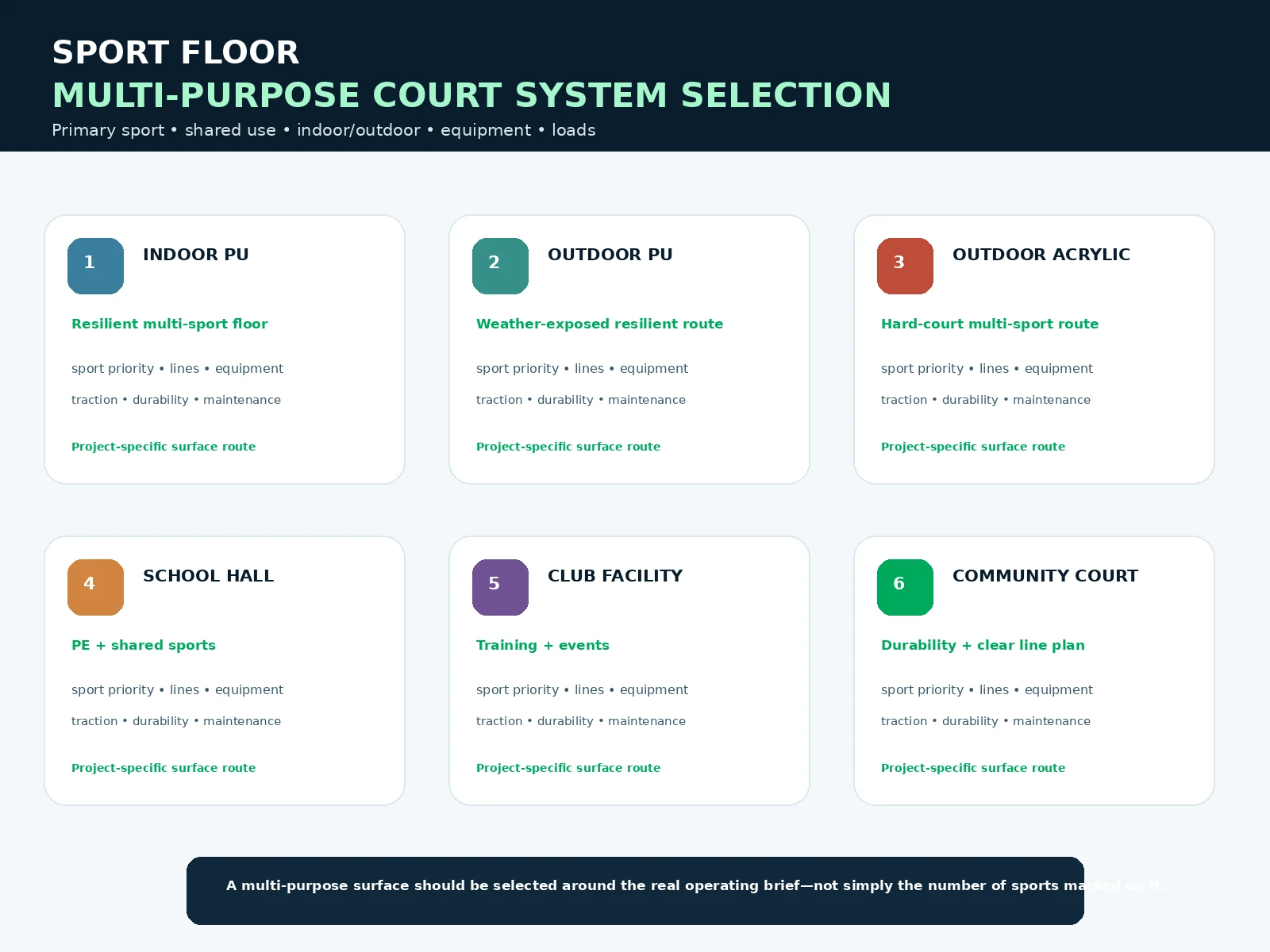
| Decision | PU resilient route | Acrylic hard-court route |
|---|---|---|
| Typical environment | Indoor halls and project-specific resilient outdoor courts. | Outdoor schools, community courts, clubs and residential hard courts. |
| Surface concept | Resilient polyurethane construction with system-specific elastic response. | Hard-court acrylic coating system over a stable concrete/asphalt base. |
| Primary reason to select | Project requires a resilient sports-floor system and documented response. | Project prioritizes firm hard-court performance, weather exposure and practical maintenance. |
| Equipment / loads | Must check resilience, indentation and rolling/point load behavior. | Must protect coating and base from anchors, concentrated loads and abrasion. |
| Outdoor water | Coordinate permeability or surface falls with base/drainage. | Coordinate court falls, drainage and ponding control. |
| Sport Floor route | PU Multi-Purpose Court System → | Acrylic Courts → |
A shared floor may need to support basketball ball response, volleyball traction and landing, handball movement, futsal training, physical education and temporary non-sport use.
Those demands can conflict. More resilience may improve one use while changing ball response or equipment behavior. A softer system may need additional protection from static or rolling loads. More texture can change traction and maintenance behavior.
That is why the exact performance target should be written into the project brief and confirmed against the selected complete system.
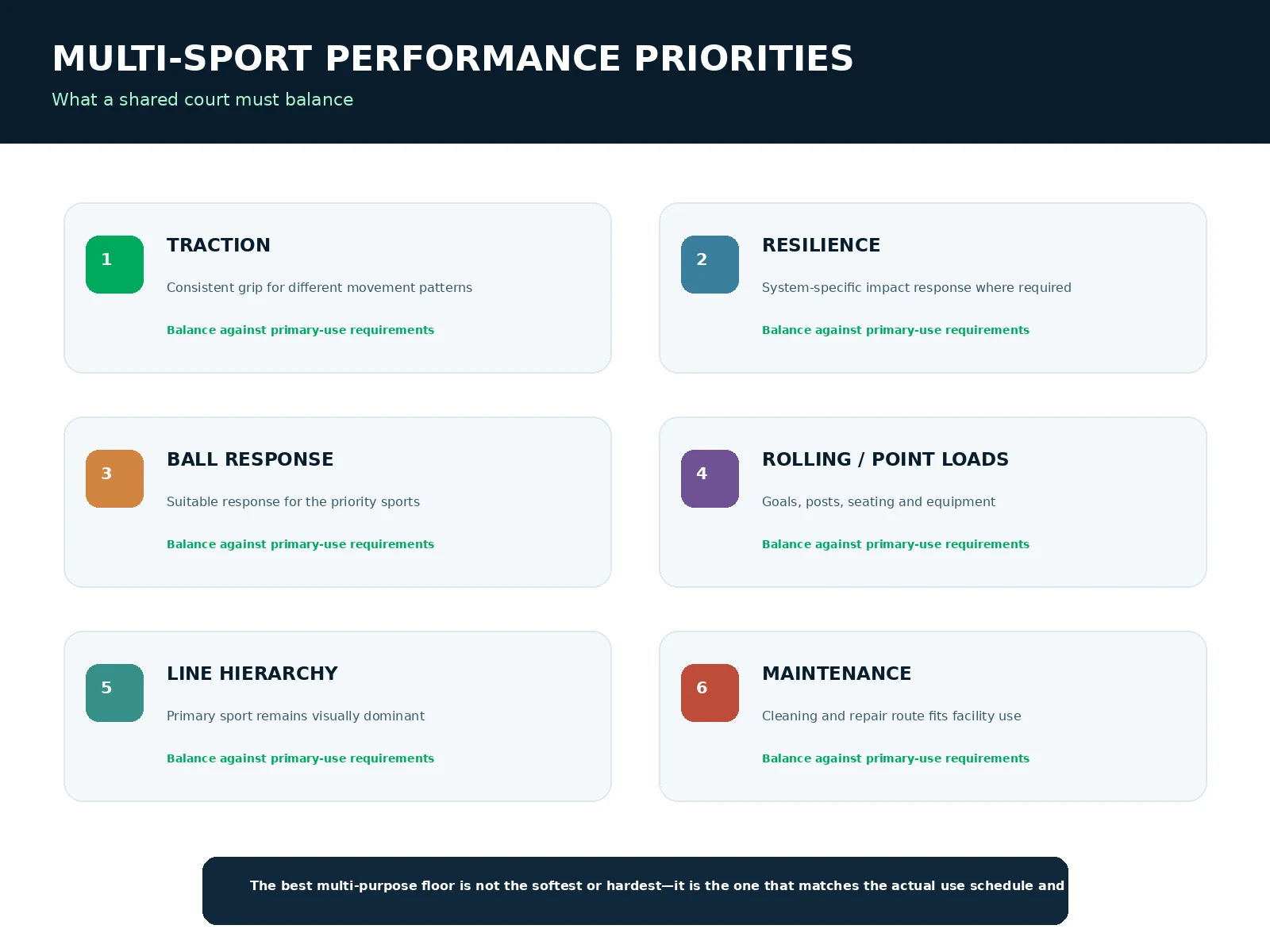
| Primary activity | Main floor priorities | Secondary coordination |
|---|---|---|
| Basketball | Ball rebound, traction, flatness, resilient response where required. | Coordinate volleyball/handball lines and equipment loads. |
| Volleyball | Traction, landing response, uniformity, post/socket integration. | Coordinate basketball bounce and shared line hierarchy. |
| Handball | Rapid-direction traction, resilience, goal-area wear, rolling loads. | Coordinate basketball/volleyball and movable goals. |
| School PE | Versatility, durability, practical maintenance and clear zoning. | Plan broad activity use rather than one federation-only specification. |
| Community Court | Durability, outdoor exposure, drainage and intuitive markings. | Often favors a separate acrylic hard-court route. |
| Events + Sport | Sports performance plus indentation, static load and rolling-load resistance. | Define seating, tables, stages, protection and access routes. |
| Layer / product family | Role in a compatible multi-purpose system | Sport Floor resource |
|---|---|---|
| Structural Base | Stable, level substrate capable of supporting the sports floor and facility loads. | Concrete / asphalt / approved existing base. |
| Primer | Creates the compatible interface between the accepted base and the following PU construction. | Indoor Primer / Outdoor Primer |
| Elastic Layer | Provides system-dependent resilient response where included in the selected floor. | PU Elastic Cushion Layer → |
| Rubberized PU Base | Project-specific resilient base where the approved system uses rubber and PU. | Rubberized PU Base → |
| Pore Sealer | Seals an open resilient layer before dense PU where required. | PU Pore Sealer → |
| Self-Leveling PU | Creates a dense seamless polyurethane layer in compatible systems. | Self-Leveling PU → |
| Top Coat | Provides the final indoor/outdoor texture, color and functional finish. | Indoor Matt / Outdoor UV Top Coat |
| Line Marking | Creates controlled multi-sport line colors over the accepted final surface. | PU Line Marking Paint → |
Sport Floor uses German raw materials within applicable polyurethane primers, binders, elastic layers and finishing formulations.
Sport Floor manufactures the polyurethane sports-flooring product family used in compatible multi-purpose systems.
Contractors can source compatible layers, current technical documents and project-dependent support through one coordinated route.
Global multi-use flooring specifications increasingly address not only athlete protection and sports performance but also static loads, rolling loads, indentation and non-sport uses such as ceremonies, meetings, seating and tables.
If a Sport Floor PU hall will also host events, identify chair loads, mobile seating, equipment carts, temporary staging and floor-protection requirements before the system is finalized.
Do not assume that a surface designed only for sports shoes automatically tolerates concentrated event loads without protection.
Use the clearest, most dominant line color for the main sport and preserve readability at game speed.
Select distinct but visually subordinate colors that do not obscure the primary court geometry.
Coordinate logos, keys, circles, goal areas and decorative zoning before final marking begins.
Fixed or mobile backstops can create structural, rolling and point-load requirements.
Socket locations, covers and anchoring should be coordinated before final surface layers.
Goal anchoring, movement and protection should be included in the project details.
Seating, tables, staging and maintenance equipment may require floor-protection measures.
Before pricing the floor, identify the primary sport, secondary activities, indoor/outdoor environment, total area, substrate, equipment, rolling loads, line plan, resilience requirements, maintenance expectations and supply scope.
Then choose the correct surface family: indoor PU, outdoor PU or acrylic hard court. Only after that should the project calculate products, quantities, packing, installation and testing.
This order prevents a common mistake: choosing a material first and forcing the facility to adapt around it.
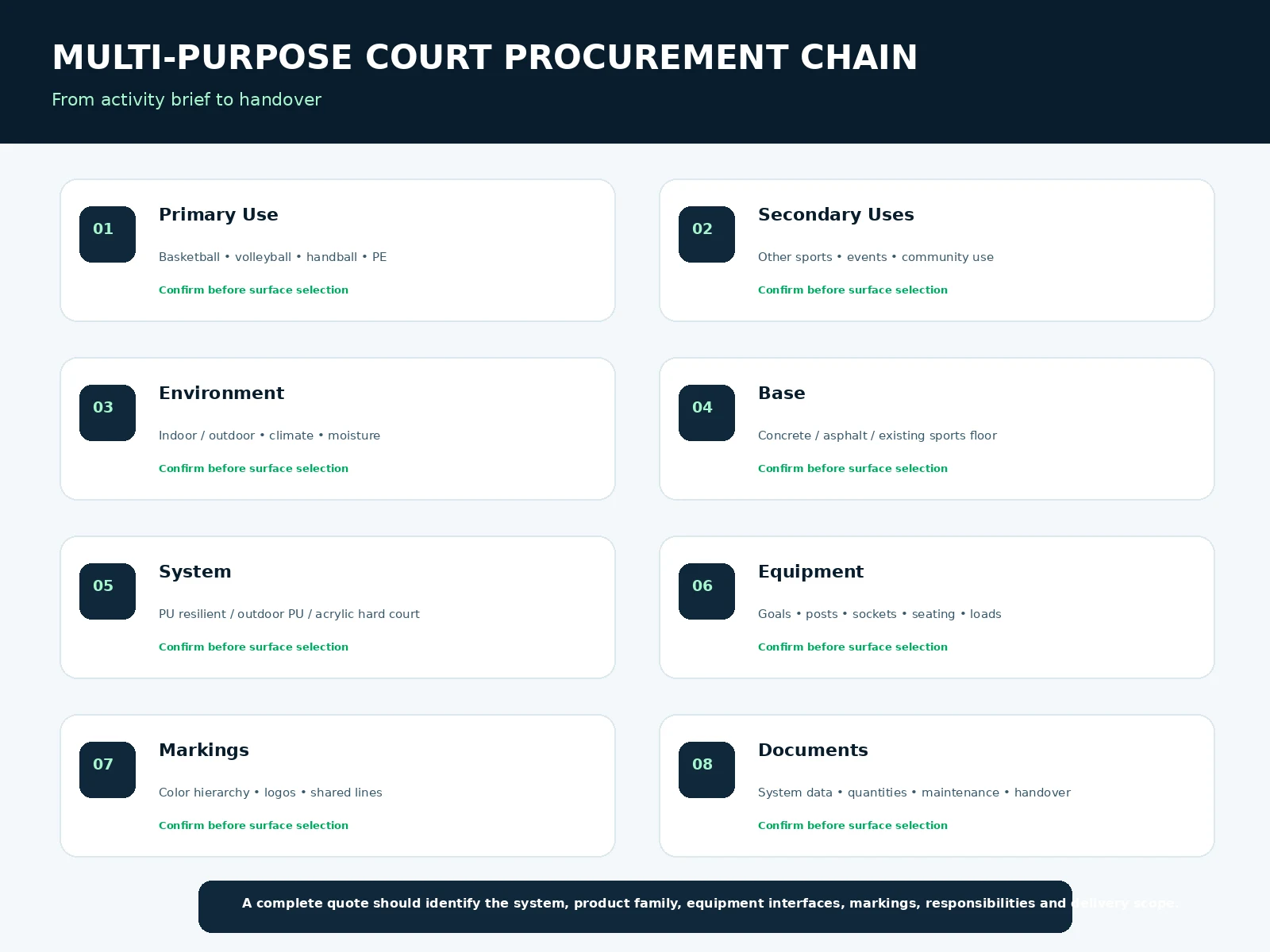
Indoor concrete: review curing, moisture, laitance, joints, cracks, planarity and primer compatibility before the PU system is selected.
Outdoor asphalt or concrete: check stability, levels, drainage, ponding, thermal movement and weather exposure before selecting PU or acrylic.
Existing sports floor: identify the old system and assess adhesion, moisture, cracks, movement and compatibility before any resurfacing proposal.
Do not use an expensive sports-floor layer to hide structural movement, failed drainage or major level defects.
Where specified, review force reduction, deformation, ball response, friction and other relevant performance evidence.
For true multi-use halls, define static, rolling and equipment loads and any floor-protection requirements.
Request the exact system build-up, current TDS/SDS, product schedule, installation method and maintenance guidance.
| Quotation item | What should be stated | Why it matters |
|---|---|---|
| Primary sport | Main activity and required performance priority. | Controls the first system decision. |
| Secondary uses | Other sports, PE, events, community use or temporary seating. | Controls versatility and load requirements. |
| Environment | Indoor or outdoor plus climate / building conditions. | Changes surface family and finishing route. |
| Surface family | PU resilient, outdoor PU or acrylic hard court. | Prevents non-equivalent quotations. |
| Base | Concrete, asphalt or existing floor plus condition. | Controls preparation, moisture and drainage scope. |
| Equipment | Goals, posts, sockets, seating, backstops and mobile loads. | Controls interfaces and protection. |
| Markings | Primary/secondary line hierarchy, colors and logos. | Controls usability and final finish. |
| Performance | Specified resilient, friction, load or ball-response requirements. | Controls exact system evidence. |
| Commercial scope | Materials, installation, supervision, civil work, testing and freight. | Makes competing offers comparable. |
Sport Floor can supply the approved PU or acrylic system materials to a qualified local contractor according to the agreed package.
System selection, material schedule, quantity planning and project-dependent installation guidance can be defined separately.
Project-dependent execution can include the agreed sports-floor work and broader construction responsibilities where expressly contracted.
State the dominant activity.
List all sports and non-sport uses.
Define building or climate exposure.
Send the full surfaced footprint.
Concrete, asphalt or existing sports floor.
List resilience, friction, ball or load requirements.
Goals, posts, seating, backstops and mobile loads.
Primary sport, secondary sports and logos.
Materials, support, installation or turnkey.
Country, city, delivery point and programme.
It is a shared sports surface designed around one primary activity plus defined secondary sports or facility uses. The correct system depends on the full operating brief.
Yes. PU can be used in resilient multi-sport systems where the complete system matches the required indoor/outdoor environment, sports performance and load conditions.
Yes. Acrylic is often a strong option for outdoor school, community and club hard courts that prioritize firm play, weather exposure and practical maintenance.
Neither is universally better. PU is appropriate where a resilient sports-floor route is required; acrylic is often preferable for outdoor hard-court applications. The primary use and environment should decide.
Yes, provided the complete floor performance, line hierarchy, equipment interfaces and primary sport are coordinated before installation.
Yes, but point loads, rolling loads, chairs, tables, stages and required floor protection should be part of the specification.
No. Too much or unsuitable resilience can affect ball response, movement and equipment behavior. Use the exact system performance required by the facility.
Use a clear primary line color and visually subordinate secondary sport colors, coordinated with logos and equipment zones.
Yes, with a compatible system after checking moisture, curing, joints, cracks, preparation and levels.
Outdoor PU or acrylic systems may use suitable asphalt when stability, levels, drainage and system compatibility are confirmed.
Potentially, after identifying the existing floor and checking adhesion, cracks, moisture, movement, levels and compatibility.
Yes. Sport Floor manufactures its polyurethane sports-flooring material family used in compatible systems.
Yes. German raw materials are used within applicable Sport Floor polyurethane formulations. This does not mean the finished products are manufactured in Germany.
Yes. Contractors, distributors and project buyers can request coordinated sports-floor material packages for international projects.
Send the primary sport, secondary uses, indoor/outdoor environment, total area, base, performance requirements, equipment, line plan, commercial scope and destination.
Send the primary sport, secondary uses, indoor/outdoor environment, total floor area, base, equipment loads, performance requirements, line plan, scope and destination. Sport Floor can recommend the correct PU or acrylic route and prepare the corresponding material or installation quotation.