
Schools
Durable seamless courts for physical education and repeated daily use, selected according to indoor/outdoor conditions and facility specification.
A basketball court surface must do more than look clean and colorful. It must provide a firm and level playing plane, consistent ball rebound, controlled traction, documented resilience where required, durable markings and a system appropriate for the facility's competition level, indoor or outdoor exposure and supporting base.
Sport Floor manufactures polyurethane sports-flooring materials for basketball and other court systems, including compatible primers, resilient layers, pore sealers, self-leveling PU, top coats and line-marking products. German raw materials are used within applicable Sport Floor PU formulations, giving contractors and project buyers a coordinated route from substrate preparation to finished court.
For international projects, Sport Floor can supply basketball-court material packages separately from locally executed civil works and installation, or define broader project scope according to the quotation.
Basketball combines acceleration, hard stops, jumps, pivots, lateral movement and repeated ball impact. The flooring therefore affects both player interaction and ball behavior.
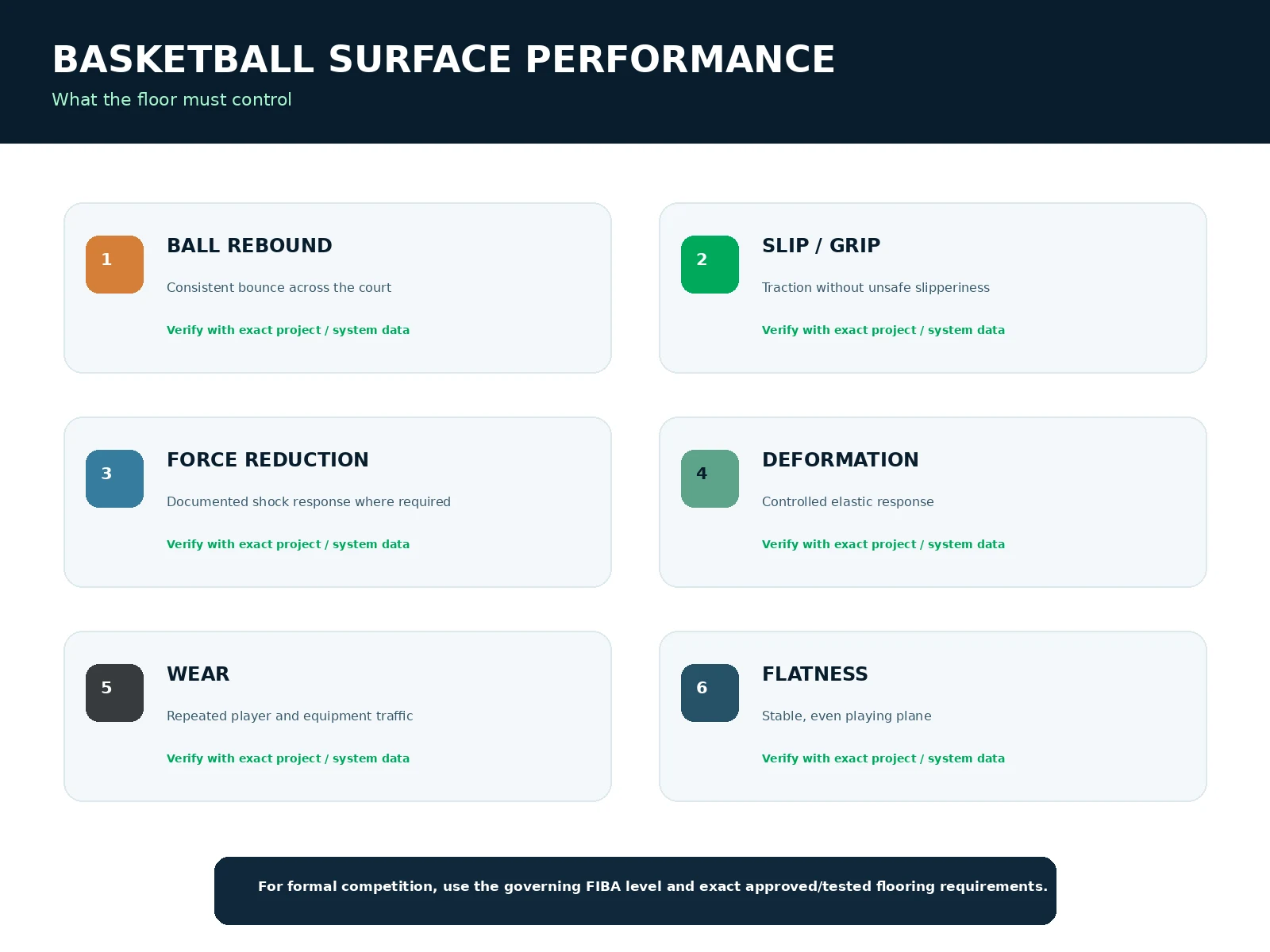
FIBA's venue guidance identifies a firm, level surface, consistent performance, resilience, shock absorbency and reliable ball bounce as key basketball-floor characteristics. For synthetic flooring, FIBA's Level 2 requirements address force reduction, vertical deformation, ball rebound, slip resistance, wear and rolling load.
Sport Floor therefore evaluates a PU basketball system as a complete performance build-up rather than a decorative coating.
Current FIBA venue guidance states that Level 1 competition must use FIBA Approved wooden or glass flooring. Synthetic flooring, including polyurethane systems, is recognized for Level 2 competition and other project-dependent facilities when the applicable technical requirements are satisfied.
For Level 2 synthetic floors, FIBA's published equipment rules include requirements for force reduction, vertical deformation, ball rebound, slip resistance, wear and rolling-load resistance. The manufacturer and flooring installer are also required to provide project documentation including prototype test results, installation procedure, maintenance advice and inspection information for the installed floor.
Therefore, Sport Floor should not describe every PU basketball court as “FIBA approved.” For a formal FIBA project, confirm the competition level, exact flooring product, current approval status and required test documentation before quotation.
Durable seamless courts for physical education and repeated daily use, selected according to indoor/outdoor conditions and facility specification.
Training floors where consistent response, traction, maintenance and long-term traffic are key project considerations.
Basketball can share the facility with volleyball, handball and other activities when line hierarchy and surface performance are planned together.
Weather-exposed systems require separate review of UV, wet traction, drainage, thermal movement and base condition.
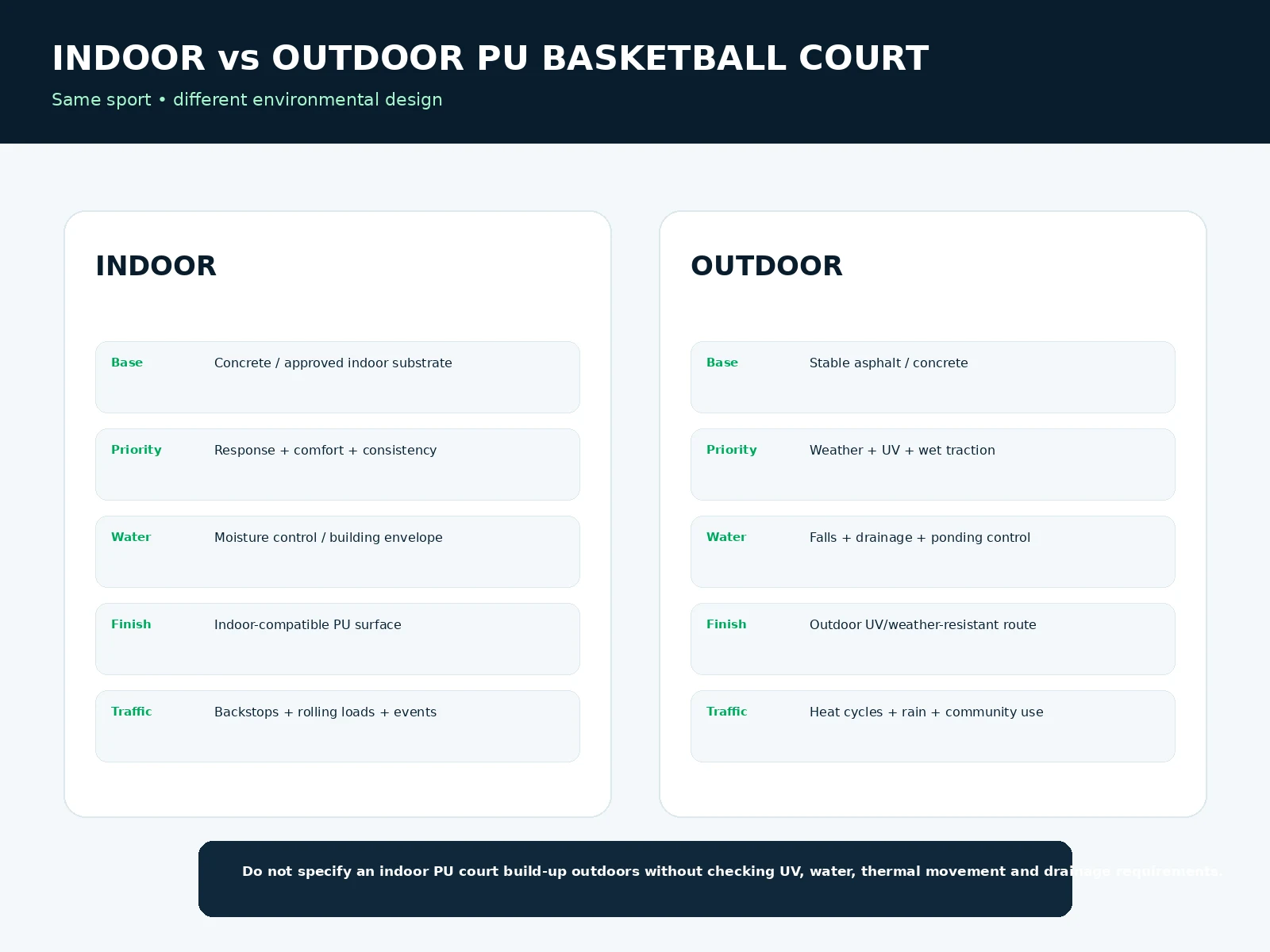
Indoor courts emphasize surface consistency, ball response, athlete comfort, rolling loads, humidity control and compatibility with the building substrate.
Outdoor courts must additionally address solar exposure, rain, wet-condition traction, drainage, temperature cycling and external contamination.
FIBA's outdoor guidance highlights UV weathering, wet slip resistance, dimensional stability and infiltration rate for approved outdoor products. It also stresses stable sub-base construction and drainage.
| Layer / function | What it does | Sport Floor resource |
|---|---|---|
| Structural base | Provides the firm, stable, level platform required by the complete sports floor. | Concrete / asphalt or approved substrate according to project. |
| Preparation | Removes contamination and weak material; repairs approved defects before PU work. | Project-specific base preparation. |
| Primer | Creates the compatible interface between substrate and the following PU system. | Indoor Primer / Outdoor Primer |
| Elastic / resilient layer | Provides system-dependent resilience and impact response where included. | PU Elastic Cushion Layer → |
| Pore sealing / transition | Controls an open resilient layer before dense polyurethane where the system requires it. | PU Pore Sealer → |
| Dense / self-leveling PU | Creates a seamless polyurethane structural/wearing layer in compatible court systems. | Self-Leveling PU → |
| Functional top coat | Provides the selected texture, appearance and indoor/outdoor surface finish. | Matt Anti-Slip / Outdoor UV Top Coat |
| Line marking | Creates the final basketball or multi-sport markings using a compatible coating. | PU Line Marking Paint → |
Sport Floor uses German raw materials within applicable polyurethane primers, binders, intermediate layers and finishing formulations.
Sport Floor manufactures its polyurethane sports-flooring material family, allowing the layer schedule to be coordinated instead of assembled from unrelated products.
Contractors can request the PU material package, technical documentation and project-dependent installation/support scope from one source.
A basketball court must be firm, stable and level. Local depressions can change ball response and, outdoors, create water ponding. High spots and abrupt transitions can also affect player movement and final PU thickness.
Concrete bases should be reviewed for curing, moisture, joints, laitance, contamination and structural movement. Asphalt bases should be checked for compaction, stability, smoothness, levels and compatibility with the selected PU system.
Do not use expensive polyurethane layers as a substitute for major civil levelling or structural repair. Correct the base before the sports-floor system is installed.
FIBA's outdoor venue guidance emphasizes stable ground and appropriate drainage. It notes that impermeable systems need controlled drainage and that outdoor basketball floors should remain flat rather than using crowns or envelope-shaped surfaces.
For an outdoor PU court, determine whether the proposed system is permeable or impermeable, then coordinate the base, falls, channels, outlet and surrounding runoff accordingly. Ponding should not be solved by increasing the PU thickness over low spots.
FIBA's venue guidance identifies a 28.0 m × 15.0 m inner playing area for a full-size court, with a surrounding boundary area and 50 mm court lines for the formal layout. Project design should use the current applicable FIBA rules and local governing requirements rather than copying dimensions from an old drawing.
Basketball line marking should be set out after the finished surface is accepted and the final court geometry is confirmed. For multi-sport halls, secondary sport markings should use a controlled hierarchy so that basketball lines remain clear.
Request the exact test result where ball-rebound performance is part of the project specification.
Use system-specific evidence where resilience or player-impact performance is required.
Confirm how the flooring responds under load through the applicable test method.
Traction should be documented for the relevant indoor or outdoor conditions where specified.
Review test evidence for repeated sporting traffic and the actual surface construction.
Indoor sports halls may need to accommodate mobile backstops and other rolling equipment without damaging the floor.
| Quotation item | What should be stated | Why it matters |
|---|---|---|
| Application | Indoor / outdoor, school / club / Level 2 synthetic or other specified use. | Controls the required system and documentation. |
| Base | Concrete, asphalt or existing sports surface plus preparation scope. | Changes primer, repairs, drainage and installation risk. |
| System build-up | Every primer, elastic layer, sealer, PU layer, top coat and marking product. | Prevents one-line “tartan” quotations. |
| Performance | Exact required test values and supporting reports where specified. | Allows technical comparison rather than marketing comparison. |
| Thickness | Approved system thickness and layer distribution. | Controls material quantities and response. |
| Markings | Basketball only or multi-sport plan, colors and logos. | Affects line-marking scope. |
| Equipment interfaces | Backstops, sockets, posts, covers or floor-protection requirements. | Protects the finished sports floor from concentrated loads and damage. |
| Commercial scope | Materials only, installation, supervision, civil work, testing and freight. | Makes competing quotations comparable. |
Supply the approved Sport Floor PU system materials to the buyer's qualified local contractor with agreed technical documentation.
Coordinate system selection, current product data, material quantities and project-dependent technical support.
Project-dependent execution can include the agreed synthetic-surface work and broader construction responsibilities where contracted.
School, recreation, training, club, formal competition or other defined use.
Confirm building environment or outdoor climate and weather exposure.
Provide court dimensions and total surface area, including surrounds where applicable.
Concrete, asphalt or existing sports floor plus condition and moisture information.
Provide specified force reduction, rebound, slip, deformation or approval requirements.
Basketball only, multi-sport lines, colors, logos and equipment locations.
Materials only, technical support, installation or full project execution.
Country, city, delivery point and required procurement programme.
It is a commercial term for a synthetic basketball surface that may use polyurethane and resilient layers over a prepared base. The exact construction must be defined by the selected system.
Yes, polyurethane is one of the synthetic flooring categories recognized in FIBA guidance for Level 2 flooring, subject to the exact system and required performance.
Current FIBA venue guidance states that Level 1 competition must use FIBA Approved wooden or glass flooring. Do not present a generic PU court as a Level 1 approved alternative.
FIBA publishes performance requirements addressing force reduction, vertical deformation, ball rebound, slip resistance, wear and rolling load for synthetic Level 2 flooring.
Do not assume so. Outdoor systems must address UV, rain, drainage, wet-condition traction and thermal movement, while indoor systems have different environmental and usage priorities.
Project-dependent systems may use suitable concrete or asphalt. The base must be stable, level, correctly prepared and compatible with the selected primer/system.
Drainage depends on whether the selected surface is permeable or impermeable, the base construction, designed falls and the channel/outlet arrangement.
Where shock or resilience performance is specified, use a documented flooring system with applicable test evidence rather than assuming performance from material thickness alone.
Basketball needs consistent response across the playing area. FIBA's Level 2 synthetic-floor requirements include ball-rebound performance and uniformity.
Yes, but the primary sport, secondary sports, line hierarchy, equipment and required performance should be coordinated before the floor is selected.
Potentially, after identifying the existing material and checking adhesion, cracks, base movement, moisture, drainage, levels and compatibility.
Yes. Sport Floor manufactures its polyurethane sports-flooring material family used in compatible court systems.
Yes. German raw materials are used within applicable Sport Floor polyurethane formulations. This does not mean the products are manufactured in Germany.
Yes. Contractors, distributors and project buyers can request coordinated PU sports-flooring material packages for international projects.
Provide playing level, indoor/outdoor use, area, drawings, base condition, performance requirements, markings, commercial scope, destination and required delivery programme.
Send the playing level, indoor/outdoor condition, court area, base, performance requirements, line plan, project scope and destination. Sport Floor can recommend the appropriate PU route and prepare a coordinated material or installation quotation.