
School Sports Hall
Shared-use PU flooring selected for physical education, handball and other indoor sports with durable line-marking and practical maintenance.
Handball is a fast, high-load indoor sport built around acceleration, sudden stopping, jumping, landing, body contact and repeated movement through the goal areas. The flooring must therefore be selected as a complete resilient sports-floor system—not as a generic acrylic paint or a decorative “tartan” coating.
Sport Floor manufactures polyurethane sports-flooring materials for compatible handball and multi-sport systems, including primers, elastic layers, pore sealers, self-leveling PU, top coats and line-marking products. German raw materials are used within applicable Sport Floor polyurethane formulations, providing a coordinated manufacturer-direct material route.
For formal IHF projects, approval belongs to the exact tested floor product and its documented scope. For schools, clubs, academies and multi-purpose halls, Sport Floor can support material supply, system selection and project-dependent installation according to the required performance and commercial scope.
Indoor handball: the professional market is dominated by resilient sports-floor systems such as polyurethane, vinyl/PVC, rubber and other approved elastic constructions. The IHF maintains dedicated Floor Regulations and a Seal of Approval programme for identified flooring products.
Outdoor recreational handball: an acrylic hard-court system can be a practical option where the project prioritizes weather resistance, simple maintenance and a firmer surface rather than an indoor-style resilient floor.
This page therefore remains focused on PU/resilient handball flooring. Sport Floor's acrylic systems should be evaluated separately for outdoor school and community hard courts.
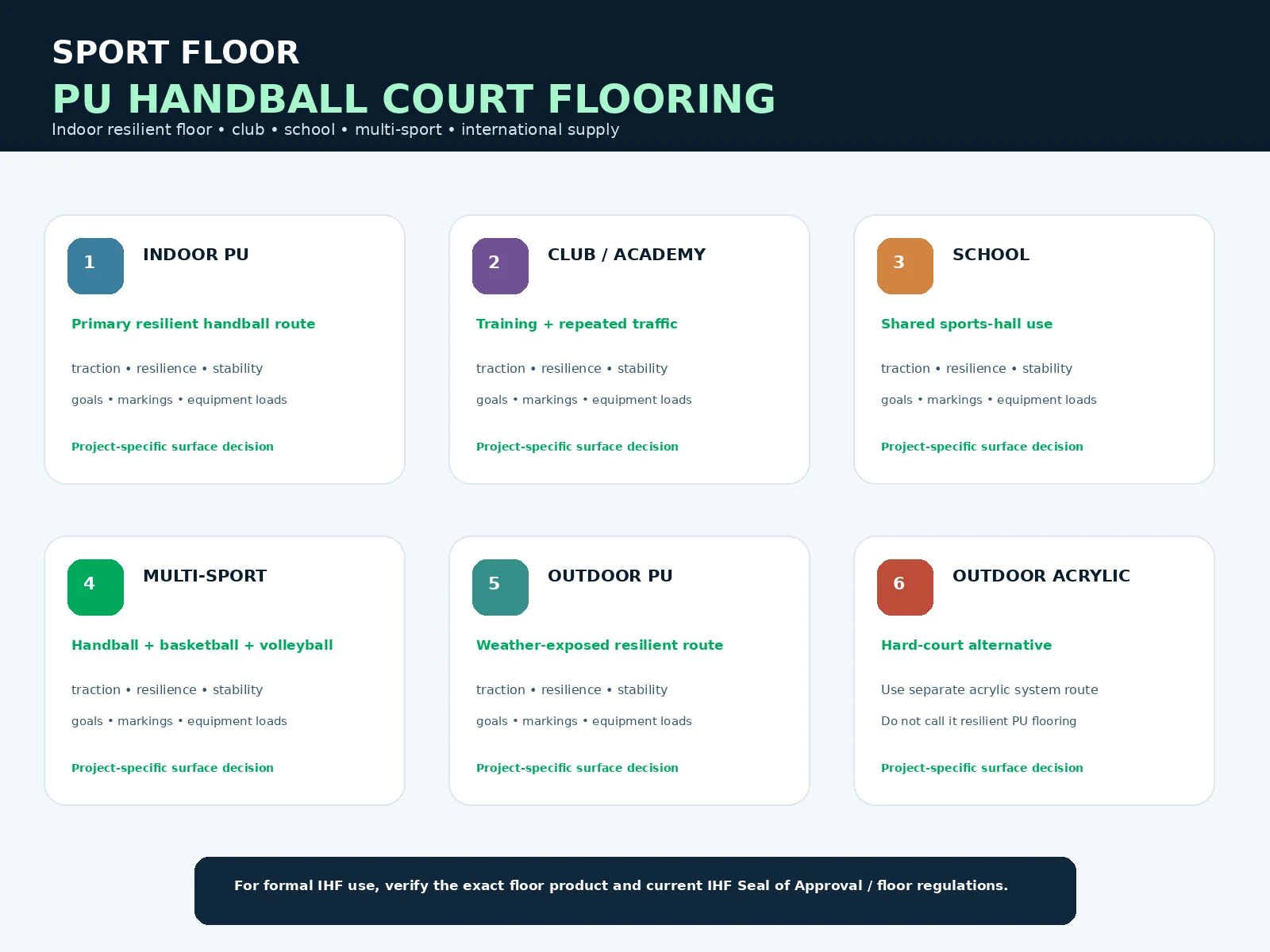
The International Handball Federation maintains dedicated Floor Regulations that define criteria for handball floors and a separate Seal of Approval programme for products that have completed the applicable assessment process.
This is commercially important. A quotation should not describe a generic polyurethane floor, vinyl floor or rubber floor as “IHF approved” unless the exact offered product is listed with the appropriate current evidence.
For formal competition projects, confirm the exact floor manufacturer, product name, approval status, required performance classification and current IHF documentation before the order is placed.
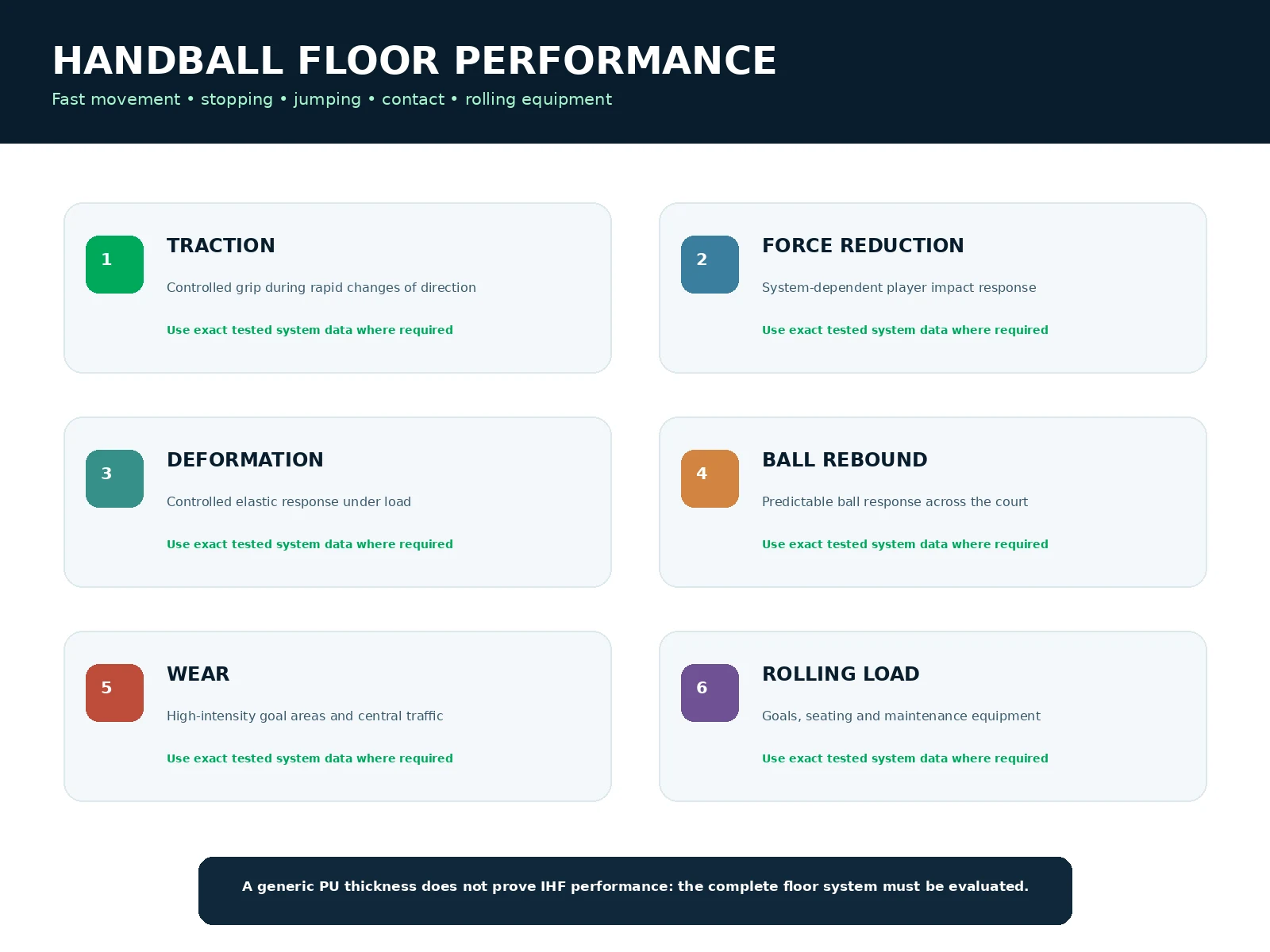
Handball produces rapid changes of direction, hard deceleration, jumping and landing around the entire floor. Goal areas receive particularly concentrated traffic, while movable goals, seating and maintenance equipment can introduce rolling or point loads.
The IHF floor framework evaluates floor performance rather than relying on total thickness alone. Relevant project criteria can include force reduction, vertical deformation, ball rebound, friction, resistance to wear and rolling-load behavior.
A thicker floor is not automatically a better handball floor. Performance depends on the complete layer architecture, material properties and test classification.
Shared-use PU flooring selected for physical education, handball and other indoor sports with durable line-marking and practical maintenance.
Repeated training use with greater emphasis on traction consistency, resilience, goal-area wear and equipment traffic.
Handball coordinated with basketball, volleyball and other sports through one approved performance and line hierarchy.
Project requiring confirmation of the applicable IHF rules, approved floor product, equipment and acceptance documentation.
The standard indoor handball playing court is 40 m long and 20 m wide. Project planning must also include the required safety space outside the playing rectangle, goal structures, substitution/team areas, scorer/timekeeper interfaces, access and any event-specific operational zones.
Material quantities should therefore be calculated from the actual surfaced area—not automatically from 800 m². If the PU floor extends through the surrounding safety zone or the entire sports hall, that full area belongs in the material schedule.
Coordinate the selected goal model, anchors and structural fixing so floor penetrations do not become last-minute details.
Movable goals, seating and maintenance equipment may require load-spreading protection to prevent permanent indentation or surface damage.
Do not describe goals as IHF approved unless the exact supplied model carries the applicable current approval evidence.
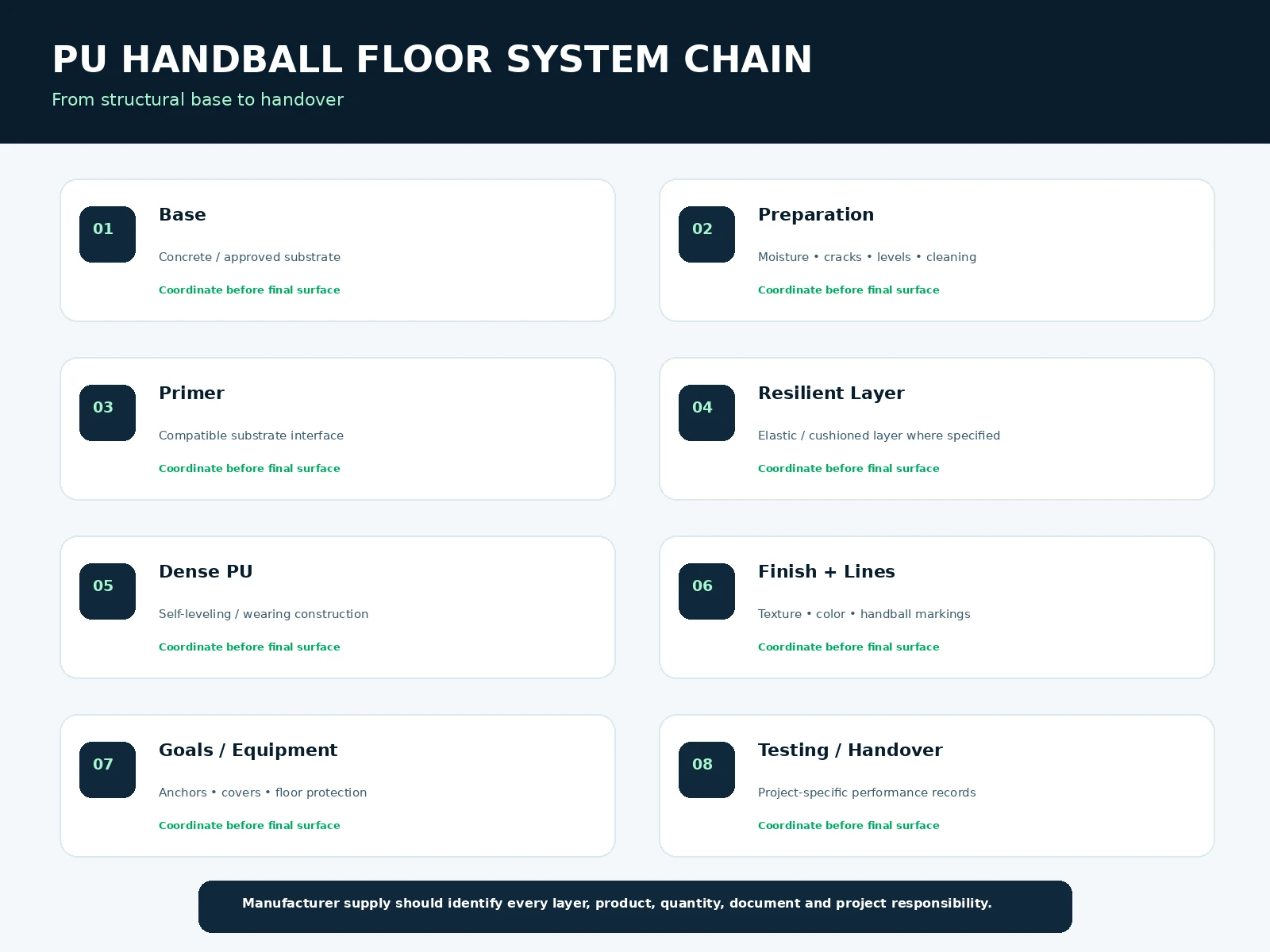
The exact construction depends on the substrate and performance target. A compatible system may include concrete preparation, primer, a resilient layer, pore sealing, dense or self-leveling polyurethane, a functional top coat and compatible handball markings.
Not every handball floor uses SBR, EPDM or every Sport Floor PU product. Each layer must be included because it belongs to the approved construction—not because it appears in a generic bill of materials.
| Layer / product family | Role in a compatible handball system | Sport Floor resource |
|---|---|---|
| Indoor PU Primer | Creates the compatible bond between the accepted indoor substrate and the following PU layers. | PU Primer Indoor → |
| Moisture Barrier Primer | Project-specific moisture-management route where confirmed by substrate assessment and product specification. | PU Moisture Barrier Primer → |
| Elastic Cushion Layer | Provides system-dependent resilient response where the selected floor architecture includes an elastic PU layer. | PU Elastic Cushion Layer → |
| Rubberized PU Base | Project-dependent resilient base route where rubber and PU are part of the approved construction. | Rubberized PU Base Layer → |
| Pore Sealer | Seals an open resilient layer before dense PU where required by the selected system. | PU Pore Sealer → |
| Self-Leveling PU | Creates a seamless dense polyurethane layer in compatible indoor sports-floor systems. | PU Self-Leveling Compound → |
| Matt Anti-Slip Top Coat | Provides the selected final texture and finish for compatible indoor PU floors. | PU Matt Anti-Slip Top Coat → |
| Line Marking | Creates the approved handball and multi-sport markings using compatible PU line paint. | PU Line Marking Paint → |
Sport Floor uses German raw materials within applicable polyurethane primers, binders, elastic layers and finishing formulations.
Sport Floor manufactures the polyurethane sports-flooring family used in compatible handball and multi-purpose court systems.
Contractors can source coordinated primers, resilient layers, dense PU, finish and line-marking materials with project documentation from one manufacturer-direct route.
Concrete should be assessed for curing, moisture, contamination, laitance, cracks, joints, planarity and structural movement before the primer is selected. A dense seamless PU finish can trap or react to moisture problems that should have been resolved below the sports floor.
Major levelling defects should be corrected with the appropriate civil/floor-preparation route rather than hidden through excessive PU material. The final floor should be installed only after the substrate is technically accepted.
For an existing hall, identify the old flooring and adhesive system before proposing resurfacing. Compatibility cannot be assumed from appearance alone.
Schools and clubs often combine handball with basketball, volleyball, futsal, physical education and community events. The floor therefore needs a clear primary-use hierarchy covering performance, line colors, rolling loads, seating, equipment movement and maintenance.
A multi-purpose PU floor should not be designed by simply adding more line colors. Surface response and operational loading must also work for the intended sports.
| Decision | Outdoor PU route | Outdoor acrylic route |
|---|---|---|
| Surface concept | Polyurethane sports-court construction with project-specific resilient / coating architecture. | Hard-court acrylic coating system over a suitable base. |
| Primary reason to select | Project wants a PU-based surface and its documented system characteristics. | School/community project prioritizes practical hard-court use and acrylic maintenance route. |
| UV / weather | Use an outdoor-compatible PU system and UV-resistant finish where specified. | Use the defined Sport Floor outdoor acrylic court system. |
| Drainage | Coordinate permeability or surface falls with base and outlets. | Coordinate court falls, base and drainage with the acrylic system. |
| Internal Sport Floor page | PU Outdoor Sports Court → | Acrylic Courts → |
Do not use an outdoor acrylic court as evidence of IHF indoor floor performance. These are different project routes with different testing, resilience and commercial expectations.
Where required, confirm the tested value and floor classification for the exact complete system.
Review system-specific deformation rather than assuming it from foam or PU thickness.
Use applicable test evidence where ball response is part of the handball-floor specification.
Traction should be verified for the exact finished surface and intended indoor/outdoor condition.
Match wear evidence to the exact floor type and expected goal-area traffic.
Consider mobile goals, seating and maintenance loads when selecting the complete sports floor.
| Quotation item | What should be stated | Why it matters |
|---|---|---|
| Facility type | School, club, academy, multi-sport hall or formal competition. | Determines performance and approval route. |
| Surface family | Indoor PU/resilient, outdoor PU or separate outdoor acrylic route. | Prevents comparison of fundamentally different floors. |
| Total area | Playing rectangle plus all safety and surrounding surfaced areas. | Controls material quantity and price. |
| Base | Concrete, existing sports floor, asphalt for outdoor use, condition and moisture. | Changes preparation, primer and installation risk. |
| Floor classification | Project-required elastic floor category and applicable test standard where specified. | Controls the complete resilient architecture. |
| System build-up | Every primer, resilient layer, sealer, PU layer, top coat and marking material. | Prevents generic “tartan” quotations. |
| Equipment | Goals, anchors, protective interfaces, seating and mobile equipment. | Controls local structural and load details. |
| Approval / testing | Exact current IHF or consultant requirements and supporting documents. | Prevents unsupported approval claims. |
| Commercial scope | Materials, installation, supervision, testing, civil works and freight. | Makes competing offers comparable. |
Supply the approved Sport Floor PU material package to a qualified local contractor with the agreed current technical documents.
Coordinate system selection, product schedule, material quantities and project-dependent installation guidance.
Project-dependent execution can include the agreed synthetic flooring and broader construction responsibilities where expressly contracted.
School, training, club, national or formal IHF-level requirement.
Confirm sports hall conditions or external climate exposure.
Provide the full surfaced plan, not only the 40 × 20 m playing rectangle.
Concrete, existing floor or outdoor asphalt plus condition and moisture information.
State required IHF, consultant or project-specific floor performance and tests.
Goals, anchors, seating, protection and other rolling/mobile loads.
Materials only, technical support, installation or broader construction work.
Country, city, delivery point and required procurement programme.
“Tartan” is a broad market term. For handball, the more technically useful description is the exact sports-floor family: resilient PU, vinyl/PVC, rubber, wood or another approved system.
No. Indoor professional handball generally uses resilient indoor sports-floor systems. Acrylic is better treated as a separate outdoor hard-court option for project-specific recreational or school facilities.
Yes. PU is an established resilient sports-floor technology for compatible indoor and multi-purpose halls, subject to the exact system performance and project requirements.
No. The IHF Seal of Approval applies to identified floor products that meet the federation's applicable regulations and approval process.
The standard indoor playing rectangle is 40 m × 20 m. Total flooring area can be larger because safety and surrounding operational areas must be included.
Project requirements can include force reduction, vertical deformation, ball rebound, friction, wear and rolling-load behavior.
No. Performance depends on the full floor architecture and material properties. Use test evidence for the exact system.
Do not assume so. Outdoor PU requires specific review of UV, rain, drainage, wet traction and thermal movement.
Yes, an outdoor school/community project may use a suitable acrylic hard-court system. It should be specified and evaluated separately from an indoor resilient PU floor.
A suitable concrete or other approved substrate may be used when moisture, cracks, joints, levels, preparation and primer compatibility are correctly addressed.
Movable goals, seating and maintenance equipment can create concentrated or rolling loads that the selected sports floor must tolerate or be protected against.
Yes. The surface, line hierarchy and equipment should be selected around the actual sports and operating loads of the facility.
Yes. Sport Floor manufactures its polyurethane sports-flooring material family used in compatible systems.
Yes. German raw materials are used within applicable Sport Floor polyurethane formulations. This does not mean the finished products are manufactured in Germany.
Yes. Contractors, distributors and project buyers can request coordinated Sport Floor PU sports-flooring material packages for international projects.
Send the playing level, full surfaced area, indoor/outdoor environment, base, performance requirements, equipment loads, line plan, project scope and destination. Sport Floor can recommend the appropriate PU route—or direct an outdoor hard-court project to the correct acrylic system.