
Non-Porous Systems
Full PU and classic Sandwich routes commonly rely on accurate surface falls, planarity, channels and reliable outlets.
A professional tartan running track is a complete synthetic athletics system—not simply a colored polyurethane layer. The final track depends on engineered geometry, supporting base, drainage, the selected Full PU, Sandwich or Spray Coat build-up, compatible PU/EPDM/SBR materials, line marking and project-specific testing.
Sport Floor manufactures its own polyurethane sports-flooring materials and uses them across compatible athletics-track systems. German raw materials are used within applicable Sport Floor PU formulations, allowing primers, binders, intermediate PU layers and finishing materials to be coordinated as one technical family.
Sport Floor supports new tracks, resurfacing, material-only supply and project execution according to scope. For international projects, the synthetic material package can be supplied separately from locally executed earthworks, drainage and asphalt/concrete construction.
A tartan running track is a synthetic athletics surface commonly formed from polyurethane and rubber-based layers over an engineered supporting base. Depending on the project, the system may be Full PU, Sandwich, Spray Coat, prefabricated or another defined athletics construction.
The visible red, blue or other colored finish does not tell you what lies beneath it. Surface permeability, layer thickness distribution, PU material intensity, rubber content, drainage strategy and maintenance route can all differ.
The correct specification therefore identifies the system family, each layer, substrate, drainage, current material references and required tests—not simply “tartan track per square metre.”
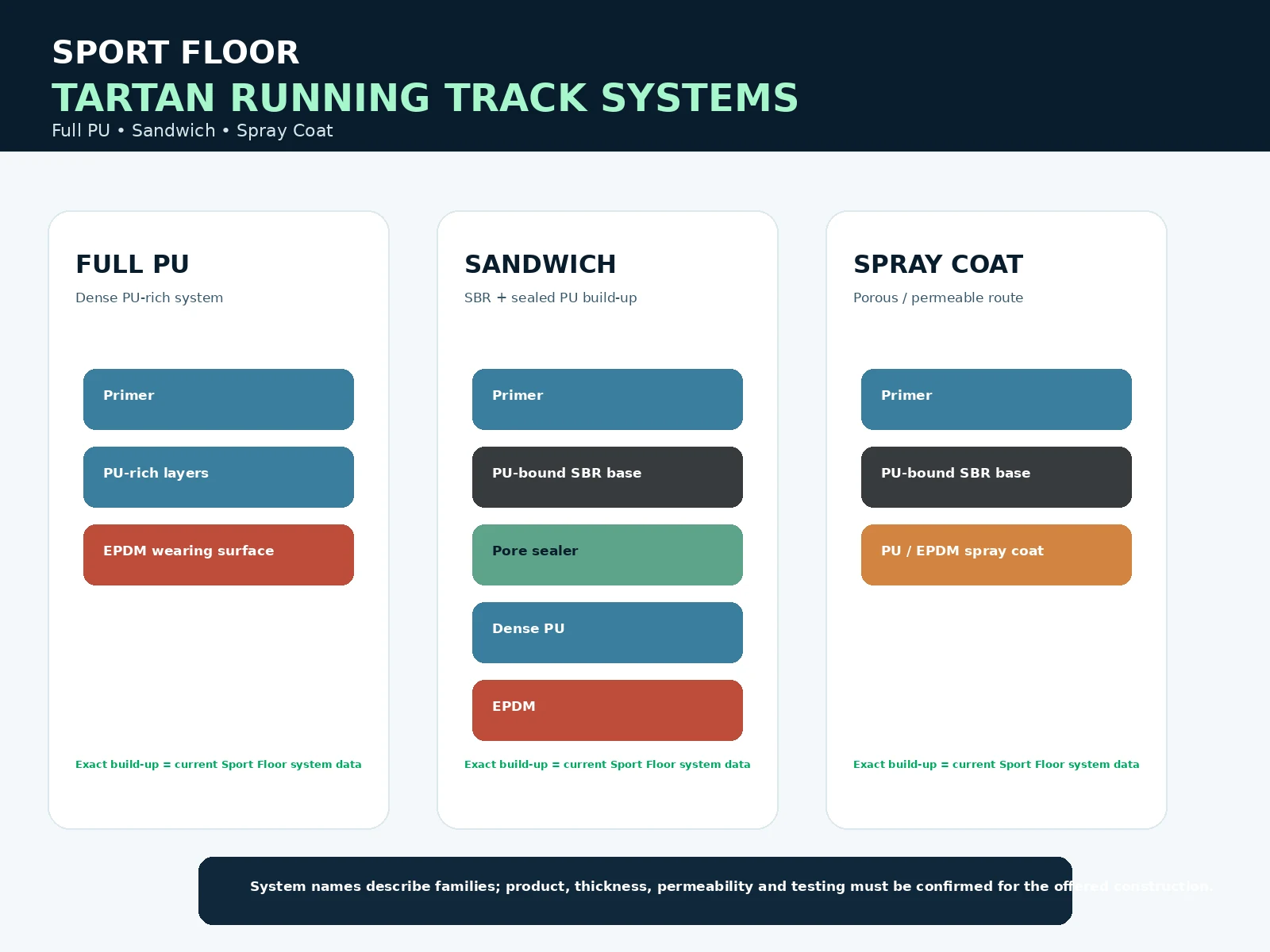
| Decision point | Full PU | Sandwich | Spray Coat |
|---|---|---|---|
| System character | Dense PU-rich track construction. | Resilient rubber base with sealed dense upper PU build-up. | Material-efficient resilient base with sprayed wearing coat. |
| Typical permeability | Commonly non-porous. | Commonly non-porous upper construction. | Classic system commonly permeable. |
| Main material emphasis | Higher PU material intensity. | SBR + binder + pore sealer + dense PU + EPDM. | SBR + binder + spray PU/fine EPDM. |
| Water-management priority | Surface falls, channels and outlets. | Surface drainage plus protection of resilient layers. | Surface permeability plus compatible base/sub-base drainage. |
| Typical commercial position | Premium/high-performance route. | Balanced performance and material architecture. | Cost-conscious training/school/community route where specification permits. |
| Detailed comparison | Compare Full PU vs Sandwich vs Spray Coat → | ||
International manufacturers such as CONICA, Polytan and STOCKMEIER separate athletics tracks into distinct system families with different layer sequences, permeability and performance positioning. STOCKMEIER, for example, differentiates Full Pour, Sandwich and Spray Coat through their primer, SBR, pore-sealer, self-leveling PU and EPDM/spray layers. CONICA also separates Full PUR, Sandwich, Spray Coat and renovation systems for athletics facilities.
Sport Floor follows the same professional system logic while differentiating its own offering through manufacturer-direct PU supply, German raw materials within applicable formulations, system-specific technical guidance and the ability to supply contractors and project buyers internationally.
Before polyurethane installation, the project must resolve track geometry, earthworks, subgrade, sub-base, asphalt/concrete construction, drainage and substrate acceptance. The synthetic system is a performance surface—not a structural repair layer.
Low spots create ponding. Settlement can reflect through the surface. Active cracks can reappear. Residual or rising moisture can affect adhesion. Poor asphalt or weak concrete can compromise the primer interface.
Sport Floor therefore separates civil engineering from surface material specification while coordinating the two technically.
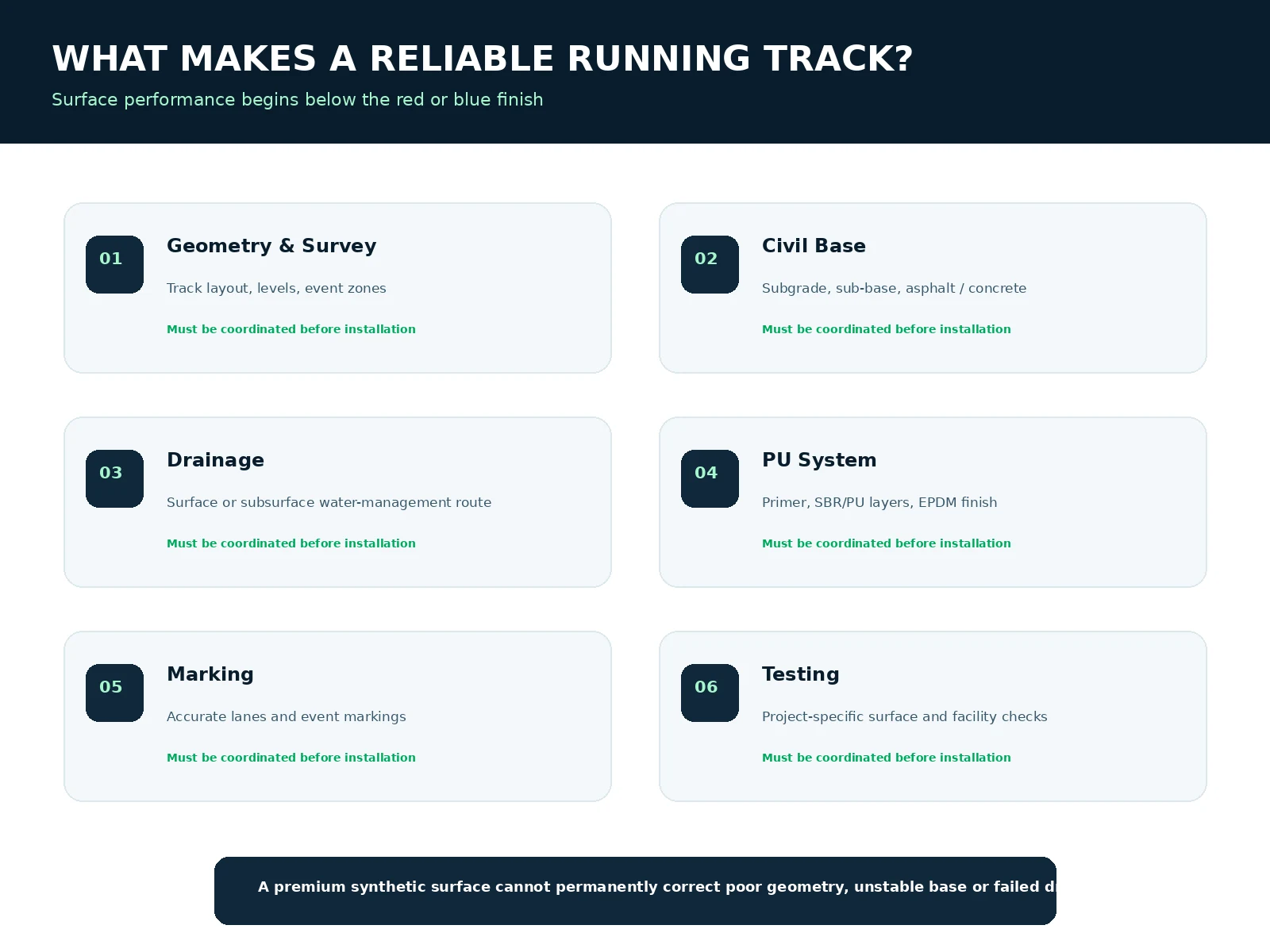
Full PU and classic Sandwich routes commonly rely on accurate surface falls, planarity, channels and reliable outlets.
Water passing through a Spray Coat surface still needs a compatible base, sub-base and final drainage route.
Drainage performance should be checked on the completed facility rather than assumed from drawings alone.
World Athletics currently publishes separate lists for Certified Track Surfacing Products and Certified Athletics Facilities. Its certified-product list identifies the company, product, system description, absolute thickness and certification number for each approved surface.
This means that Full PUR, Sandwich or Spray Coat is a system description—not a certificate by itself. A Sport Floor quotation should only claim World Athletics product certification where the exact offered product is supported by current documentation. Facility certification is a separate scope involving the completed athletics venue.
For competition projects, define the required certification level, testing, geometry, marking and accredited-laboratory scope before tender comparison.
Two track systems can have similar overall thickness while distributing that thickness through very different materials. One may contain more PU, another more PU-bound SBR, another a porous resilient layer plus spray coating.
World Athletics' certified-product list itself contains Full PUR, Sandwich and Spray Coat products at different absolute thicknesses, confirming that there is no single universal “tartan thickness” that defines every certified system.
| Material family | Track role | Sport Floor resource |
|---|---|---|
| PU Primer | Creates the compatible interface with the accepted asphalt/concrete substrate. | PU Primer Outdoor → |
| PU Binder | Binds SBR/EPDM granules in resilient layers and compatible rubber constructions. | PU Binder → |
| SBR / Rubber Granules | Common resilient-base material in Sandwich and Spray Coat routes. | Rubber Granules → |
| EPDM Granules | Common colored wearing-surface material in compatible systems. | EPDM Granules → |
| Pore Sealer | Controls an open resilient base before dense upper PU in Sandwich construction. | PU Pore Sealer → |
| Dense / Self-Leveling PU | Forms dense elastic structural/wearing layers in compatible track systems. | PU Self-Leveling Compound → |
| Line Marking | Provides final lane/event markings over the completed surface. | PU Line Marking Paint → |
| Complete Material Hub | Review the full coordinated PU, EPDM and SBR material family. | Tartan Materials → |
Sport Floor uses German raw materials within applicable polyurethane primers, binders, intermediate layers and finishing formulations.
Sport Floor manufactures the PU material family used across compatible sports-surface and running-track systems.
Contractors can source coordinated primer, PU binder, SBR, EPDM, pore sealer, dense PU and marking materials from one manufacturer-direct route.
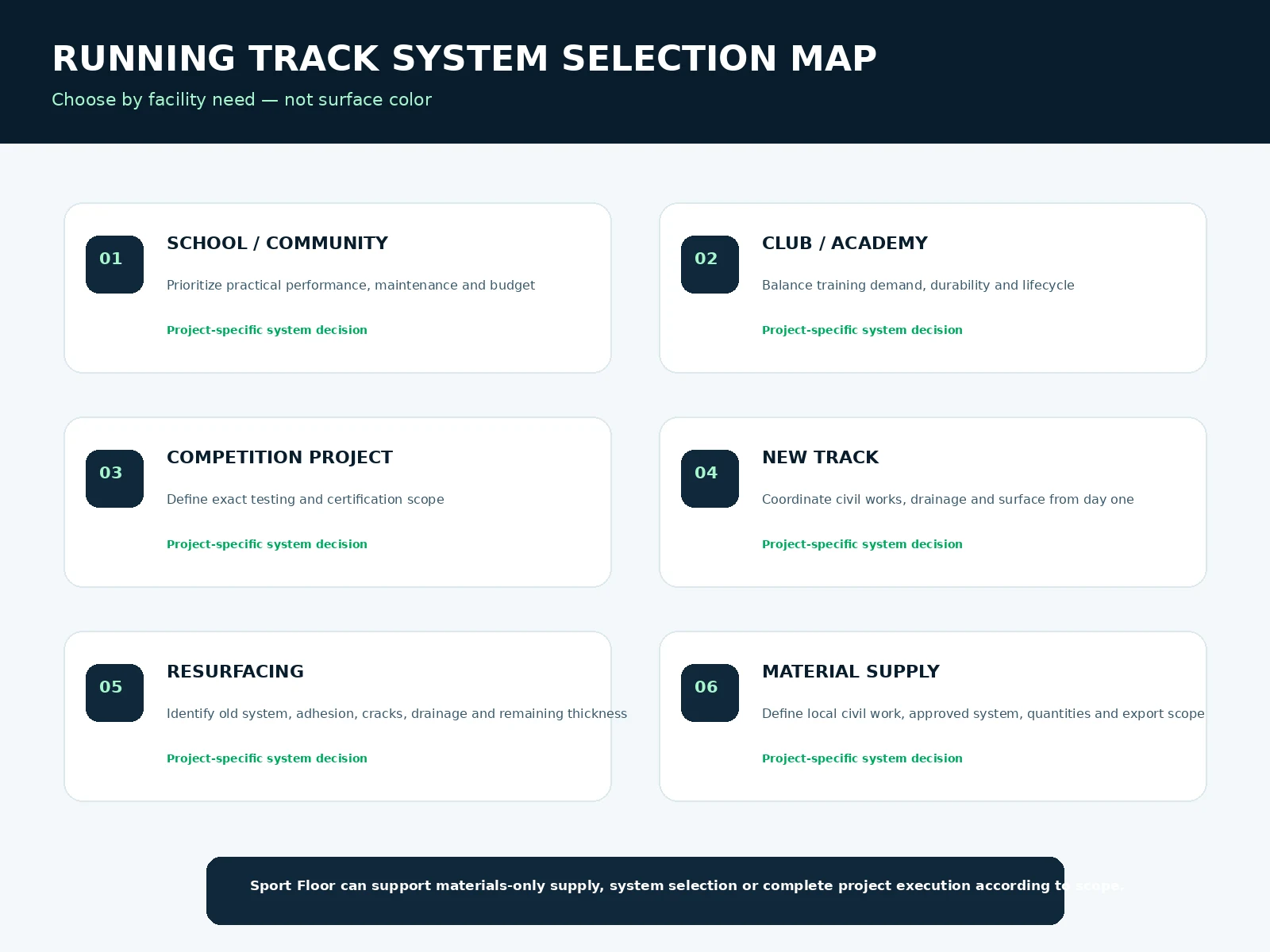
School/community tracks: prioritize practical system selection, maintenance, budget and safe long-term operation.
Club/academy tracks: balance frequent training use, durability, repairability and lifecycle planning.
Competition projects: define exact testing and certification requirements before product selection.
New tracks: coordinate earthworks, drainage, base and surface from the beginning.
Resurfacing: identify the existing system, remaining thickness, adhesion, cracks, drainage and geometry before choosing an overlay.
International material supply: separate locally executed civil works from the Sport Floor synthetic material package.
| Condition | New track | Existing track / resurfacing |
|---|---|---|
| Base | Construct and accept before surfacing. | Check settlement, cracks, moisture and previous repairs. |
| Drainage | Design as part of civil works. | Inspect ponding, blocked channels and subsurface water issues. |
| Existing system | Not applicable. | Identify Full PU, Sandwich, Spray Coat, prefabricated or other surface. |
| Adhesion | Primer/substrate compatibility. | Check existing-surface bond and delamination. |
| Remaining thickness | Use approved new system build-up. | Measure where relevant before defining overlay. |
| Repair route | Correct construction defects before PU. | Local repair, retopping, resurfacing or reconstruction based on condition. |
Verify the installed surface according to the applicable project/testing method.
Use project-specific test requirements where resilience performance is specified.
Evaluate elastic response where required by the governing specification.
Confirm surface traction through the applicable test method where required.
Check local surface regularity and defects after installation.
Verify real water behavior on the finished facility where applicable.
Confirm geometry, lane layout and event locations through the required survey/report process.
Review texture, color, markings, joints, edges and visible defects before handover.
Maintain channels and outlets, remove debris, clean with compatible methods, inspect high-wear zones, repair local damage early and investigate bubbles, cracks or loss of adhesion rather than simply recoating the surface.
Published manufacturer estimates differ substantially between Full PU, Sandwich and Spray Coat systems, which reinforces the point that no single service-life promise applies to every track. Actual durability depends on the installed system, quality of application, climate, traffic, events, base condition, drainage and maintenance.
It is a synthetic athletics surface commonly formed from polyurethane and rubber-based layers over an engineered base.
No. The term can describe Full PU, Sandwich, Spray Coat and other defined synthetic track constructions.
The principal in-situ system families covered here are Full PU, Sandwich and Spray Coat.
There is no universal best system. Selection depends on facility level, base, drainage, climate, budget, testing, maintenance and certification scope.
No. Full PU is more PU-intensive, while Sandwich uses a resilient SBR base and sealed upper PU construction. The project specification should determine the choice.
It is commonly positioned as a practical material-efficient route for training, school and community facilities where the required specification permits it.
Yes. Many synthetic athletics-track systems are installed over a carefully engineered asphalt base that meets the system and project requirements.
Some systems may use concrete where moisture, cracks, joints, preparation and primer compatibility are correctly addressed.
No. Water passing through the synthetic surface still needs a compatible base and drainage route away from the facility.
Depending on the system: primer, PU binder, SBR, pore sealer, dense/self-leveling PU, EPDM, spray material and line-marking paint.
No. Certification must match the exact certified product. Completed-facility certification is also a separate scope.
Yes, if inspection confirms the existing system, adhesion, remaining thickness, base, drainage and geometry are suitable for the proposed renovation route.
Use the approved system, area, layer schedule and current Sport Floor TDS/product data rather than generic market kg/m² values.
Yes. Sport Floor manufactures its polyurethane sports-flooring material family and supplies compatible products for athletics-track systems.
Yes. German raw materials are used within applicable Sport Floor polyurethane formulations. This does not mean the products are manufactured in Germany.
Yes. International projects can use local civil contractors while Sport Floor supplies the approved synthetic track material package.
Send the facility use, track layout, total area, base condition, drainage, system preference, required testing, destination and supply scope. Sport Floor can recommend the appropriate system and prepare a coordinated material or project quotation.