
Absolute Thickness
The overall installed depth of the synthetic track surfacing system above its approved base.
A synthetic running track should not be specified by one thickness number alone. The correct specification defines the complete layer architecture—base interface, resilient layer, pore-sealing stage where required, dense or sprayed polyurethane layers, EPDM surface and the minimum installed thickness supported by the selected system.
Full PU, Sandwich and Spray Coat tracks can all appear in similar nominal thickness ranges internationally, yet their internal construction can be completely different. That difference changes material quantities, drainage behavior, resilience, installation method, lifecycle and commercial cost.
Sport Floor manufactures its own polyurethane sports-flooring materials and supplies complete running-track material packages. German raw materials are used within applicable Sport Floor PU formulations, allowing contractors, consultants, distributors and international buyers to coordinate primers, binders, rubber layers, pore sealers, self-leveling PU, EPDM/SBR and line-marking materials through one supplier.
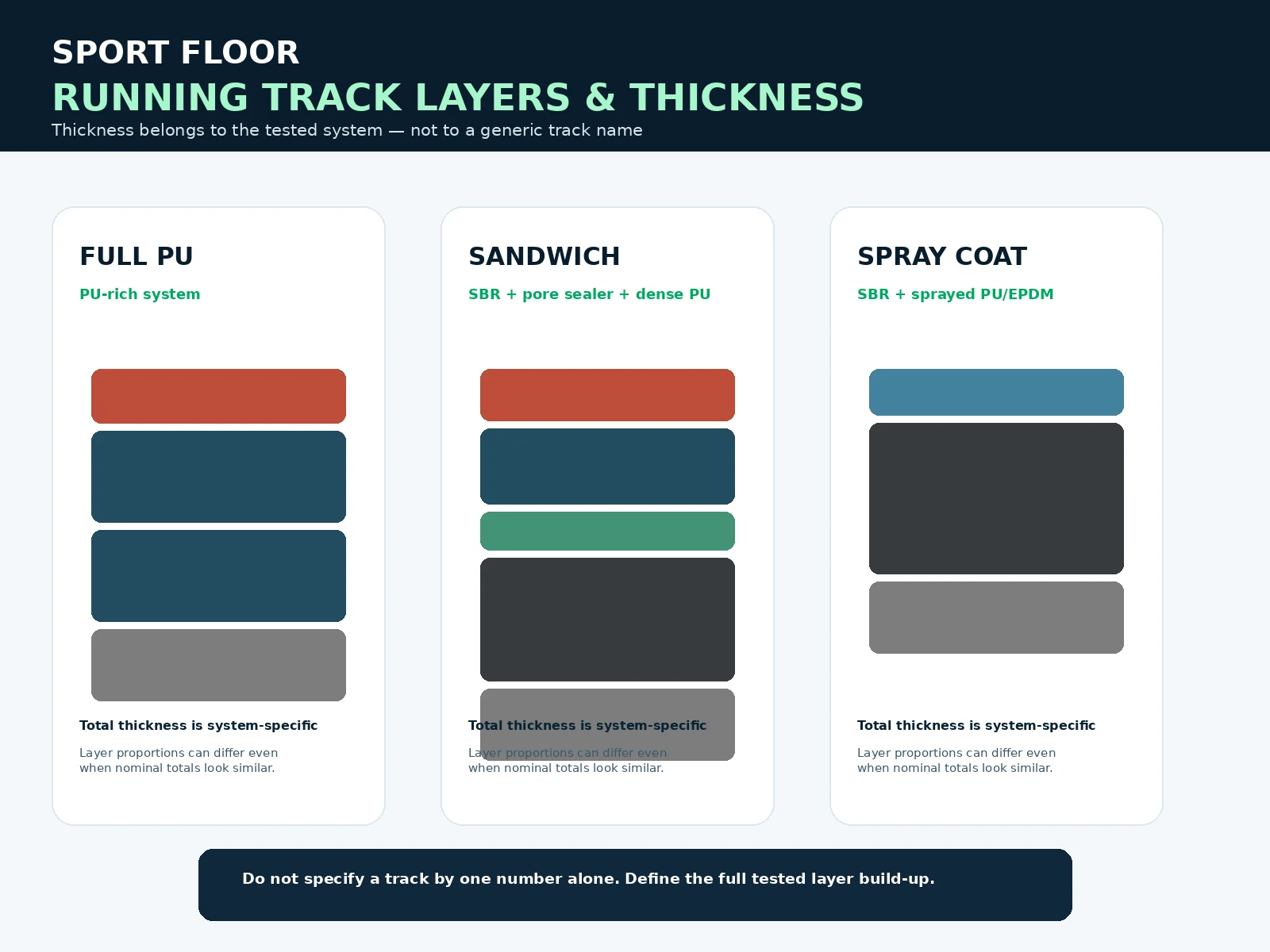
A Full PU track may devote most of its synthetic depth to dense polyurethane-rich structural layers. A Sandwich track may devote a large part of the depth to a PU-bound SBR resilient base, then add pore sealer and a dense PU/EPDM upper construction. A Spray Coat track may use a similar resilient SBR base but a much thinner sprayed wearing surface.
That means “13 mm”, “14 mm” or “15 mm” does not explain what the buyer is actually purchasing. The layer schedule must state what material occupies that depth and what function each layer performs.
This is also why copying a competitor's total thickness into a Sport Floor quotation is technically wrong. A thickness figure only becomes meaningful when it belongs to the exact tested formulation, layer sequence and installation method.
The overall installed depth of the synthetic track surfacing system above its approved base.
The depth assigned to each resilient, sealing, polyurethane or wearing layer within that total.
Where a certified product specifies a minimum absolute thickness, the installed system must respect that product requirement.
Some project zones may use modified or reinforced construction where supported by the approved system design.
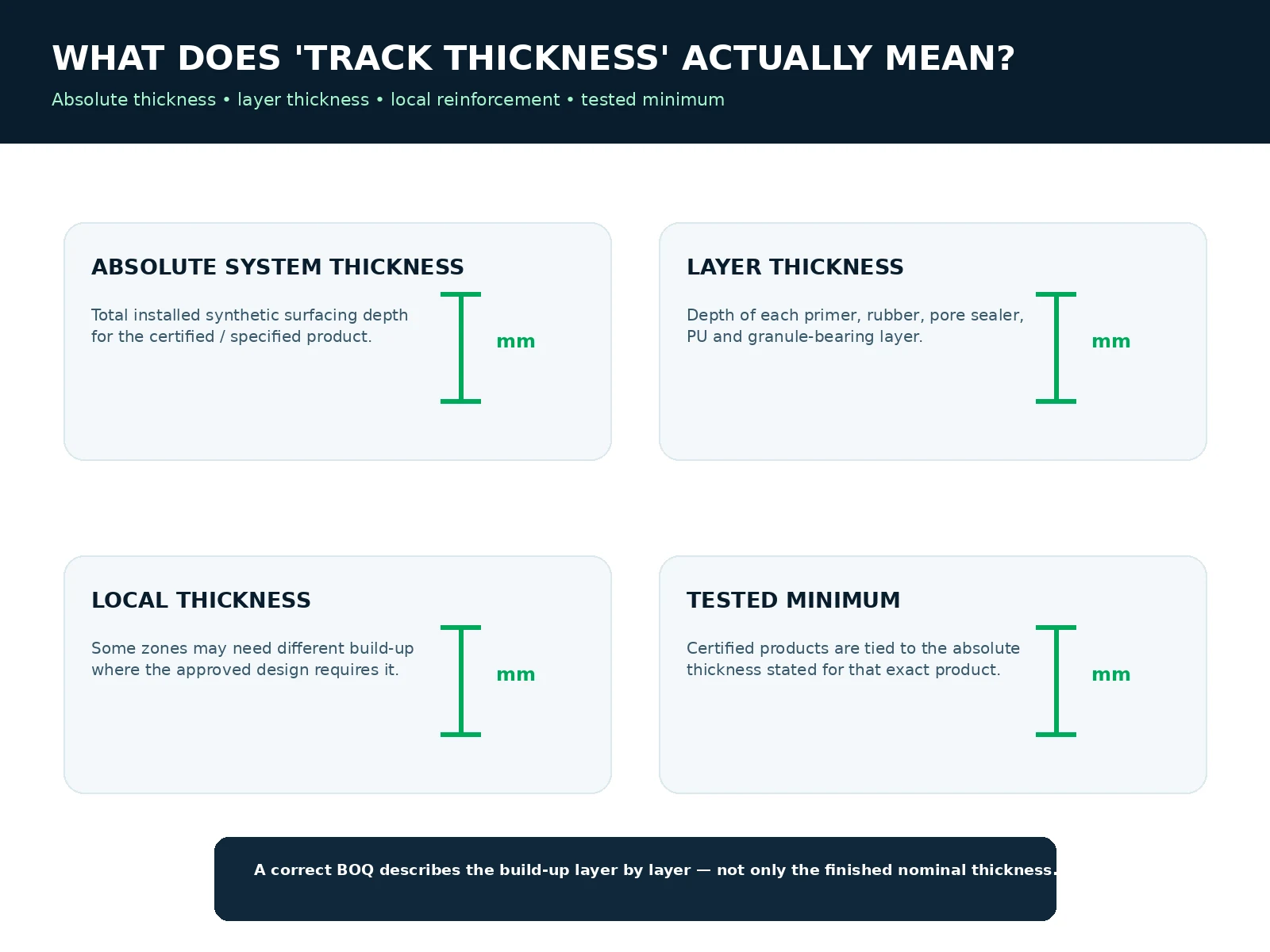
World Athletics publishes certified track-surfacing products with an absolute thickness attached to each listed product. Those values are not identical across Full PUR, Sandwich and Spray Coat products.
This is important for consultants and buyers: a generic category name does not automatically carry certification, and one manufacturer's certified thickness should never be transferred to another manufacturer's system.
If a Sport Floor project requires World Athletics product or facility certification, the exact proposed system, current certificate status, laboratory evidence and installed thickness must be checked before tender or installation.
International certified-product lists and manufacturer documentation show that synthetic running tracks exist at different absolute thicknesses. Full PUR, Sandwich and Spray Coat products can all appear around the low-to-mid teens, while other certified systems are thicker. The product architecture—not only the nominal millimetres—determines what that number represents.
| Example concept | What industry documentation shows | What Sport Floor should do |
|---|---|---|
| Full PUR | Certified and manufacturer systems exist at different absolute thicknesses; PU layer architecture varies by product. | Publish the exact Sport Floor value only after the system build-up is technically fixed and documented. |
| Sandwich | Typical manufacturer examples use a resilient recycled-rubber base plus dense PU top construction, with total thickness varying by product. | State SBR base, pore sealer, PU/EPDM top layer and exact system thickness together. |
| Spray Coat | Typical systems use a resilient rubber base plus sprayed PU/EPDM top surface; certified products do not all share one total thickness. | Specify the rubber-base depth and spray-layer route from the current system data. |
| Certified product | The certified-product list associates an absolute thickness with the exact product. | Do not imply certification from a generic category name. |
Prepares the compatible asphalt or concrete interface where required by the selected system.
Creates elastic depth in Sandwich and Spray Coat systems using rubber granules and compatible PU binder.
Closes the porous rubber base where a dense PU upper layer requires a sealed transition.
Forms the polyurethane-rich structural or wearing body in compatible track systems.
Granules can be embedded or broadcast into compatible PU layers depending on the exact system.
Creates the textured PU/EPDM wearing finish in Spray Coat system families.
Where the selected system includes it, the finish contributes to surface protection and final functionality.
Applied after the surface is ready, defining lane and event geometry without serving as structural thickness.
| Layer logic | Full PU | Sandwich | Spray Coat |
|---|---|---|---|
| Main resilient body | Primarily PU-rich structural layers according to system. | PU-bound SBR/recycled-rubber base. | PU-bound SBR/recycled-rubber base. |
| Transition layer | Depends on exact Full PU architecture. | Pore sealer is characteristic before dense PU upper layer. | Classic porous route may move directly to spray system; sealed variants differ. |
| Upper system | Dense PU layers with compatible granule surface. | Dense PU/EPDM upper construction. | Sprayed PU/EPDM coating. |
| What drives total thickness | PU structural design and performance specification. | Rubber-base depth + dense upper layer design. | Rubber-base depth + spray-layer system. |
| Sport Floor system page | Full PU | Sandwich | Spray Coat |
Competition level: competition projects may require a specific certified product and its nominated absolute thickness.
Training vs competition: the target balance between force reduction, stability and speed can influence the selected system.
Base condition: track surfacing should not be used to hide major substrate defects or poor civil tolerances.
Drainage architecture: porous and non-porous surface routes interact differently with the supporting base and drains.
Climate and use intensity: temperature, UV exposure, spike traffic, school use, events and maintenance strategy can affect system selection.
Renovation: an existing track may support resurfacing or retopping instead of complete reconstruction if inspection confirms suitability.

The synthetic track thickness sits above the structural base. The asphalt, concrete, free-draining aggregate and subgrade design belong to the civil construction of the athletics facility and are not included in the synthetic surface millimetres.
The supporting construction can be far thicker than the synthetic surface itself because it must provide stability, drainage, tolerances and long-term resistance to settlement. Site ground conditions, geotechnical design and local civil requirements determine this foundation.
Sport Floor uses German raw materials within applicable polyurethane primers, binders, dense layers and finishing formulations.
Sport Floor manufactures the polyurethane products used across the running-track material architecture.
Sport Floor combines formulation knowledge, project application and direct international supply when converting a layer schedule into materials.
Once the system and each layer are fixed, material calculation can begin. Area alone is not sufficient. Different layers use different materials, densities, granule proportions and product-specific consumption rates.
| Input | Why Sport Floor needs it | Commercial output |
|---|---|---|
| Track area | Defines the surface quantity base. | Square metres by zone. |
| Selected system | Determines which product layers are required. | Full PU / Sandwich / Spray Coat package. |
| Layer schedule | Defines the material architecture and design thickness. | Layer-by-layer quantity calculation. |
| Current TDS consumption | Converts area/build-up into actual product quantities. | PU, binder, sealer and coating quantities. |
| Granule specification | Defines SBR/EPDM type and required quantities. | Rubber / EPDM tonnage. |
| Waste / site allowance | Should follow project logistics and approved calculation method. | Procurement quantity. |
| Destination | Supports packing and export planning. | Shipment / container planning. |
This does not define Full PU, Sandwich, Spray Coat, material proportions or certification.
Another manufacturer's layer thickness and consumption belong to their formulation—not Sport Floor's.
Synthetic surface material should not be consumed unintentionally to correct major asphalt or concrete level errors.
The resilient rubber layer is only one part of Sandwich or Spray Coat construction.
A generic thickness and generic system name do not create World Athletics certification.
Correct quantities require the selected layer schedule and current product consumption data.
Total square metres, lane count and event zones.
School, club, training, stadium or competition use.
Full PU, Sandwich, Spray Coat or request a recommendation.
Asphalt, concrete, existing track or planned civil construction.
Send the specified thickness or layer schedule where one already exists.
State World Athletics or other formal requirement where applicable.
Country, city and preferred port/delivery location.
TDS, SDS, test reports, BOQ or tender-submittal requirements.
There is no single universal thickness for every running track. The correct absolute thickness belongs to the selected product/system and its intended performance or certification requirement.
13 mm appears in some certified products, but certified Full PUR, Sandwich and Spray Coat products also exist at other absolute thicknesses. Do not use 13 mm as a universal rule.
It is the overall installed synthetic-surface depth associated with the specified or certified track product, distinct from the thickness of any single layer.
The exact thickness is product-specific. Full PU systems use a PU-rich layer structure, but the absolute thickness should come from the current Sport Floor system documentation.
The total includes the PU-bound SBR resilient base plus pore-sealing and dense PU/EPDM upper layers. Exact layer depths are system-specific.
The system combines a resilient rubber base with a sprayed PU/EPDM wearing surface. Exact rubber-base and spray-layer thickness must follow the selected system.
No. More thickness can change resilience, cost and material consumption but does not automatically mean better athletics performance. The complete tested system matters.
Only if the selected product/system is appropriate for both project requirements. Facility use, performance target and certification needs should be checked first.
No. Certified track-surfacing products are listed with product-specific absolute thicknesses.
No. Asphalt, concrete, aggregate and subgrade belong to the civil base construction and are separate from the synthetic surfacing thickness.
Yes. Sport Floor manufactures polyurethane sports-flooring materials and uses them within sports projects.
Yes. German raw materials are used within applicable Sport Floor polyurethane formulations.
Yes. Send the area, selected system, approved layer schedule, destination and required documentation. Sport Floor can prepare a coordinated project material package using current product data.
Send the track area, facility level, base, selected system, consultant thickness requirement and destination. Sport Floor can convert the approved build-up into a coordinated polyurethane, SBR and EPDM material package.