
Subgrade
The existing ground must be assessed for bearing capacity, settlement risk, groundwater and unsuitable material.
A synthetic running track can only perform as well as the civil base beneath it. Flatness, structural stability, drainage, gradients, substrate condition and primer compatibility all influence the final surface before the first polyurethane layer is applied.
Sport Floor approaches athletics-track construction as a complete system: engineered ground preparation, drainage, load-bearing layers, asphalt or concrete base, substrate acceptance, compatible primer and then the selected Full PU, Sandwich or Spray Coat surface.
Sport Floor also manufactures its own polyurethane sports-flooring materials. German raw materials are used within applicable Sport Floor PU formulations, so the transition from civil base to synthetic track can be coordinated from substrate preparation through primer, binder, PU layers, EPDM/SBR and line marking.
Athletics-track foundation depth is determined by site conditions, soil bearing capacity, drainage, climate and structural design. The synthetic polyurethane surface itself is thin compared with the civil layers supporting it.
A typical construction route may include prepared subgrade, geotechnical improvement where required, free-draining aggregate, load-bearing crushed-stone layers, asphalt or approved concrete, primer and finally the selected synthetic track system.
World Athletics guidance emphasizes that the base should remain stable for far longer than the replaceable synthetic surface. That makes the foundation a long-term infrastructure asset rather than a temporary support layer.
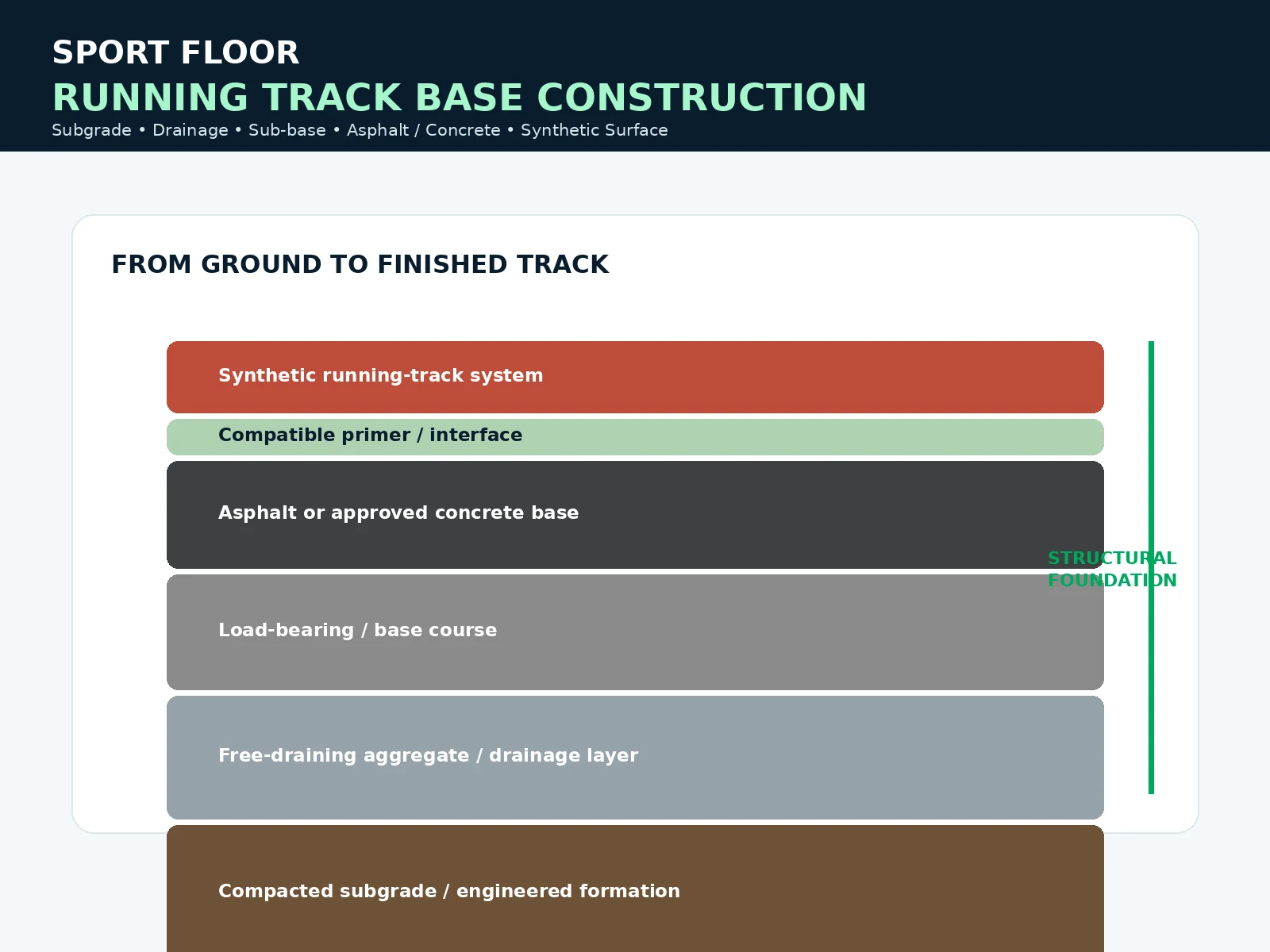
The existing ground must be assessed for bearing capacity, settlement risk, groundwater and unsuitable material.
Drainage, geotextile or other engineering measures may be required depending on soil and project design.
A properly compacted aggregate layer can provide drainage and structural separation above the formation.
Engineered crushed aggregate supports construction loads and distributes long-term surface loads.
Provides the precise, stable platform required for synthetic track surfacing.
The correct primer creates the chemical/adhesive bridge between the base and synthetic system.
Full PU, Sandwich or Spray Coat is installed only after base acceptance.
Lane geometry and events are marked after the final track surface is fully ready.
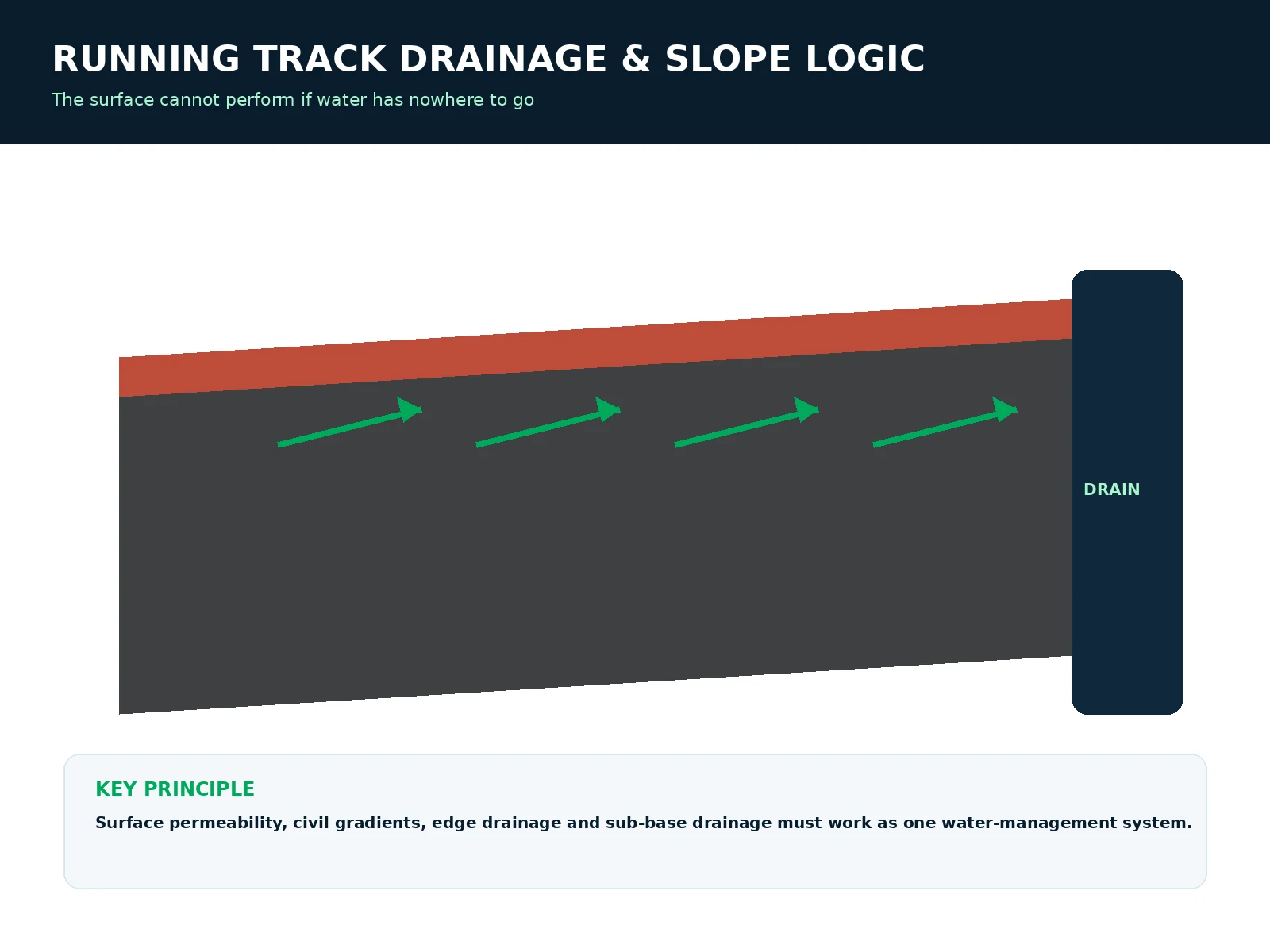
A porous surface is not a drainage system by itself. If rainfall passes through the synthetic track, the underlying construction must still receive and discharge that water. Likewise, a non-porous track must move surface water through designed falls and channels.
Drainage planning therefore begins below the synthetic surface. Sub-base permeability, longitudinal and transverse falls, perimeter channels, internal drains, outlets and surrounding areas all affect the final result.
Poor drainage can lead to standing water, trapped moisture, frost or heave problems in suitable climates, weakening of foundation layers and premature damage to the synthetic surface.
| Decision factor | Asphalt Base | Concrete Base |
|---|---|---|
| Typical athletics use | Common and widely used for outdoor running tracks. | Can be used where the system and civil design support it. |
| Surface behavior | Bituminous, slightly more forgiving than rigid mineral concrete. | Rigid mineral substrate with joints, curing and moisture considerations. |
| Key risk | Bitumen bleeding, weak areas, poor compaction or incorrect surface texture. | Residual moisture, active cracks, weak laitance, movement joints and incomplete curing. |
| Primer route | Use primer specifically compatible with bituminous/asphalt substrates. | Use primer specifically designed for mineral/cementitious substrate. |
| Moisture control | Base and surroundings still require correct drainage and dry application conditions. | Residual moisture must be checked against the selected Sport Floor product/system limits. |
| Joint treatment | Asphalt continuity reduces rigid joints but cracks/movement must still be resolved. | Structural and movement joints require deliberate detailing; do not simply bridge active joints with PU. |
| Sport Floor route | PU Primer Outdoor selected for exact substrate/system. | PU Primer Outdoor or approved concrete-specific route according to TDS. |
The final asphalt or concrete layer must be laid to a very high standard because every irregularity can affect synthetic-surface thickness. Low spots may consume extra PU material, while high spots can reduce the installed synthetic thickness below the intended specification.
Current manufacturer guidance for certified track construction uses strict straightedge tolerances and controlled slopes. Sport Floor should verify the applicable project/competition requirement before accepting the base rather than publishing one universal tolerance for every facility.
Check the finished base with suitable straightedges and surveying equipment before synthetic work.
Verify that finished levels allow the required synthetic thickness without creating raised edges or low zones.
Confirm the designed falls against project geometry and drainage before accepting the base.
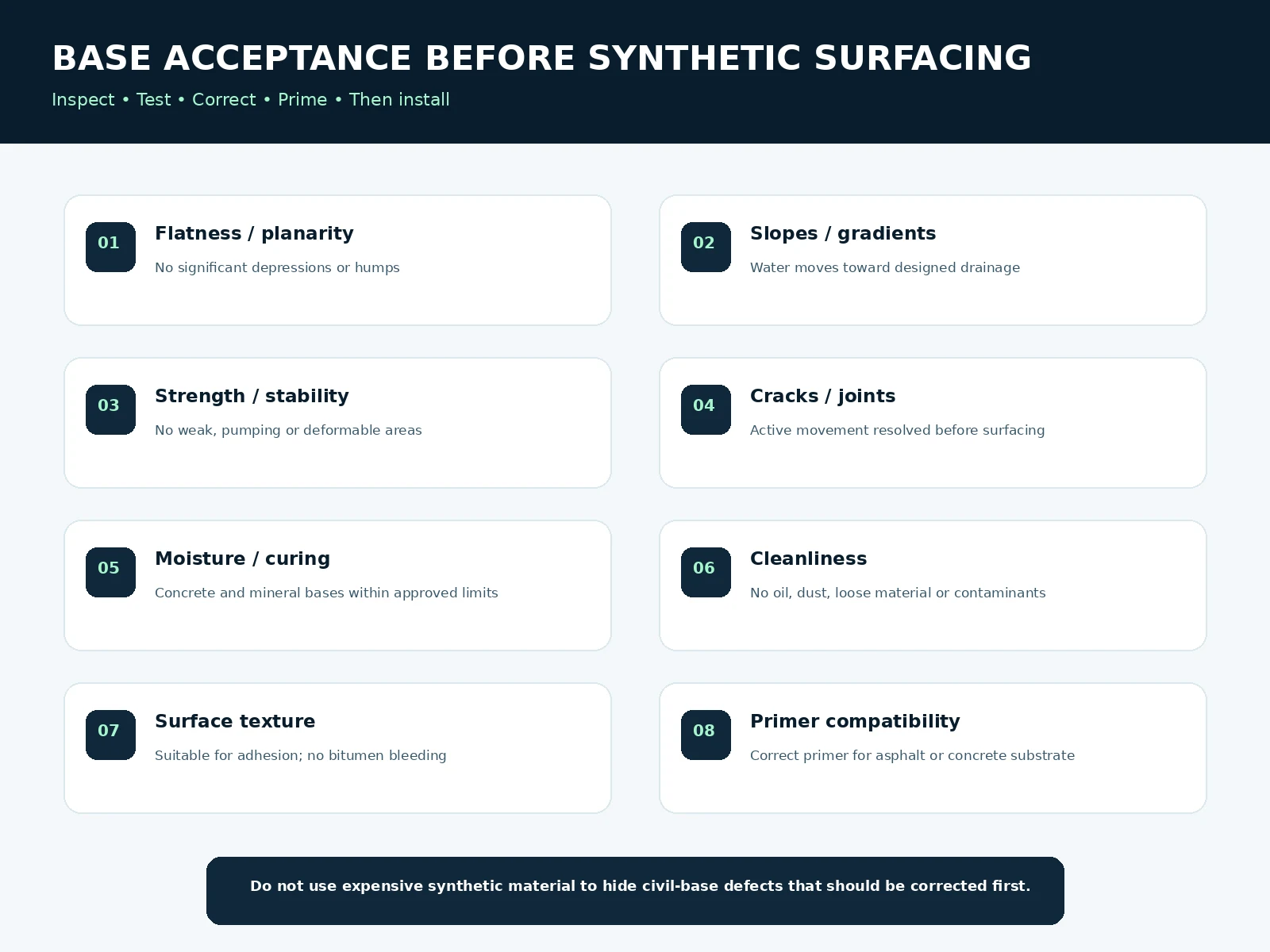
A base can look visually acceptable and still be unsuitable for synthetic surfacing. Sport Floor should therefore treat base acceptance as a technical hold point.
Flatness, strength, cracks, moisture, cleanliness, gradients, drainage and primer compatibility should all be reviewed before surfacing. If the base fails, civil correction normally costs less than repairing a failed synthetic system later.
The inspection should also confirm that any recent asphalt or concrete has reached the condition required by the selected primer and synthetic system.
Asphalt and concrete are different substrates. Using the same primer indiscriminately can create adhesion, curing or compatibility problems.
On asphalt, the primer should be suitable for bituminous substrates and should not contribute to unwanted bitumen migration. On concrete, the primer should suit mineral surfaces and the moisture/cure condition of the slab.
Sport Floor manufactures dedicated polyurethane primer products and should select them according to the current TDS, base type, moisture condition and track system.
Investigate the cause, prepare and repair using a compatible approved method before track surfacing.
Movement must be addressed structurally; simply coating over an active crack can lead to reflection through the synthetic surface.
Structural joints require deliberate continuation or compatible detailing rather than rigidly bridging them with a surface layer.
Sport Floor uses German raw materials within applicable polyurethane primers, binders, intermediate layers and finishing products.
Sport Floor manufactures the polyurethane products that connect the accepted base to the final track surface.
Sport Floor combines field execution knowledge with direct material manufacturing and international supply.
| Surface system | Base expectation | Drainage relationship | System page |
|---|---|---|---|
| Full PU | Highly accurate, stable asphalt or approved concrete base with compatible primer. | Drainage strategy depends on exact non-porous/approved system and facility design. | Full PU |
| Sandwich | Stable base suitable for PU-bound resilient rubber layer and dense upper system. | Classic Sandwich upper build-up is commonly non-porous; surface falls and drainage must be resolved. | Sandwich |
| Spray Coat | Stable base supporting a porous resilient rubber layer and spray finish. | Classic porous routes require water to continue through or toward an effective drainage system. | Spray Coat |
Settlement below the asphalt can reflect through every synthetic layer above it.
Water trapped below or beside the track can damage both civil and synthetic layers.
Low and high spots create inconsistent synthetic thickness and unnecessary material consumption.
Asphalt and concrete require substrate-compatible primer systems rather than one generic product.
Movement can reflect through the track and create premature cracking or separation.
Expensive sports-surface materials should not become an uncontrolled leveling compound for defective construction.
| Stage | Key decision | Output |
|---|---|---|
| Geotechnical / site review | Ground bearing, settlement, drainage and unsuitable materials. | Foundation design basis. |
| Earthworks | Excavation, formation and compaction. | Stable subgrade. |
| Drainage | Subsurface and surface-water strategy. | Channels, outlets, aggregate drainage route. |
| Sub-base / base course | Material grading, depth and compaction. | Stable load-bearing platform. |
| Asphalt / concrete | Levels, slopes, finish, cure and tolerances. | Surface-ready civil base. |
| Acceptance | Flatness, cracks, moisture, strength and cleanliness. | Approved substrate. |
| Primer | Select according to exact substrate and Sport Floor system. | Compatible bonded interface. |
| Synthetic track | Full PU, Sandwich or Spray Coat build-up. | Finished athletics surface. |
Country, city and site conditions.
Lane count, total area, straights, bends and field-event zones.
Geotechnical report or available soil/site information.
Existing or proposed drainage layout and outlet information.
New asphalt, concrete, existing track or renovation.
Full PU, Sandwich, Spray Coat or request a recommendation.
State World Athletics or consultant requirements where applicable.
BOQ, drawings, TDS, SDS, tests or tender-submittal requirements.
Asphalt is widely used for outdoor athletics tracks, while approved concrete can also be used in suitable systems. The correct choice depends on structural design, drainage, substrate condition and the selected synthetic system.
There is no universal foundation thickness. Ground conditions, drainage, bearing capacity, climate and civil design determine the required sub-base and base depth.
No. Asphalt or concrete belongs to the civil base. The synthetic Full PU, Sandwich or Spray Coat surface thickness is specified separately above it.
Yes, in compatible systems, but concrete must be sound, properly cured, within the permitted moisture range, correctly detailed at cracks/joints and primed with a suitable product.
Yes, asphalt is a common athletics-track base when it is stable, clean, accurately laid, correctly drained and compatible with the selected primer/system.
Water must leave the facility without remaining on the surface or becoming trapped in the foundation. Poor drainage can damage civil layers and shorten the synthetic surface life.
No. Water that passes through the surface still requires a functional drainage path through or below the base construction.
Minor system-specific leveling may be possible, but major civil irregularities should be corrected before surfacing. Expensive synthetic materials should not be used as an uncontrolled civil leveling layer.
Use a primer specifically compatible with bituminous substrates and the selected Sport Floor track system. Follow the current Sport Floor TDS.
Use the approved mineral/cementitious substrate primer for the exact system and concrete moisture condition, following current Sport Floor technical data.
Active structural movement can reflect through the synthetic surface. The cause should be investigated and corrected before track surfacing.
Yes. Sport Floor manufactures polyurethane primers, binders and other sports-flooring PU products.
Yes. German raw materials are used within applicable Sport Floor polyurethane formulations.
Sport Floor provides running-track construction in Egypt and can supply sports-flooring materials and systems internationally according to project scope.
Send the track geometry, site condition, geotechnical information, drainage design, base type, synthetic system and project destination. Sport Floor can support the construction route from substrate preparation to coordinated track-surface materials.