
Survey
Map cracks, loose areas, bubbles, cuts, ponding and high-wear zones.
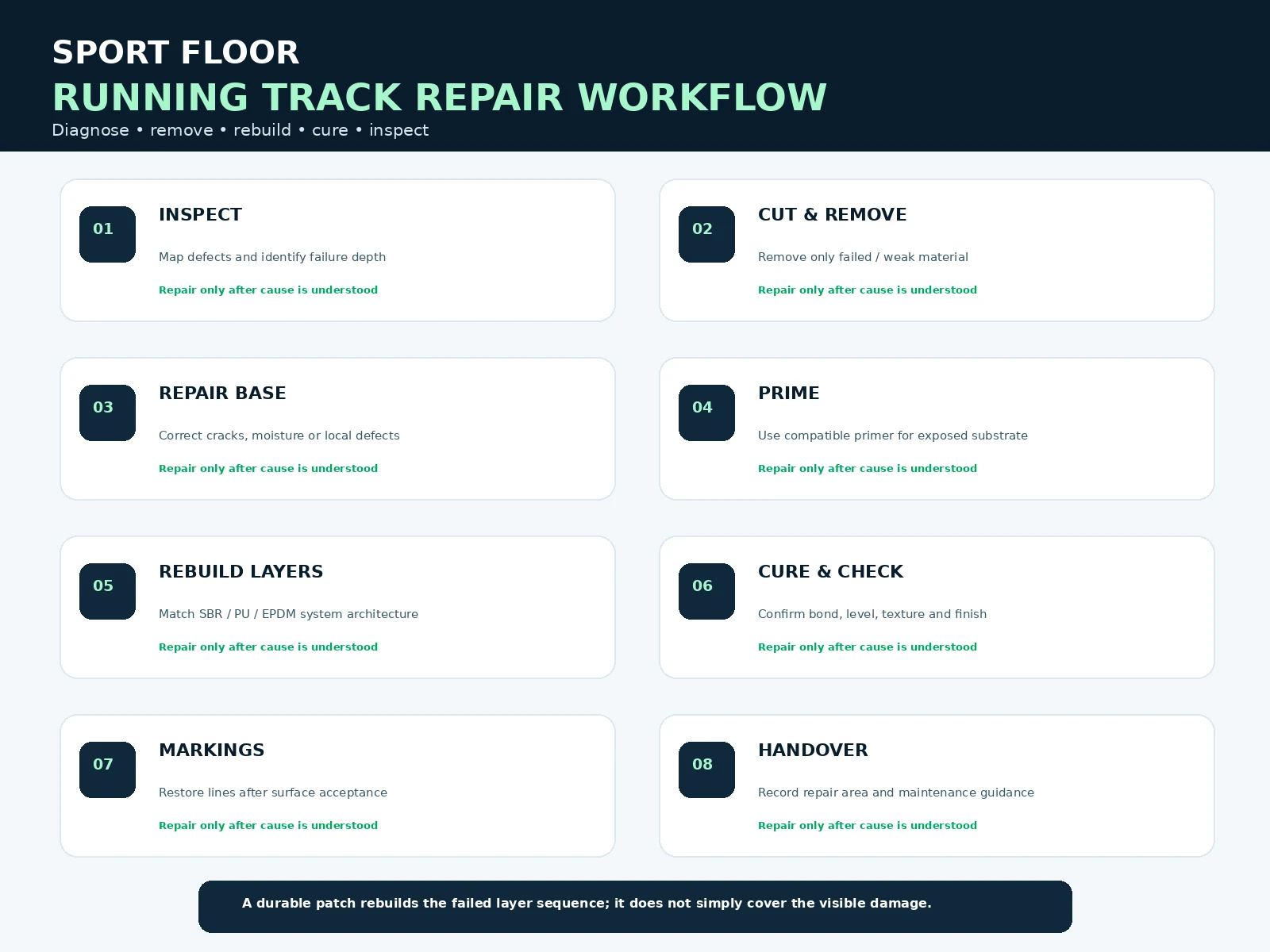
Professional running-track repair begins by removing the failure mechanism—not by covering the visible defect. A durable repair identifies which layer failed, removes weak material back to a sound boundary, corrects the substrate or moisture problem where necessary, then rebuilds the track with materials compatible with the original system.
Sport Floor manufactures and exports polyurethane running-track materials and compatible sports-flooring systems for contractors, project owners and distributors. German raw materials are used within applicable Sport Floor polyurethane formulations, supporting manufacturer-direct supply of primers, binders, pore sealers, PU layers, adhesives, top coats, EPDM/SBR materials and line-marking products for compatible repair scopes.
This page focuses on defined repair work. If the upper surface is broadly worn but the lower elastic structure remains sound, the correct route may be running-track resurfacing or re-topping instead of repeated patching.
A synthetic track is a layered construction. Depending on the system, the damaged zone may contain primer, SBR rubber base, pore sealer, dense polyurethane, spray coating, embedded EPDM or a prefabricated roll bonded with adhesive.
That means two patches that look identical from above may require completely different repair methods below. A surface cut in Full PU is not repaired in the same way as delamination in a Sandwich system or lifting at a prefabricated seam.
Serious imperfections such as bubbles, fissures, delamination and uncured areas should be treated as priority defects because they can affect safety, durability and dynamic performance.
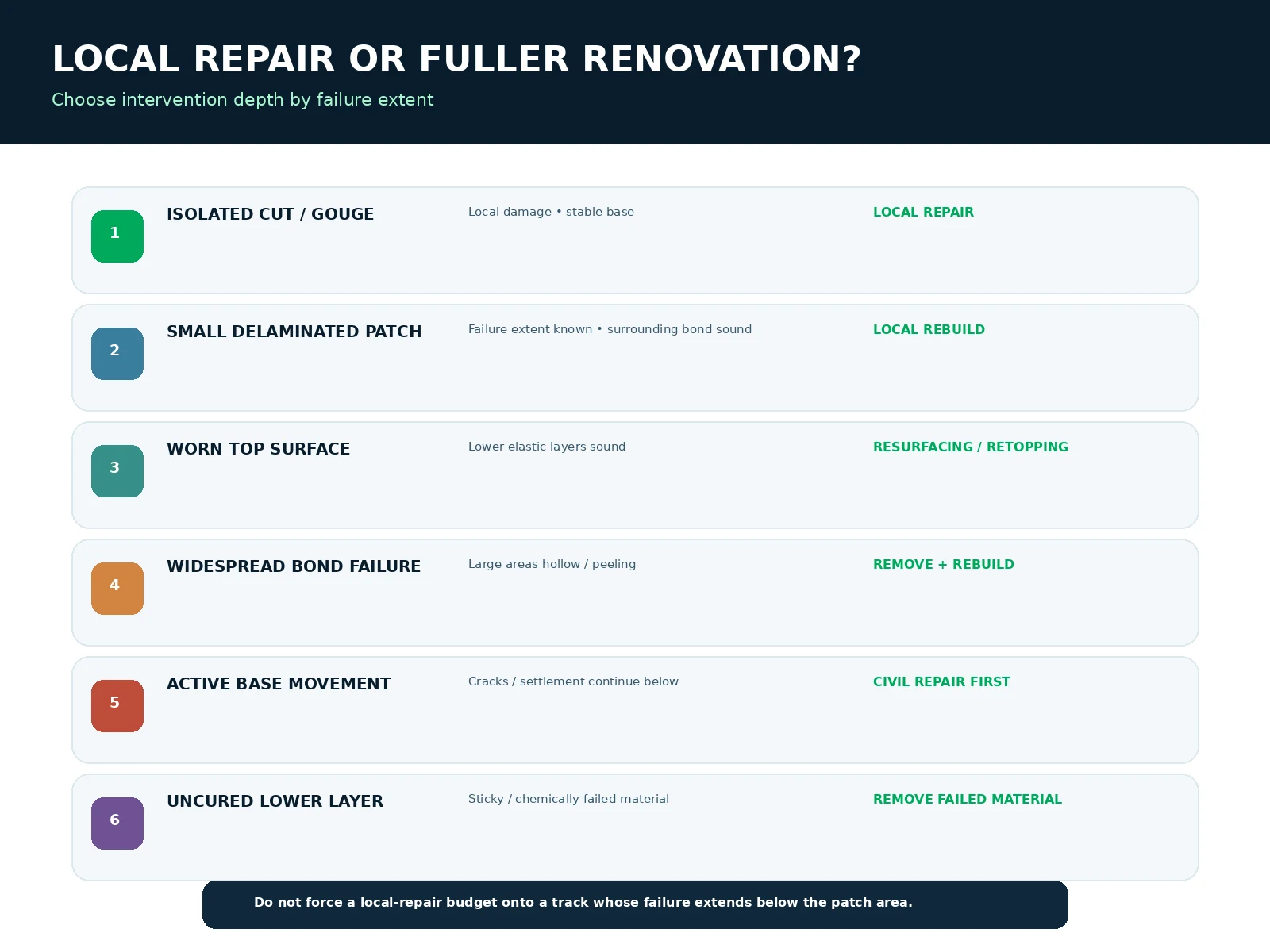
| Condition | Local repair suitable? | Reason |
|---|---|---|
| Small cut / gouge | Usually possible after inspection | Damage may be limited to the wearing layer or local layer sequence. |
| Small isolated delamination | Possible if full extent is known | Failed material can be removed back to firmly bonded edges. |
| Localized SBR damage | Possible with system-compatible rebuild | Base and upper system can be reconstructed locally if surroundings are sound. |
| Small prefabricated damage | Product-specific | Requires approved patch/replacement and compatible adhesive. |
| Repeated bubbling | Not until cause is diagnosed | Moisture or vapor may make repeated patching fail. |
| Active structural crack | No surface-only repair | Movement below the track must be stabilized first. |
| Widespread upper wear | Usually inefficient | Resurfacing/re-topping may provide a more uniform solution. |
| Large-area delamination | Usually not | Failure extent may require removal and rebuild of larger areas. |
Local repair is efficient when defects are isolated. Re-topping and resurfacing become more logical when the upper surface is broadly worn while the existing elastic substructure remains sound.
Modern re-topping systems are specifically designed to retain technically suitable lower layers while renewing the worn surface, reducing unnecessary disposal and restoring uniform performance.
If only the exposed top layer is damaged, a limited compatible surface repair may be possible. If the failure extends into dense PU, pore sealer or SBR base, each failed layer should be removed and rebuilt.
If the synthetic surface is only reflecting an active asphalt/concrete crack, settlement or drainage failure, rebuilding the PU patch before correcting the base is unlikely to provide a durable result.
The most economical repair is the smallest intervention that completely removes the failure mechanism—not simply the smallest visible patch.
Map cracks, loose areas, bubbles, cuts, ponding and high-wear zones.
Determine where sound adhesion begins.
Cut and remove damaged material without unnecessary damage.
Address cracks, moisture, contamination or local level defects.
Use the compatible primer for the exposed substrate or layer.
Restore SBR, pore sealer, dense PU, spray coat or EPDM as required.
Check adhesion, level, texture, edges and cure before traffic.
Reapply lines after the repair is accepted.
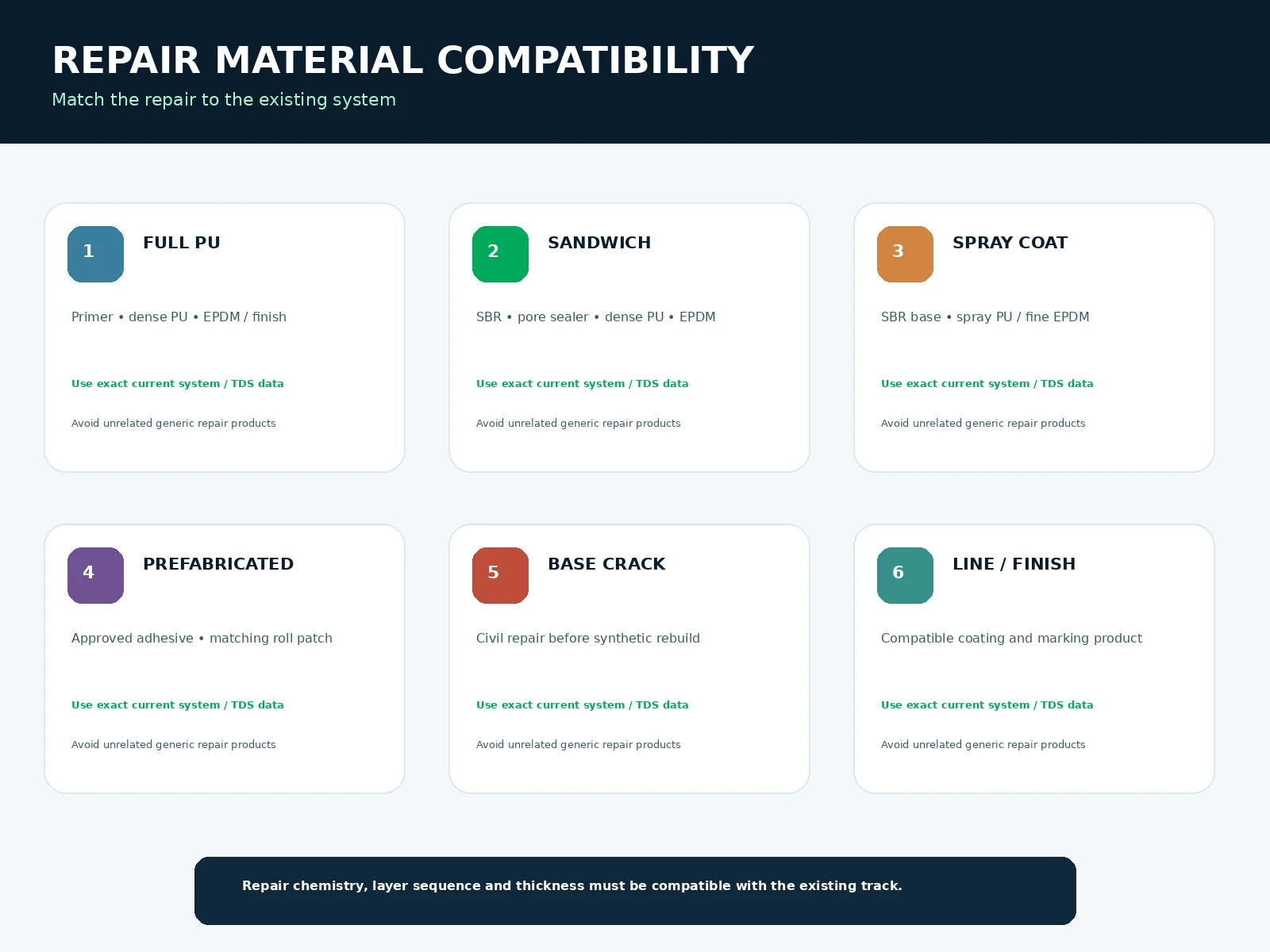
Match primer, dense PU layer, granules and final texture.
Rebuild failed SBR, pore sealer, dense PU and EPDM layers.
Restore SBR-base integrity before the compatible spray upper system.
Use an approved matching roll patch or replacement with correct adhesive.
A stable local surface crack may be repaired by cutting back damaged material and rebuilding compatible layers. A crack that follows an asphalt crack, concrete joint or settlement line requires investigation below the synthetic system.
If movement remains active, a cosmetic fill or thin PU patch can reopen. The base should be stabilized or treated using an appropriate civil repair strategy before the synthetic layer is rebuilt.
Peeling and hollow-sounding material can extend beyond the visible edge. Repair boundaries should therefore be based on actual adhesion—not only what can be seen from above.
After weak material is removed, the exposed surface should be cleaned and assessed for contamination, moisture and compatibility before primer or replacement layers are installed.
Repairing over partially detached material can allow the new patch to lift together with the old failed layer.
Cutting out a bubble and replacing the surface is appropriate only after the source of pressure or moisture is understood. The substrate, lower PU layers, drainage and edge details may all require investigation.
Where moisture is present, use only a project-specific moisture-management route supported by the current repair product data. Do not encapsulate a wet or uncured failure because the surface appears dry for one day.
Sprint starts, lane 1, hurdle positions, runways and take-off zones can receive concentrated spike and traffic wear. Small local losses of texture or material should be addressed before water and repeated loading enlarge the defect.
Where many high-wear zones show the same general upper-surface degradation, a broader resurfacing plan may be more uniform and economical than repeated local patches.
| Material family | Repair role | Sport Floor resource |
|---|---|---|
| Primer | Compatible bond to exposed substrate or accepted layer. | PU Primer Outdoor → |
| Low-Viscosity Primer | Project-specific substrate penetration/bonding where specified. | Low-Viscosity PU Primer → |
| PU Binder | Rebuilds compatible SBR/EPDM granule-bound layers. | PU Binder → |
| Pore Sealer | Restores sealed transition over compatible open rubber base. | PU Pore Sealer → |
| Self-Leveling PU | Rebuilds dense polyurethane layers. | Self-Leveling PU → |
| Outdoor Top Coat | Restores compatible exposed finish where required. | Outdoor PU Top Coat → |
| EPDM / SBR | Rebuilds exposed or resilient rubber layers according to system role. | Tartan Materials → |
| Line Marking | Restores lane/event markings after repair acceptance. | PU Line Marking Paint → |
Sport Floor manufactures polyurethane sports-flooring products for compatible track systems and repair work.
Supply can combine primer, PU binder, SBR/EPDM, pore sealer, dense PU, finish and line marking as required.
Sport Floor exports track and sports-flooring materials according to quantity, packing and destination.
Repair edges and rebuilt layers should be firmly bonded.
No local lips, depressions or abrupt transitions.
Integrate with the existing athletics finish as closely as practical.
Do not reopen before current cure requirements are met.
Confirm no new ponding or blocked water paths.
Restore markings accurately after acceptance.
Record before, during and after conditions.
Inspect repaired areas during routine checks.
| Wrong shortcut | Why it fails | Better approach |
|---|---|---|
| Coat over loose material | New layer bonds to a failed substrate. | Remove back to sound material. |
| Fill active structural crack only at surface | Movement below can reopen the patch. | Stabilize civil/base defect first. |
| Use generic industrial PU | Cure, hardness and weathering may not match. | Use compatible sports-surface material. |
| Ignore moisture | Vapor or wet substrate can cause new failure. | Investigate and manage moisture source. |
| Patch a broadly worn track repeatedly | Creates inconsistent texture and growing maintenance cost. | Assess resurfacing/re-topping. |
| Reopen too early | Traffic can damage uncured repair layers. | Follow current cure requirements. |
Close and wide views of all defect types.
Full PU, Sandwich, Spray Coat, prefabricated or unknown.
Installation date and previous repairs.
Approximate m² and number of local patches.
Asphalt, concrete and known cracks or settlement.
Ponding, bubbling or water-ingress history.
Local repair, competition readiness or pre-resurfacing work.
Materials only, support or complete repair scope.
Yes, when damage is localized and the surrounding layers and base remain sound. Failed material should be removed back to a reliable boundary and rebuilt with compatible materials.
First determine whether the crack belongs only to the synthetic surface or reflects movement below. Active base movement should be stabilized before rebuilding the surface.
Remove loose material until firm adhesion is reached, clean and assess the exposed layer, correct moisture or contamination, then rebuild the compatible layer sequence.
When upper-surface wear is widespread but the existing resilient structure remains sound, resurfacing or re-topping can be more uniform and economical than many local patches.
Yes, but repair materials and layer sequence differ. The existing system should be identified before work begins.
Yes, using the exact manufacturer's approved patch or replacement method and compatible adhesive.
Yes. Sport Floor manufactures polyurethane sports-flooring materials for compatible running-track construction, repair and resurfacing scopes.
Yes. Sport Floor exports track and sports-flooring materials for contractors, distributors and project buyers according to product, quantity and destination.
Yes. German raw materials are used within applicable Sport Floor polyurethane formulations. This does not imply that the finished products are manufactured in Germany.
Send photos, system type if known, track age, affected area, base type, moisture/drainage history, project objective and whether you need materials only or installation support.
Send defect photos, track system, age, base, affected area, moisture/drainage history and required scope. Sport Floor can prepare the compatible repair-material package or project repair route.