
Local Repair
For isolated cuts, cracks, delamination or local layer damage where surrounding construction is sound.
Running-track resurfacing is the controlled renewal of a worn athletics surface while retaining the existing structure that is still technically sound. Done correctly, it can restore texture, color, traction, markings and system performance without paying for unnecessary full-depth replacement.
Sport Floor manufactures and exports polyurethane running-track materials and compatible sports-flooring systems for contractors, facility owners and international project buyers. German raw materials are used within applicable Sport Floor polyurethane formulations, supporting manufacturer-direct resurfacing packages that can include primers, repair materials, PU coatings, EPDM/SBR materials, top coats and line-marking products.
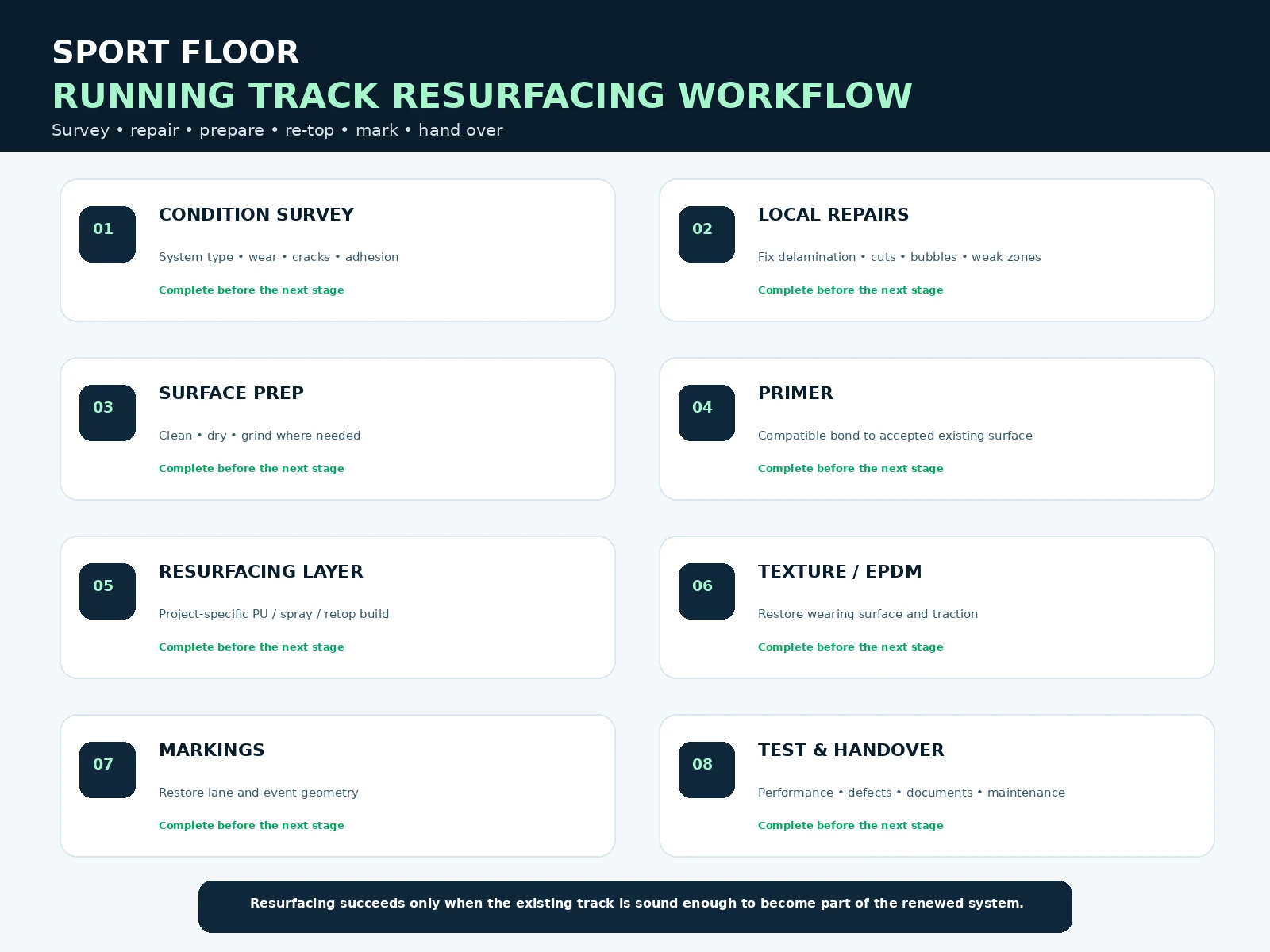
Resurfacing is not a shortcut around structural failure. The existing track must first be inspected for cracks, delamination, moisture, drainage, flatness, worn zones and bond quality. Areas that are not technically suitable for retention should be repaired or removed before the new wearing construction is installed.
A synthetic athletics track does not always need to be removed when the surface becomes worn. If the resilient base and supporting construction remain sound, the existing system can become the foundation for a compatible new wearing layer.
That is the economic logic behind re-topping: inspect first, repair defects, prepare the old surface, restore adhesion and then apply a defined new upper construction.
This approach can reduce demolition, disposal, downtime and material use compared with full replacement—but only when the existing track is technically suitable.
| Condition | Resurfacing potential | Reason |
|---|---|---|
| Worn / polished top surface | Strong candidate | Upper texture can be renewed if lower layers remain sound. |
| Faded color / markings | Strong candidate | Visual and line renewal can be integrated into re-topping. |
| Localized repaired defects | Possible | Repairs must be completed and accepted before resurfacing. |
| Uneven high-wear zones | Possible with preparation | Special treatment may be needed to blend wear before new layer installation. |
| Small stable cracks | Project-dependent | Cause and movement should be assessed first. |
| Widespread delamination | Poor candidate | Weak layers should not be trapped under a new surface. |
| Active structural cracking | Not until corrected | Base movement can reflect through the new surface. |
| Major drainage / settlement failure | Not until corrected | Surface renewal cannot fix failed civil construction. |
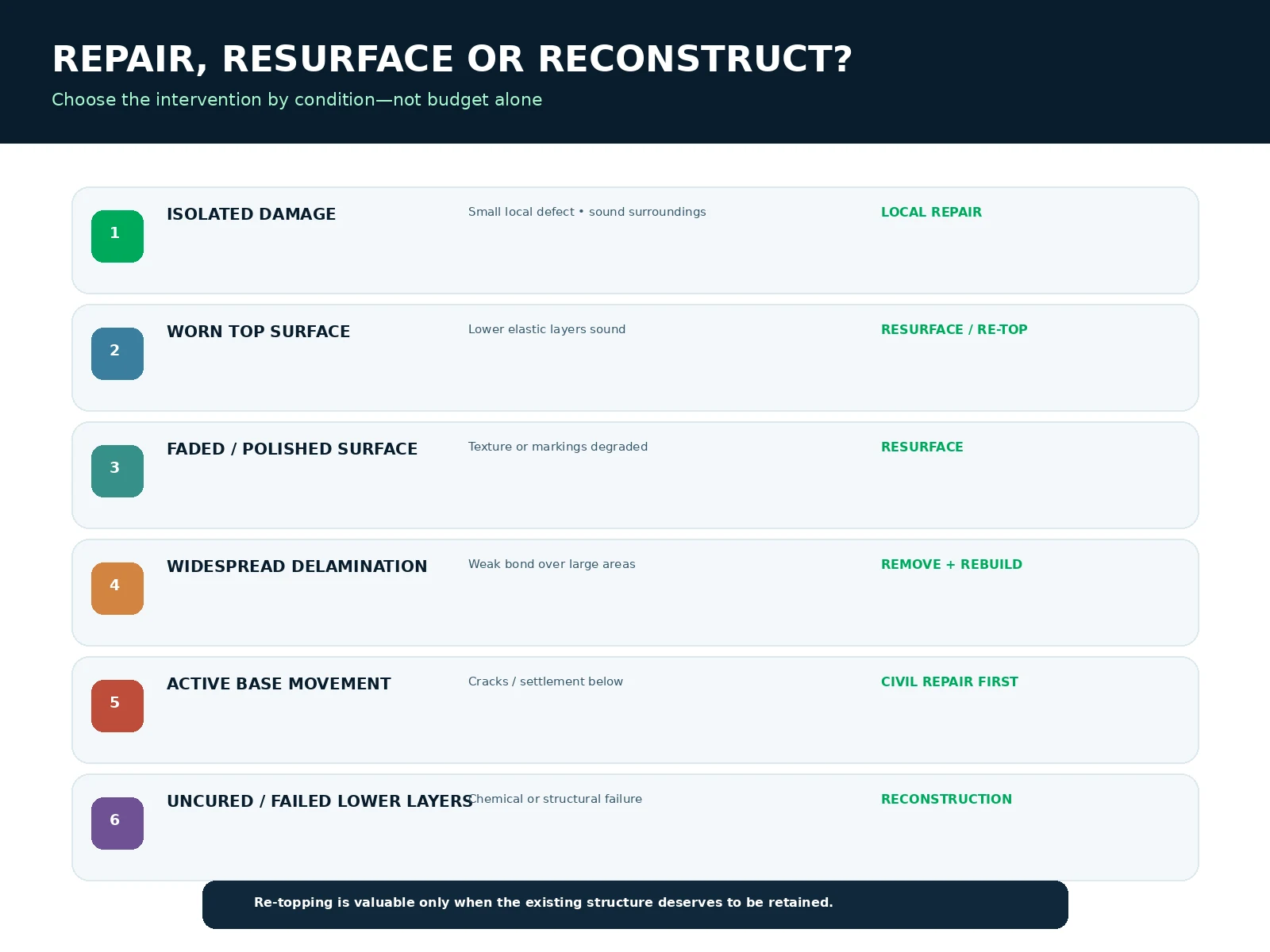
For isolated cuts, cracks, delamination or local layer damage where surrounding construction is sound.
For broad upper-surface wear where the existing elastic structure remains technically suitable.
For major bond failure, uncured layers, active base movement, severe settlement or drainage failure.
Full PU, Sandwich, Spray Coat, prefabricated or unknown.
Lane 1, sprint starts, runways, curves and high-use zones.
Look for peeling, hollow areas and interlayer separation.
Separate stable surface defects from active base movement.
Inspect ponding, channels, outlets and edge water ingress.
Identify settlement, local depressions and transition defects.
Investigate bubbles, vapor or wet lower construction.
Agree any field tests or certification requirements before work.
All loose, weak, brittle or contaminated material should be removed. Local delamination, cuts, bubbles and defective zones should be repaired before the full-area resurfacing layer is applied.
The existing track may require pressure cleaning, grinding or other mechanical preparation depending on condition and compatibility. The surface should be sufficiently clean and dry for the approved primer and resurfacing system.
Drainage, gradients and local separations should be checked before resurfacing. A renovation layer should not be used to hide failed drainage or poor levels.
| Existing / target condition | Potential renewal route | Critical check |
|---|---|---|
| Impermeable in-situ track | Compatible cast PU / EPDM re-topping system. | Adhesion, condition, required force reduction and final thickness. |
| Water-permeable track | Compatible spray / structured re-topping system. | Permeability, SBR integrity and drainage below. |
| Prefabricated track | Product-compatible retop or replacement route. | Roll adhesion, seams and approved renovation chemistry. |
| Mixed repair history | Trial / compatibility evaluation before full work. | Different old materials may respond differently to the same retop. |
The final resurfacing build-up should be project-specific. Do not copy another manufacturer's exact kg/m², thickness or primer schedule into a Sport Floor specification.
A resurfacing system may add new polyurethane and EPDM thickness above the old track, but the correct amount depends on the old surface condition, remaining resilience, target performance and exact system design.
Do not assume one universal re-topping thickness. Existing tracks age differently, and high-use zones can lose more material than lower-traffic areas.
Where competition requirements apply, final track performance and geometry should be evaluated against the current project criteria rather than judged only by nominal added thickness.
World Athletics maintains separate current lists for certified surfacing products and certified athletics facilities. A resurfacing product or system should therefore be distinguished from certification of the completed venue.
For competition projects, define the required facility certification or field-testing scope before the resurfacing system is selected. Repair work, geometry, gradients, line markings and final performance may all matter to the outcome.
For schools and community tracks, avoid unnecessary certification costs while still requiring a clearly documented renovation system and competent installation.
Sport Floor manufactures polyurethane sports-flooring products for compatible running-track resurfacing systems.
German raw materials are used within applicable Sport Floor polyurethane formulations as a material-quality differentiator.
Sport Floor exports resurfacing and track materials to contractors, distributors and project buyers according to quantity, packing and destination.
| Material family | Role in resurfacing | Sport Floor resource |
|---|---|---|
| Repair Primer | Bond to exposed repaired zones or accepted existing surface. | PU Primer Outdoor → |
| PU Binder | Repair or rebuild compatible rubber-bound areas where required. | PU Binder → |
| Pore Sealer | Used where compatible repaired open rubber base requires sealing. | PU Pore Sealer → |
| Dense / Self-Leveling PU | Project-specific renewal layer for compatible impermeable resurfacing systems. | Self-Leveling PU → |
| EPDM Granules | Restores exposed wearing texture in compatible cast systems. | EPDM Granules → |
| Outdoor Top Coat | Project-specific final protection / color route where specified. | Outdoor PU Top Coat → |
| Line Marking | Restores lanes and event markings after surface acceptance. | PU Line Marking Paint → |
A heavily worn or irregular track can require more preparation and more resurfacing material than a uniformly worn track. High-use areas may also require localized rebuilding before the main retop layer.
Therefore, quantity planning should begin with measured project area plus the current Sport Floor product consumption for the selected resurfacing system, then add the approved allowance for repairs, application loss and packing units.
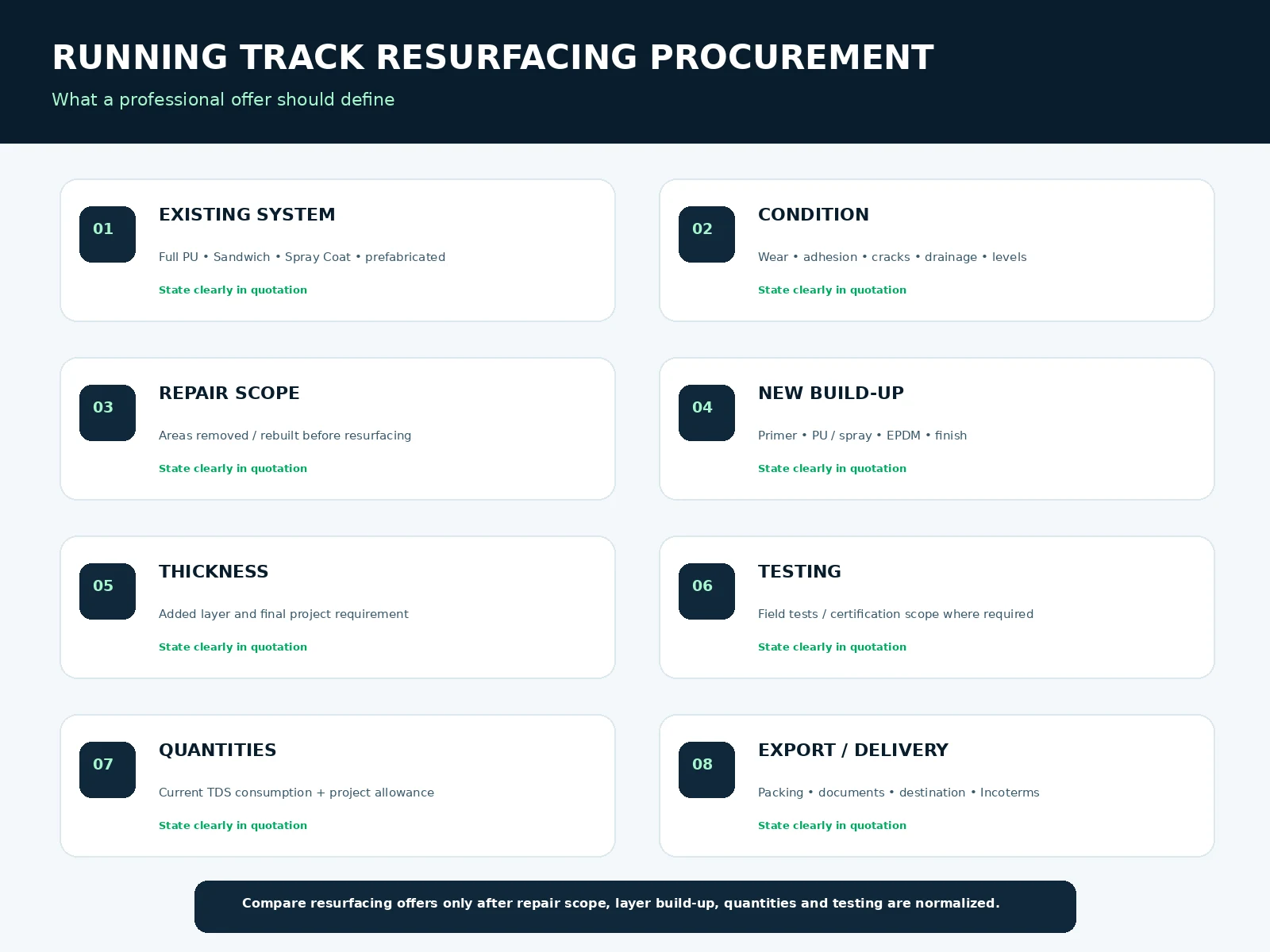
| Quotation item | What should be visible |
|---|---|
| Existing track | System type, age, known previous repairs and condition. |
| Repair scope | Areas cut out, rebuilt, crack-treated or excluded. |
| Preparation | Cleaning, grinding, drying and adhesion preparation. |
| Primer | Exact compatible product and where it is used. |
| New surface build | PU / spray / EPDM / coating layers and sequence. |
| Thickness | Added construction and any final project requirement. |
| Testing | Field tests, certification responsibilities and exclusions. |
| Markings | Lane/event re-marking included or excluded. |
| Quantities | Material consumption basis and project allowance. |
| Commercial scope | Materials, labour, equipment, freight, supervision and taxes. |
Unknown failure depth can turn resurfacing into premature delamination.
New layers cannot strengthen material that is already detached.
Ponding and trapped water remain active after a cosmetic retop.
Incompatible adhesion chemistry can compromise the entire new surface.
Existing tracks do not all need the same added thickness.
Unknown old materials may react differently to the proposed system.
Lane 1 and sprint/runway zones may need extra preparation.
Renewal should end with a plan for cleaning, inspection and drainage care.
Full track plus close-ups of wear and defects.
Full PU, Sandwich, Spray Coat, prefabricated or unknown.
Installation date and previous retopping/repairs.
Track, runways, D-zones and related surfaced areas.
Cracks, delamination, bubbles, ponding and worn zones.
Training, school, club or competition/certification requirement.
Materials only, technical support or installed resurfacing.
Country, city / port, delivery requirements and programme.
It is the renewal of a worn synthetic athletics surface while retaining existing lower construction that remains technically sound and compatible with the new system.
Re-topping is a resurfacing method that installs a new wearing construction over a prepared existing track after necessary repairs and compatibility checks.
When upper-surface wear is broad but the existing elastic structure, base and drainage remain suitable for reuse.
Widespread delamination, uncured lower layers, major settlement, active structural cracks or serious drainage failure can make deeper reconstruction necessary.
Yes, where the existing system is sound enough and the new resurfacing route is compatible with its construction and required performance.
Yes, subject to condition assessment, repair of failed zones, permeability requirements and system compatibility.
Potentially, using a compatible and approved renovation system after checking roll adhesion, seams and substrate condition.
No. Active base movement should be corrected before synthetic resurfacing.
No. Drainage defects and ponding causes should be corrected first.
Potentially, where the complete facility, final performance, geometry and testing meet the applicable current requirements. Product and facility certification are separate.
Yes. Sport Floor manufactures polyurethane sports-flooring materials for compatible running-track resurfacing and repair systems.
Yes. Sport Floor exports sports-flooring and track materials to contractors, distributors and project buyers according to product, quantity and destination.
Yes. German raw materials are used within applicable Sport Floor polyurethane formulations. This does not imply German manufacture of the finished product.
Use the measured project area multiplied by the current approved product consumption for the selected system, then add approved repair and application allowances before rounding to current pack sizes.
Send photos, existing track system, age, total area, defect summary, testing requirements, commercial scope and destination.
Send photos, track system, age, total area, defects, testing goal and project scope. Sport Floor can define whether the correct route is local repair, re-topping, material supply or deeper reconstruction.