
Lane 1
High training volume and repeated use can accelerate texture loss.
Synthetic running tracks are durable, but they are not maintenance-free. Their performance and service life depend on routine inspection, debris removal, drainage care, correct cleaning, early repair of small defects, controlled use and timely resurfacing before wear develops into large-scale failure.
Sport Floor manufactures and exports polyurethane running-track materials and compatible sports-flooring systems for contractors, owners and international project buyers. German raw materials are used within applicable Sport Floor polyurethane formulations, and compatible repair and resurfacing materials can be supplied as part of a manufacturer-direct lifecycle strategy.
This guide turns maintenance into a practical operating system: what to inspect after use, what to clean weekly, what to review seasonally, how to protect drains and high-wear zones, when a defect needs local repair and when resurfacing becomes the more economical intervention.
Sand, leaves, grass, mud and organic debris can hold moisture, reduce drainage efficiency and increase surface abrasion. Small cuts and loose areas can grow under repeated traffic. Clogged channels can turn ordinary rainfall into persistent ponding.
Professional maintenance therefore combines surface cleaning with condition monitoring. A good facility team does not wait for a large peeled area before recording the problem.
Maintenance records also help owners distinguish normal wear from recurring defects linked to drainage, overuse, wrong footwear or base movement.
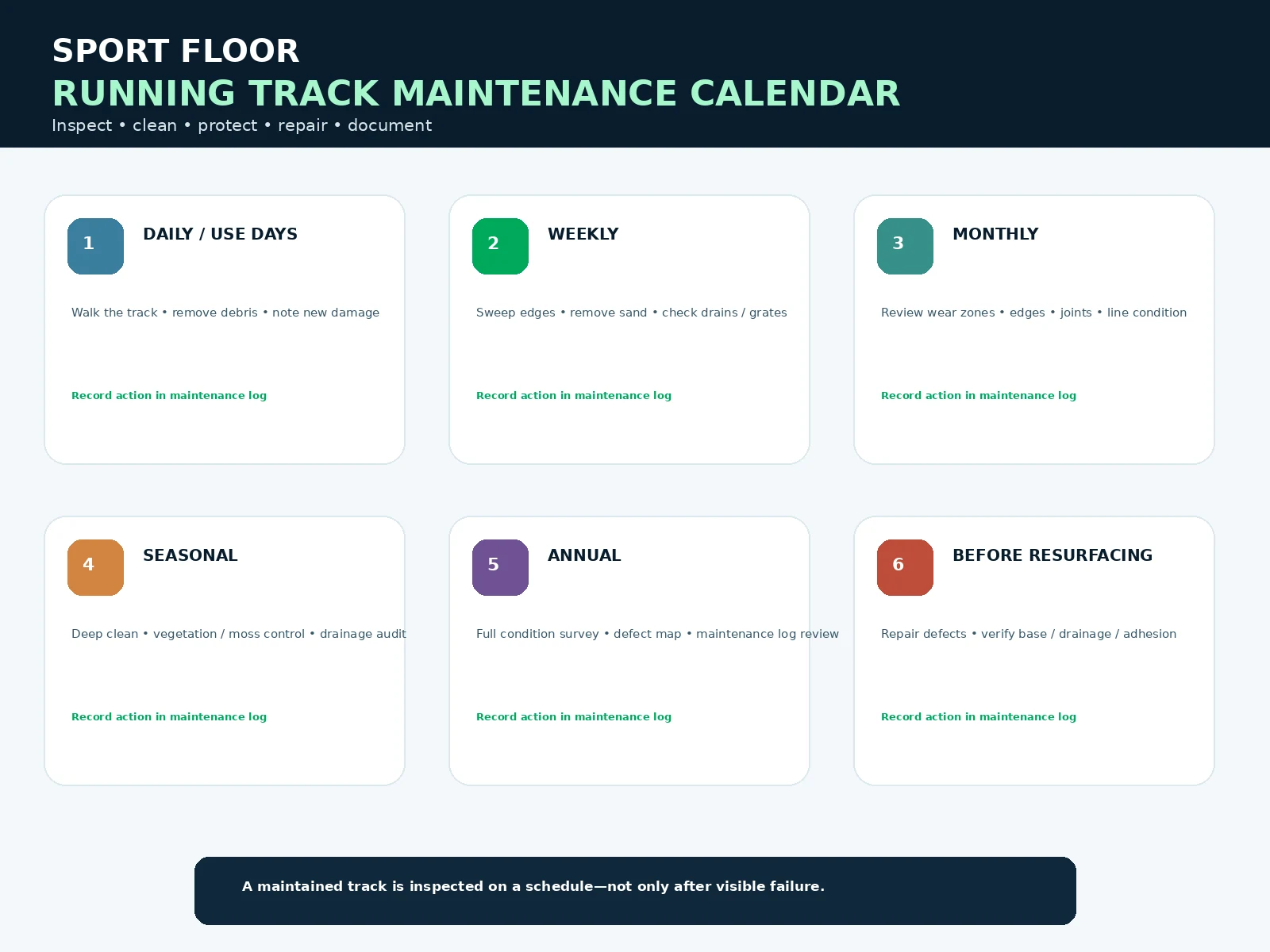
| Frequency | Main tasks | Purpose |
|---|---|---|
| Daily / Use Days | Walk the surface, remove litter and obvious debris, note cuts, loose spots, bubbles or unsafe contamination. | Catch damage before repeated use enlarges it. |
| Weekly | Sweep loose material, remove sand migration, inspect drains, grates, edges and high-use areas. | Protect traction, drainage and surface texture. |
| Monthly | Review markings, wear zones, local repairs, ponding areas and access-control problems. | Identify developing patterns rather than isolated incidents. |
| Seasonal | Deep clean where appropriate, control moss/algae/vegetation, check drainage before wet season, inspect thermal/UV wear after harsh weather. | Prepare the surface for changing environmental loads. |
| Annual | Full condition survey, defect map, repair list, resurfacing assessment and maintenance-log review. | Plan budget before damage becomes urgent. |
| Before Competition / Major Event | Clean, inspect markings, repair defects, verify drainage and review event protection measures. | Reduce operational risk before intensive use. |
Routine cleaning should remove dirt while protecting the installed texture, granules, seams and coatings. Soft manual brushing, compatible mechanical sweeping and water cleaning can all be appropriate depending on the exact surface.
High-pressure cleaning is not automatically suitable for every system. On some surfaces it can loosen poorly bonded granules or damage weak areas. Always follow the current product/manufacturer maintenance guidance for the exact installed system.
Avoid aggressive solvents, unknown degreasers or metal brushes unless specifically approved. A cleaner that removes a stain but softens or discolors the PU is not a successful maintenance product.
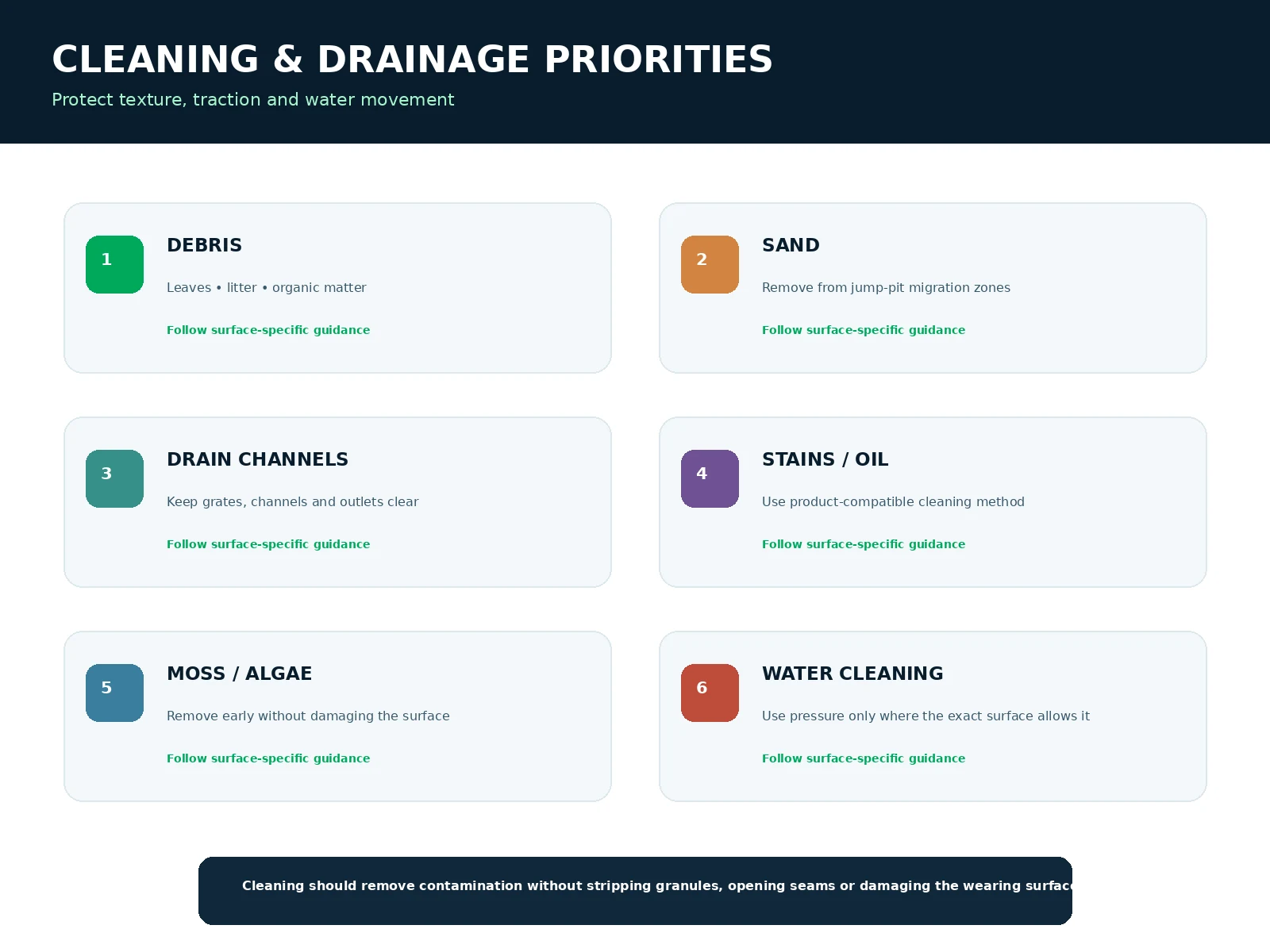
Sand carried from long-jump and triple-jump pits can be ground into the surface by spikes and repeated foot traffic. Over time it can accelerate wear and polish the texture.
Use pit covers where practical, control surrounding housekeeping and remove migrated sand promptly rather than allowing it to build up along runways and adjacent lanes.
Pay special attention to runoff zones and edges where sand accumulates outside the obvious pit area.
Leaves, mud, grass, sand and weeds can reduce drainage capacity even when the original system was correctly designed. Routine drain cleaning is therefore part of surface maintenance, not a separate civil task.
Persistent ponding after drains are cleaned may indicate level loss, settlement or deeper drainage problems. Do not keep treating the water symptom if the surface or base has changed shape.
Athletics tracks are designed for appropriate sports footwear—not unrestricted studs, football/rugby cleats, metal equipment edges or heavy machinery. Facility rules should define permitted spike type and length according to the installed surface and event requirements.
Control unauthorized access and prevent vehicles or maintenance equipment from crossing the track unless the surface is properly protected and the load is acceptable.
Temporary seating, stages, barriers and event equipment can create point loads. Use project-appropriate protection and avoid long-term storage directly on the track.
High training volume and repeated use can accelerate texture loss.
Blocks and concentrated spikes create intense local loading.
Repeated event positioning can create concentrated wear patterns.
High-speed approach and spike use increase abrasion.
Localized impact and spike traffic can accelerate surface loss.
Lateral forces and repeated training lines can create uneven wear.
Pedestrian and equipment routes may wear faster than competition lanes.
Previously repaired zones deserve extra inspection during routine checks.
Food, beverages, oil, fuel, rubber marks and unknown chemicals should be addressed quickly. First remove excess material without spreading it, then use a cleaning method compatible with the installed sports surface.
Unknown solvents can swell, soften, discolor or weaken polyurethane. When contamination is unusual, test the cleaning method on a small inconspicuous area or request product-specific guidance before full treatment.
Moss and algae can reduce traction and hold moisture at the surface. Remove them early using a method that does not damage the synthetic system.
Also inspect why growth is recurring: shade, poor drying, trapped organic matter, blocked drainage or adjacent landscaping may be contributing.
Weeds at edges and channels should be controlled before roots disturb perimeter details or drainage paths.
Routine maintenance is for contamination, minor housekeeping and early detection. Once material is loose, cracked, blistered or delaminated, the intervention becomes a repair problem.
When wear becomes widespread across the upper surface but the lower elastic construction remains sound, resurfacing or re-topping may be more economical and uniform than repeated local patches.
Active base cracks, settlement or major drainage failure move the problem deeper again and may require civil correction or reconstruction.
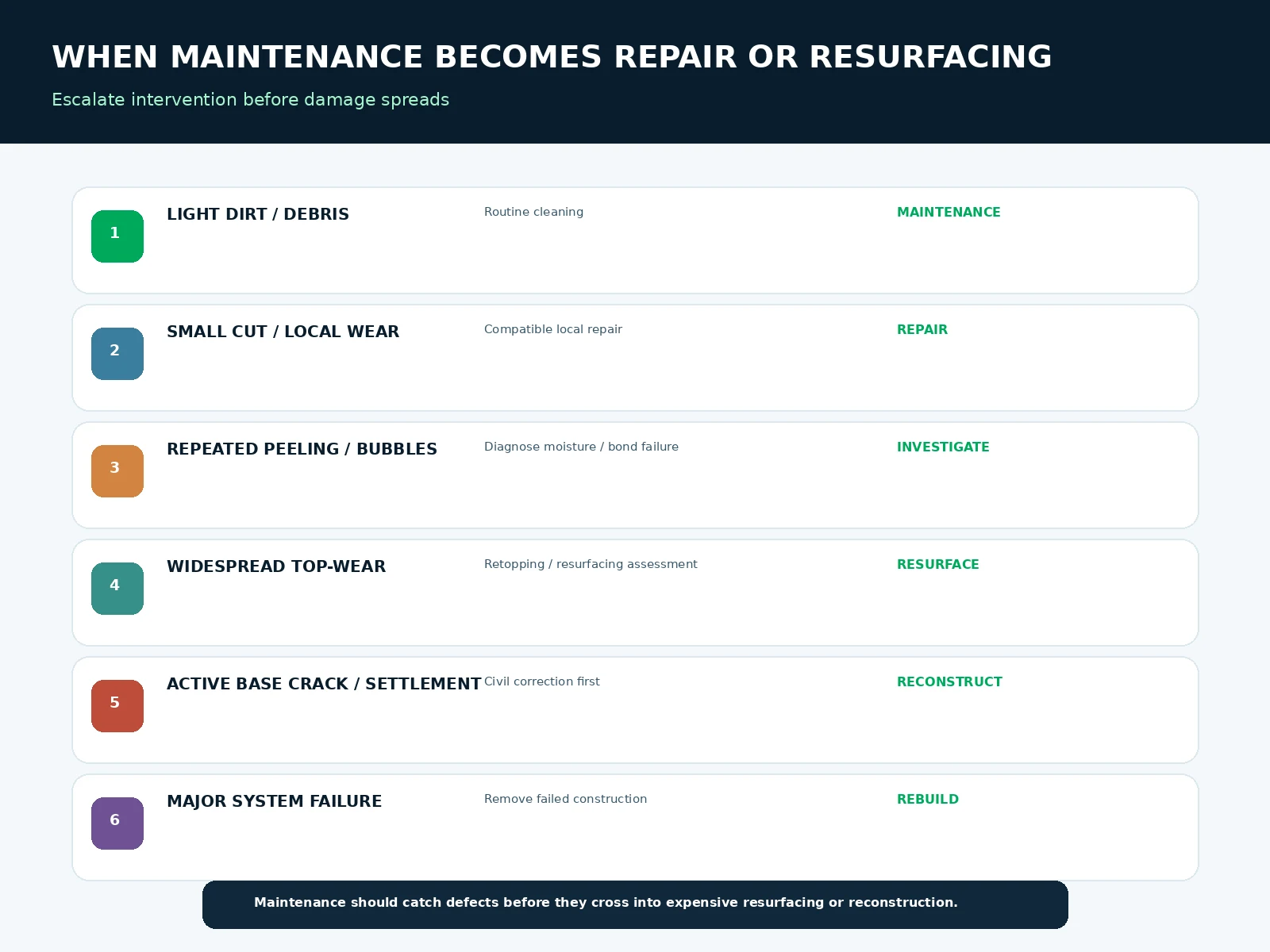
Loose granules, cuts, peeling edges, small delaminated patches and local damage should be reviewed promptly. Repeated loading can enlarge repair boundaries and allow water to enter vulnerable interfaces.
Do not simply add coating over loose material. Correct repair means removing the failed material back to a sound boundary and rebuilding compatible layers.
Resurfacing is most valuable when the upper wearing construction is broadly tired but the lower structure is still worth retaining. Waiting until widespread delamination, severe cracking or base failure develops can eliminate that advantage.
Annual condition reviews should therefore include a forward-looking question: is the track still in a maintenance phase, entering a repair phase or approaching the best time for re-topping?
Compatible primers, binders, pore sealers, PU layers, finishes and adhesives can be supplied for defined repair scopes.
German raw materials are used within applicable Sport Floor polyurethane formulations.
Sport Floor exports track and sports-flooring materials for contractors, distributors and project buyers according to product, quantity and destination.
| Log item | Record | Why it helps |
|---|---|---|
| Date | Inspection / cleaning / repair date. | Builds maintenance history. |
| Location | Lane, curve, runway, D-zone or edge. | Reveals recurring problem zones. |
| Condition | Dirt, wear, crack, bubble, loose area, stain or ponding. | Separates cleaning needs from material failure. |
| Action | Cleaned, repaired, monitored or referred for assessment. | Tracks response effectiveness. |
| Material Used | Product name / batch where relevant. | Supports repair traceability. |
| Photos | Before and after. | Shows progression or stability over time. |
| Follow-Up | Next review date. | Prevents unresolved defects from being forgotten. |
Define permitted spike types and limits for the exact surface.
Protect the surface from machinery and concentrated rolling loads.
Use protection where event equipment or repeated traffic must cross.
Avoid prolonged point loading from materials, seating or barriers.
Reduce staining, litter and burn damage.
Prevent contamination from soaking or spreading.
Control sand migration onto adjacent lanes and runways.
Define coverings and load routes before non-athletics events.
Yes. Routine inspection, cleaning, drainage care, early repair and planned resurfacing help preserve safety, appearance and long-term performance.
Use-day visual inspection is recommended for obvious damage and debris, with more structured weekly, monthly, seasonal and annual reviews.
Cleaning frequency depends on environment and use. Remove debris and sand as soon as practical and plan deeper cleaning according to contamination and the exact surface guidance.
Only when the exact surface manufacturer/system permits it and the equipment is used correctly. Excessive pressure can damage weak areas or dislodge material.
Sand can act as an abrasive under spikes and repeated foot traffic, accelerating wear of the sports surface.
Keep drains, channels and grates clear. If ponding continues, investigate levels, settlement and deeper drainage rather than relying on cleaning alone.
Facility rules should restrict footwear that can damage the surface. Use only footwear appropriate to the installed athletics system and event rules.
Once the material is cut, loose, blistered, delaminated or cracked beyond routine housekeeping, the problem should be assessed as a repair issue.
When upper-surface wear becomes broad but the underlying resilient structure remains technically suitable for retention.
Yes. Sport Floor manufactures polyurethane sports-flooring materials for compatible track repair, resurfacing and construction applications.
Yes. Sport Floor exports running-track and sports-flooring materials to contractors, distributors and project buyers according to product, quantity and destination.
Yes. German raw materials are used within applicable Sport Floor polyurethane formulations. This does not mean the finished product is manufactured in Germany.
Yes. A simple log helps track recurring defects, repairs, cleaning history and when the facility is approaching a resurfacing decision.
Send the track system, age, photos, maintenance history, drainage condition and current defects. Sport Floor can support the correct next step with compatible materials for maintenance-related repair or resurfacing projects.