
Continuous Base
A well-constructed asphalt course can provide a smooth platform without the regular movement joints associated with large concrete slabs.
Both asphalt and concrete can support a high-quality synthetic running track. The better choice depends on the project—not on a universal rule. Each substrate has different behavior, preparation requirements, moisture risks, joint details and primer needs.
Asphalt is widely used for outdoor athletics tracks because it can provide a continuous, accurately graded base with fewer rigid structural joints. Concrete offers a strong, rigid platform but requires careful attention to curing, residual moisture, cracks and movement joints before a seamless polyurethane surface is installed.
Sport Floor combines running-track construction knowledge with direct manufacture of polyurethane sports-flooring materials. German raw materials are used within applicable Sport Floor PU primer and flooring formulations, allowing the substrate-to-surface transition to be specified as one coordinated system rather than unrelated civil and chemical products.
Asphalt and concrete can both produce excellent results when engineered correctly. Problems begin when one substrate is selected by habit and its specific failure risks are ignored.
An asphalt base must be stable, accurately compacted, clean and free from problematic bitumen migration or surface segregation. A concrete base must be fully cured, structurally sound, suitably prepared and within the moisture limits of the selected primer and PU system.
The synthetic track above does not eliminate these differences. Primer chemistry, crack detailing, moisture control and joint treatment must be selected around the substrate below.
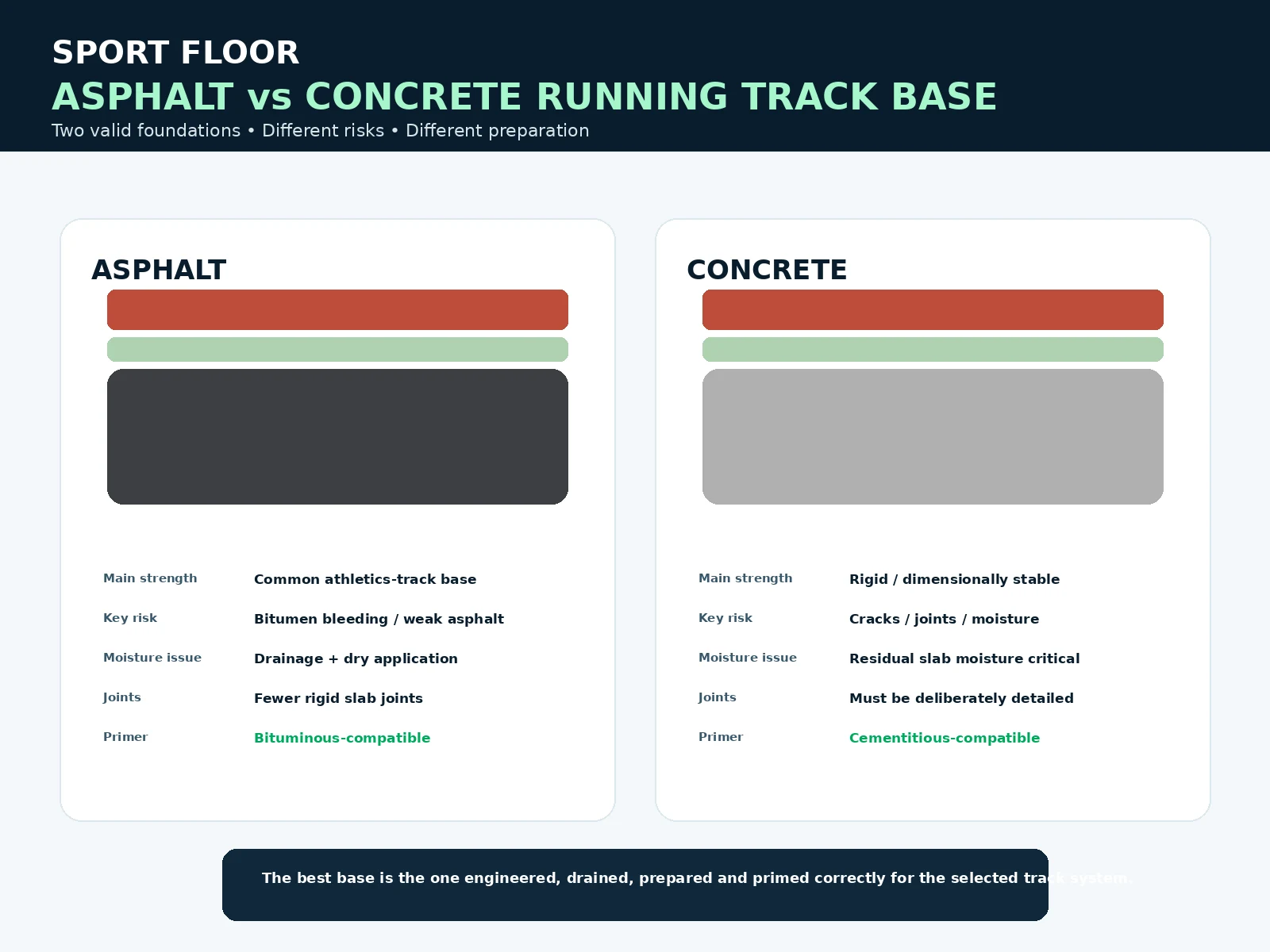
| Decision factor | Asphalt | Concrete |
|---|---|---|
| Typical outdoor athletics use | Very common base route for synthetic running tracks. | Viable where the system and civil design support a rigid mineral substrate. |
| Structural behavior | Bituminous, relatively flexible compared with concrete. | Rigid and dimensionally different from asphalt. |
| Surface continuity | Can provide a largely continuous platform with fewer rigid slab joints. | Construction and movement joints require deliberate treatment. |
| Moisture sensitivity | Drainage and dry application conditions remain essential. | Residual and rising moisture are major pre-surfacing concerns. |
| Crack risk | Settlement or weak asphalt can crack/deform. | Shrinkage, structural and movement cracks can reflect through seamless surfacing. |
| Surface preparation | Stable texture, no loose aggregate, contamination or problematic bitumen bleeding. | May require grinding, shot blasting or other mechanical preparation to remove weak laitance and create a suitable profile. |
| Primer | Primer approved for bituminous/asphalt substrates. | Primer approved for cementitious/mineral substrates and actual moisture condition. |
| Drainage | Falls and drainage routes are integrated into the asphalt/civil design. | Falls and drains must be formed correctly; rigid slab design must avoid trapped water. |
| Renovation assessment | Check oxidation, deformation, cracks and bond condition. | Check cracks, joints, moisture, laitance and structural movement. |
| Best choice | When a high-quality, accurately graded outdoor asphalt platform is practical. | When the rigid slab is correctly engineered and moisture/joint risks can be controlled. |
A well-constructed asphalt course can provide a smooth platform without the regular movement joints associated with large concrete slabs.
Paving and grading can create the precise track levels and drainage falls required by the civil design.
Many in-situ Full PU, Sandwich and Spray Coat systems are designed for properly prepared asphalt substrates with the correct primer.
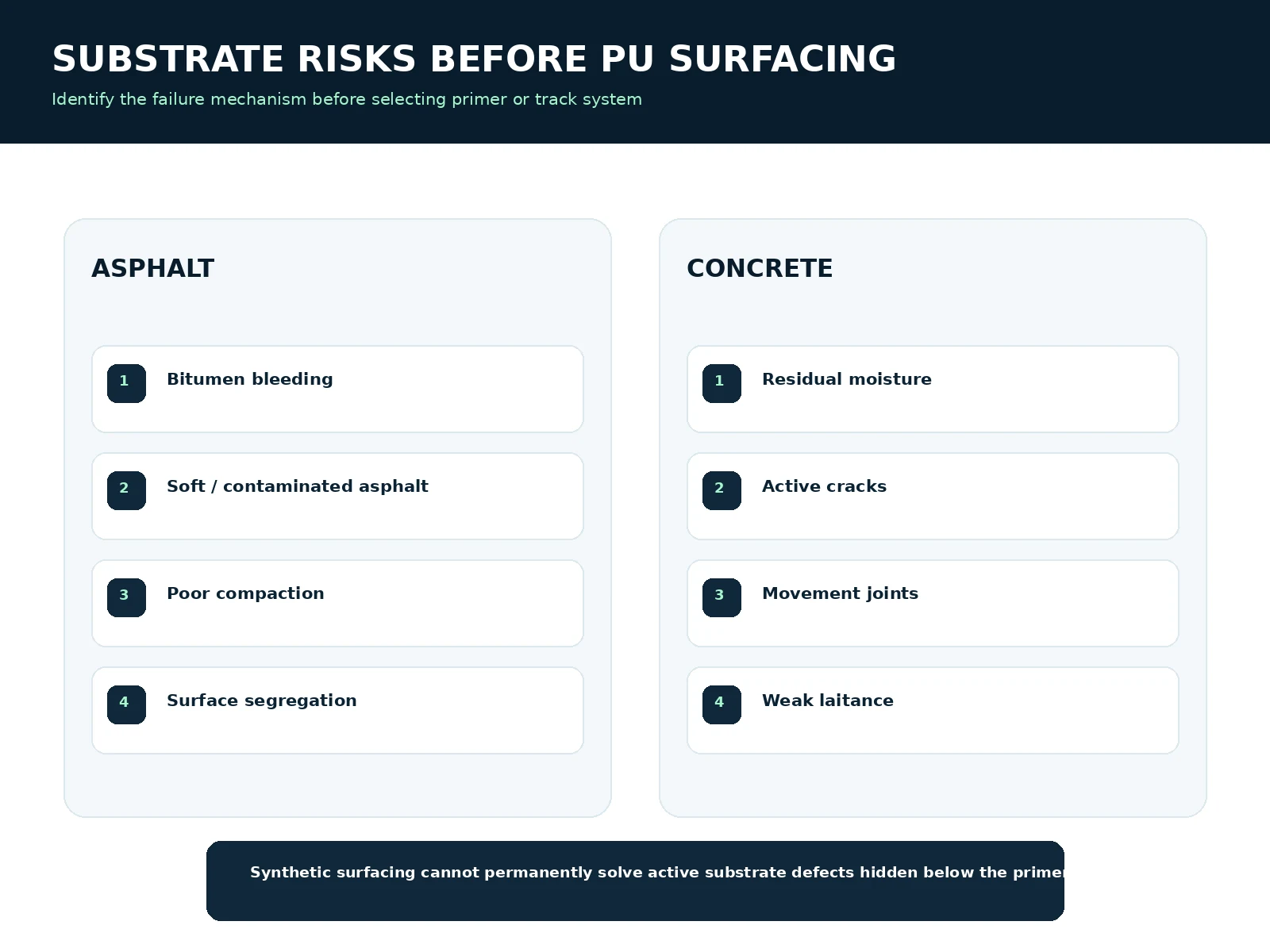
The asphalt should be mechanically stable and fully suitable for sports surfacing. Weak compaction, segregation, loose stone, contamination, excess binder at the surface or bitumen bleeding can reduce adhesion and create visible defects.
Surface texture matters too. A base that is too closed or contaminated can reduce mechanical bonding, while excessively rough or irregular asphalt can increase primer and synthetic-material consumption and create thickness variation.
Settlement or deformation in the supporting civil layers can also show through the asphalt. Synthetic polyurethane is not a structural repair system for a moving foundation.
A correctly designed concrete slab can provide a firm structural platform with excellent load distribution.
When constructed correctly, concrete can achieve accurate geometry and levels for sports-surface installation.
Existing concrete may be retained where inspection confirms structural suitability and moisture/joint issues are resolved.
Moisture trapped in or rising through concrete can contribute to blistering, adhesion loss and coating failure if the system is not designed for it.
Concrete cracking should be investigated before covering the slab with a seamless synthetic surface.
Structural movement joints should be respected and detailed; they should not simply disappear beneath a rigidly bridged PU layer.
Weak cementitious surface material may require mechanical removal before priming and sports-surface installation.
Bituminous and cementitious substrates interact differently with polyurethane systems. The primer is therefore selected by substrate type, substrate condition, moisture, porosity and the track build-up above.
| Primer decision | Asphalt route | Concrete route |
|---|---|---|
| Substrate chemistry | Bituminous. | Cementitious/mineral. |
| Main primer objective | Create reliable bond while remaining compatible with asphalt/bitumen. | Bond to mineral surface while accounting for absorption and moisture condition. |
| Wrong-primer risk | Adhesion problems, bitumen interaction or irregular curing. | Blistering, delamination, poor wetting or moisture-related failure. |
| Sport Floor route | PU Primer Outdoor selected according to current TDS. | PU Primer Outdoor / PU Moisture Barrier Primer where technically appropriate. |
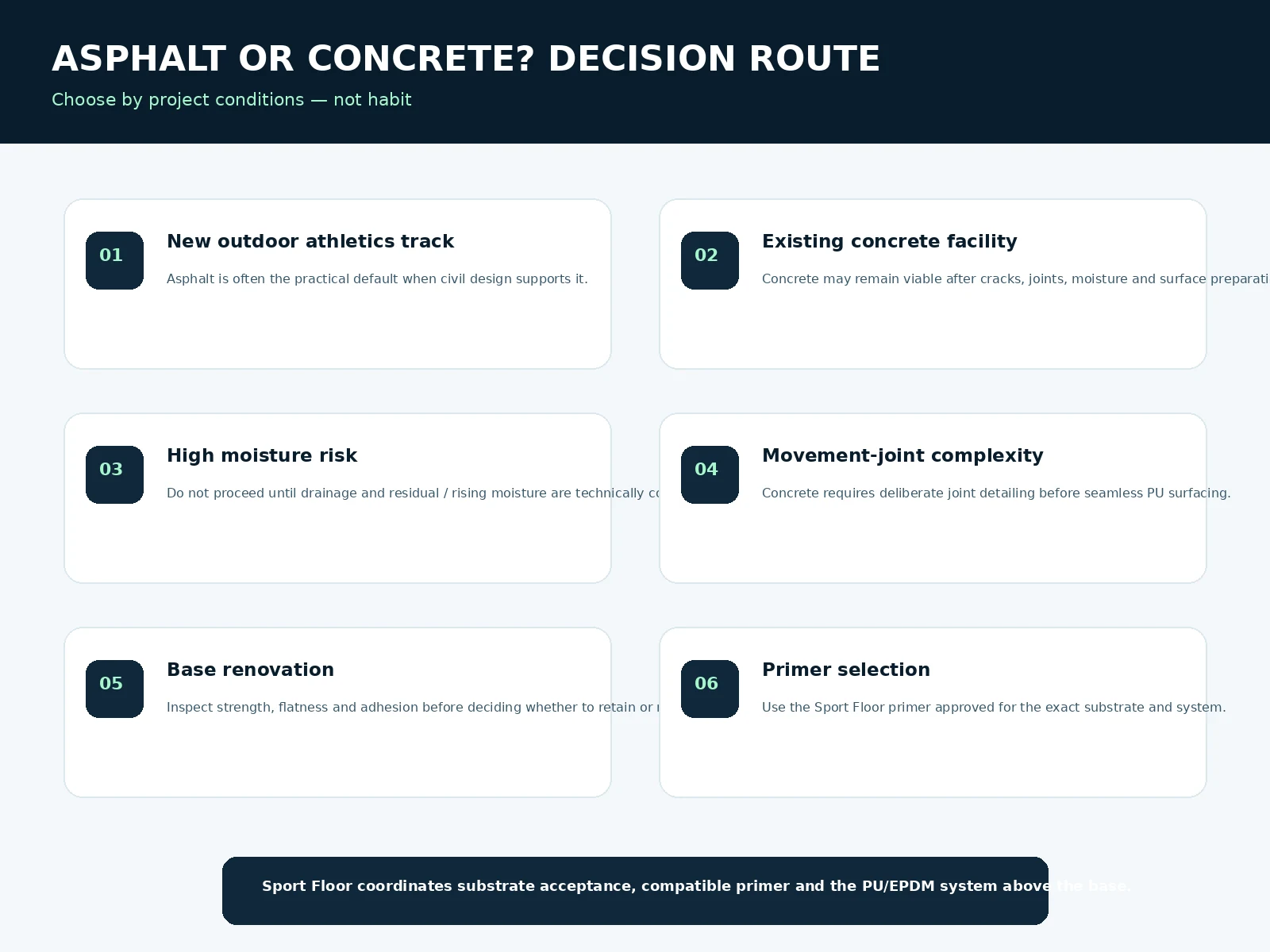
New outdoor track: asphalt is often a practical route when a high-quality paving contractor can achieve the required levels, drainage and surface condition.
Existing concrete facility: reconstruction is not automatically necessary. Concrete may remain suitable if structural movement, cracks, joints, moisture and surface condition are technically resolved.
High groundwater or rising moisture risk: the civil and waterproofing strategy should be solved before any seamless PU surface is considered.
Complex slab joints: concrete may create additional detailing requirements that should be designed rather than hidden.
Renovation: the decision should follow inspection, not the substrate label alone.
| Track system | Asphalt | Concrete | Key check |
|---|---|---|---|
| Full PU | Commonly suitable when prepared and primed correctly. | Possible where concrete condition, moisture and joints meet system requirements. | Precise substrate acceptance + compatible primer. |
| Sandwich | Common route for PU-bound rubber base over asphalt. | Possible with approved mineral-substrate preparation and primer. | Bond of elastic base to substrate. |
| Spray Coat | Common route for porous resilient system construction. | Possible only when the full drainage and substrate design is suitable. | Water-management strategy + adhesion. |
Concrete contains water during curing and may also be exposed to moisture from below or from surrounding ground. Installing a low-permeability synthetic system before the slab meets the selected material requirements can trap moisture and create pressure at the bonding interface.
Where rising moisture is possible, simply waiting longer may not solve the underlying problem. The project may need civil waterproofing, drainage improvement or a compatible moisture-control primer route supported by current Sport Floor data.
No generic moisture percentage should be copied from another manufacturer and presented as a Sport Floor limit. The actual permitted value belongs to the primer and system supplied.
Assess whether the joint is static and whether compatible treatment is technically acceptable under the selected system.
Active structural joints normally require continuity or deliberate detailing; do not hide them below seamless PU without design.
Identify the cause before repair. Structural or active cracking requires more than filling the visible line.
Sport Floor uses German raw materials within applicable polyurethane primer, binder and sports-surface formulations.
Sport Floor manufactures the polyurethane materials used from substrate interface through the final sports-flooring layers.
Sport Floor combines execution knowledge in Egypt with direct international material supply for contractors, distributors and project buyers.
There is no universal answer because the substrate is only one part of the civil works. Local asphalt availability, concrete cost, earthworks, drainage, reinforcement, paving equipment, joint detailing, curing time and renovation conditions all affect the final price.
Asphalt may offer a simpler route for a new outdoor track where specialist paving and accurate grading are available. Existing concrete may be commercially attractive when it can be retained safely rather than demolished and rebuilt. Conversely, repairing a moisture-affected or heavily cracked slab can remove that apparent saving.
The strongest commercial comparison is therefore total installed foundation cost + risk + preparation + expected serviceability, not simply the unit price of asphalt versus concrete.
No unacceptable depressions, ridges or waves.
Falls match the project geometry and drainage strategy.
No loose, weak, pumping or unstable zones.
Within the limits of the actual selected Sport Floor primer/system.
Cause identified and treatment accepted before PU application.
Detailed according to structural movement requirements.
Free of dust, oil, loose material and contaminants.
Approved for the exact substrate and synthetic track system.
Neither is universally better. Asphalt is a common practical outdoor-track base, while concrete can perform very well when moisture, cracks, curing and movement joints are correctly controlled.
It can provide a continuous accurately graded outdoor platform with fewer rigid slab joints and is compatible with many in-situ athletics-track systems when properly prepared and primed.
Yes, where the exact Sport Floor system permits it and the slab is structurally sound, prepared, cured, within moisture limits and correctly primed.
Potentially yes, with the approved substrate preparation and primer route. The elastic base must bond reliably to the concrete substrate.
It may be possible where the complete substrate and drainage design is suitable. A porous surface still needs a functional water-management route.
Poor compaction, unstable areas, segregation, contamination, deformation or problematic bitumen bleeding can compromise adhesion and surface uniformity.
Residual/rising moisture, active cracking and movement joints are among the most important risks before seamless polyurethane surfacing.
It may. Grinding, shot blasting or other suitable methods can be required to remove weak laitance or create the surface profile needed by the selected primer.
Do not assume so. Bituminous and cementitious substrates have different chemistry and absorption. Use the Sport Floor primer approved for the actual substrate and system.
No. Rising moisture, poor drainage or hydrostatic pressure may require civil correction. A primer should only be used within its documented technical limits.
Project economics depend on local material cost, drainage, earthworks, paving, reinforcement, repairs, joints, curing and whether an existing base can be retained.
Yes. Sport Floor manufactures polyurethane sports-flooring materials, including primer products for compatible systems.
Yes. German raw materials are used within applicable Sport Floor polyurethane formulations.
Yes. Sport Floor can coordinate polyurethane, EPDM, SBR and related sports-flooring materials for international project supply.
Send the site condition, existing base, drainage, cracks/joints, moisture information, selected track system and destination. Sport Floor can help define the substrate-preparation and polyurethane material route for the project.