
Granule Size
Finer granules normally present greater total surface area and can change coating demand compared with coarser granules.
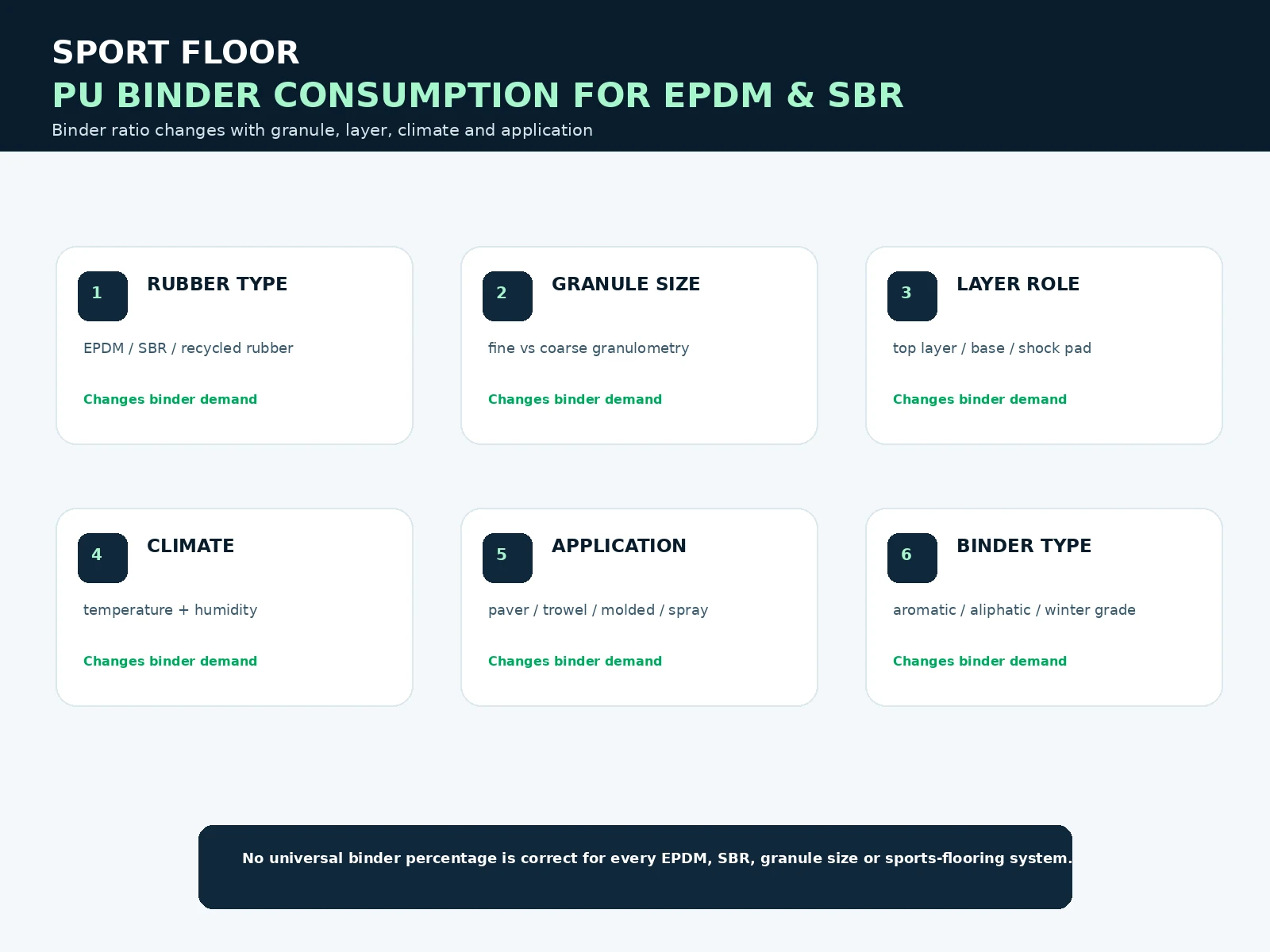
There is no single polyurethane binder percentage that is correct for every EPDM or SBR application. Binder demand changes with rubber type, granule size and shape, layer function, compaction, temperature, humidity, application method and the chemistry of the binder itself.
A resilient SBR base layer, an exposed EPDM wet-pour surface, a running-track shock layer and a molded rubber tile can all use polyurethane binder—but they should not automatically use the same ratio.
Sport Floor manufactures polyurethane sports-flooring binders and related PU products using German raw materials within applicable formulations. The correct project quantity is therefore calculated from the actual Sport Floor binder, the actual granule and the actual system—not from a generic percentage copied from another brand.
Fine granules expose more total surface area than coarse granules of the same weight. Irregular recycled rubber can behave differently from purpose-made EPDM. Fibres, dust, contamination, granule shape and material quality can also change how effectively the binder coats and connects the particles.
International manufacturers explicitly warn that binder consumption may need adjustment when rubber type, fibres, granule shape or grain size change. This is why one binder percentage cannot be treated as a universal market rule.
The target is sufficient coating and cohesion without creating an over-rich mixture that becomes unnecessarily expensive, sticky, slow to cure or different from the approved system behavior.
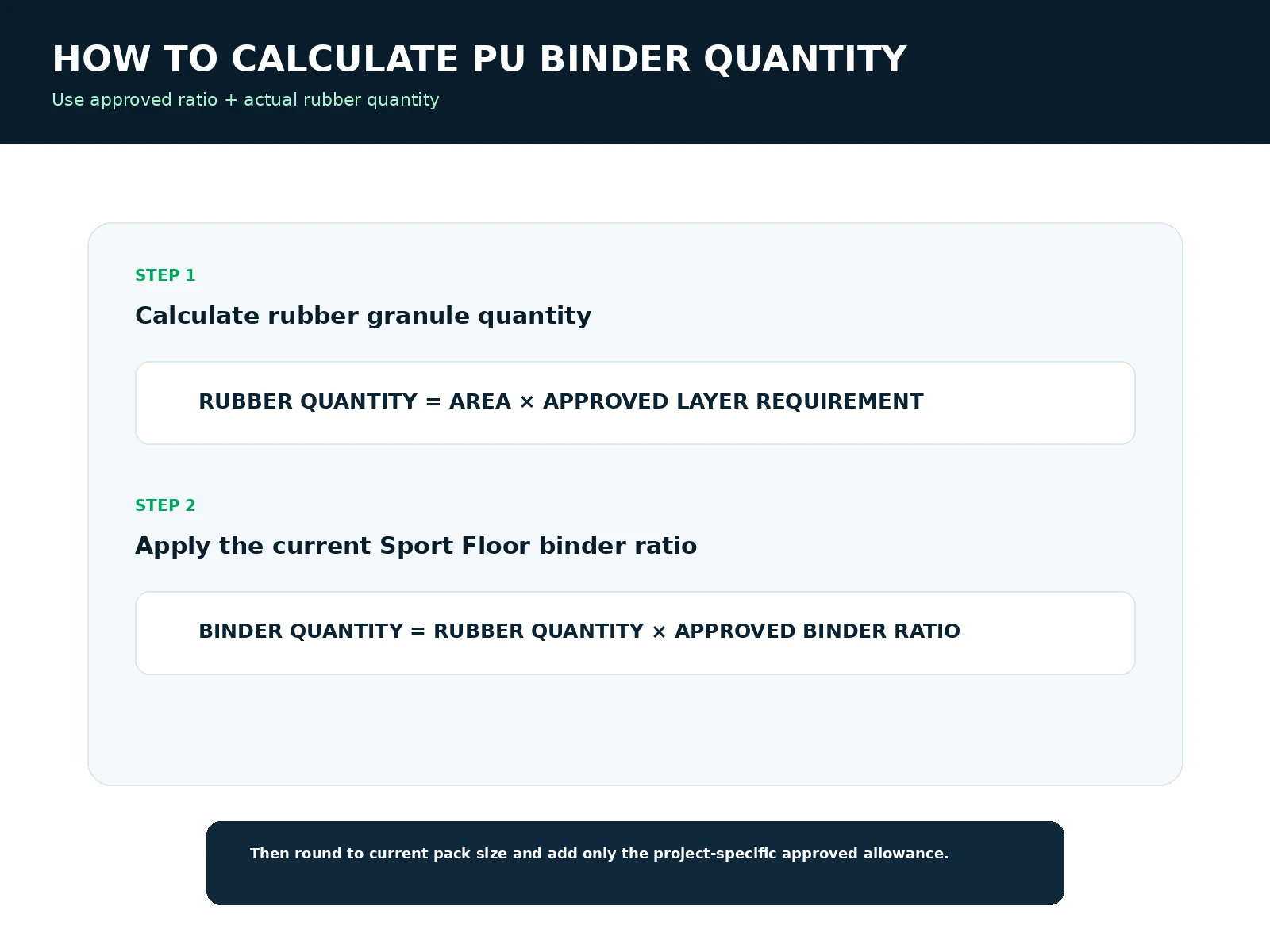
This is safer than starting from “binder per square metre” because the binder is functionally tied to the rubber quantity. When the rubber layer, density, thickness or granule type changes, the binder requirement may change with it.
Finer granules normally present greater total surface area and can change coating demand compared with coarser granules.
Irregular recycled particles, cut EPDM and other shapes can pack and coat differently.
EPDM, SBR and other recycled rubber materials can require different binder approaches.
Exposed top layers, resilient bases, shock pads and molded products do not share one performance requirement.
Moisture-curing polyurethane reacts with ambient conditions, affecting working time and cure behavior.
Aromatic, UV-stable, aliphatic and winter-grade binders can serve different installation and exposure requirements.
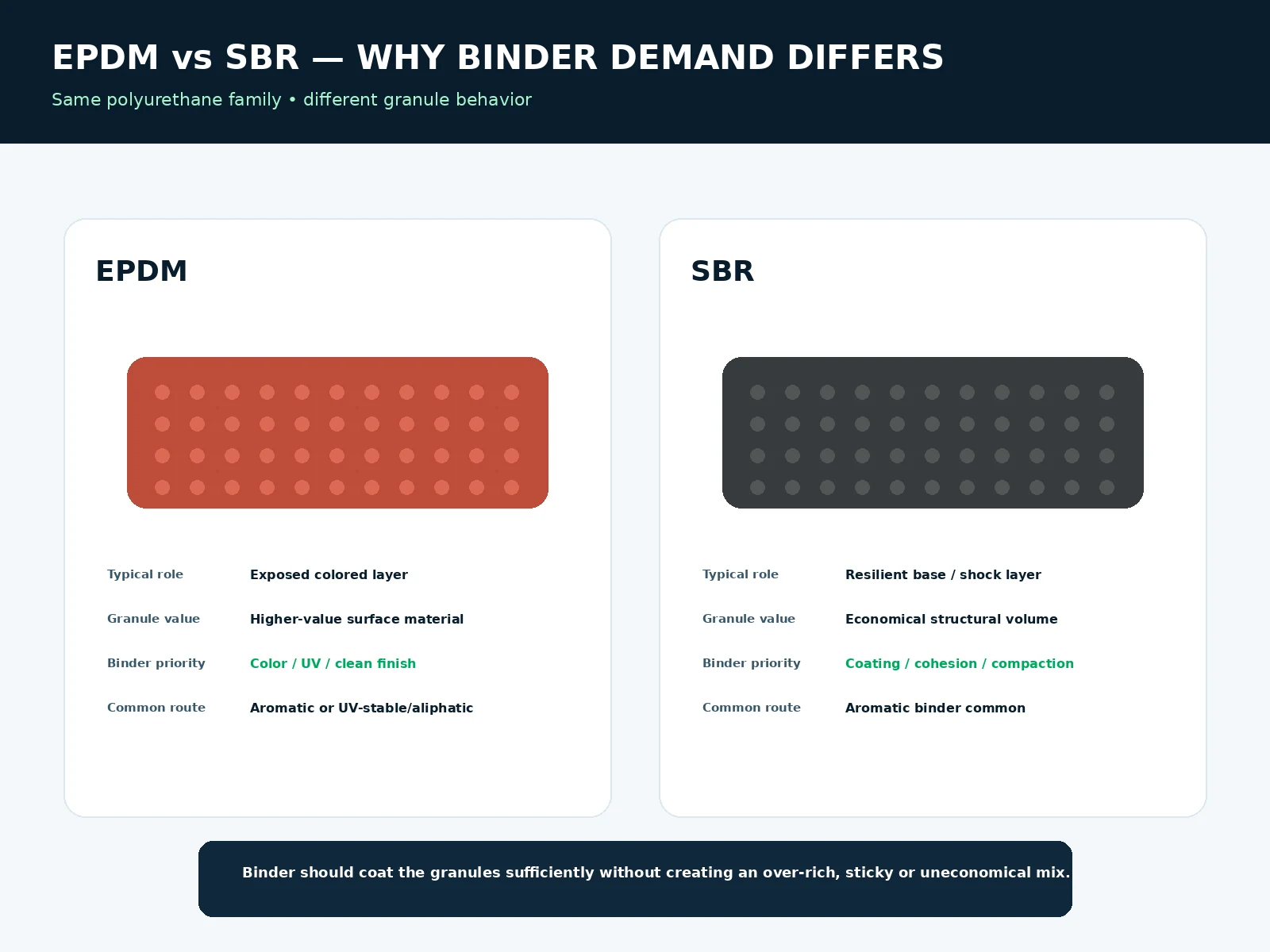
EPDM is commonly used in exposed colored surfaces. Here the binder must provide reliable cohesion while supporting the visual and weather-facing role of the top layer. For sensitive colors or higher UV/color-stability requirements, the binder family may also change.
SBR is commonly used in resilient base layers. Here the commercial priority is normally efficient coating and reliable bonding of a larger rubber volume that is hidden beneath the wearing surface.
Because the layer functions differ, a project may deliberately use one binder route below and another above.
Current manufacturer documents provide useful evidence of the principle. KDF publishes one system example in which a 10 mm SBR layer uses a different binder-to-rubber relationship from a 10 mm EPDM layer. CONICA likewise states that binder quantity must be adjusted when rubber type, fibres, particle shape or grain size changes.
Those figures belong to the manufacturers and products that published them. They should not be copied into a Sport Floor tender, TDS or quotation.
| What industry documentation demonstrates | Meaning for the buyer | Sport Floor approach |
|---|---|---|
| SBR and EPDM can use different binder ratios | Rubber chemistry and layer function matter. | Calculate each layer independently from current Sport Floor data. |
| Different granule sizes can change consumption | One percentage cannot automatically be reused across granulometries. | Confirm the actual EPDM/SBR size before final calculation. |
| Different rubber quality can change binder demand | Fibres, shape, dust and contamination can influence coating behavior. | Use the supplied granule specification, not only total tonnes. |
| UV-sensitive applications may use another binder family | Binder choice is not only a quantity decision. | Select aromatic or UV-stable/aliphatic route according to system requirement. |
| Low-temperature products exist | Climate can influence both product choice and application. | Confirm project temperature/humidity before final material selection. |
A common manufacturer-direct route for SBR bases and many EPDM/rubber applications where the exact system permits it.
Useful where exposed color performance has higher importance than in a hidden resilient base.
Selected where stronger color/UV stability is required for exposed premium surfaces, subject to system design.
Some manufacturers provide specific moisture-curing binder grades for lower-temperature installation conditions.
| Application | Granule role | Binder calculation logic | What must be confirmed |
|---|---|---|---|
| Wet-Pour EPDM Top Layer | Exposed colored wearing layer. | EPDM quantity × current approved Sport Floor top-layer binder ratio. | EPDM size/color, exposure, binder type, layer thickness. |
| Wet-Pour SBR Base | Resilient shock-absorbing lower layer. | SBR quantity × current approved base-layer binder ratio. | SBR size, base thickness, compaction and layer density. |
| Sandwich Running Track | PU-bound SBR resilient base. | Calculated SBR quantity × current Sandwich binder ratio. | Granule grade, layer build-up and current system data. |
| Spray Coat Running Track | PU-bound SBR resilient base. | Calculated base granules × current binder ratio. | Porosity, layer thickness and system specification. |
| Rubber Tiles / Molded Products | Molded rubber body. | Binder by rubber weight according to production formulation. | Granule size, molding pressure/temperature and product formulation. |
| Shock Pad / Base Mat | Prefabricated or in-situ resilient layer. | Binder ratio follows rubber/foam type and required performance. | Granule type, target density and manufacturing/application method. |
Can contribute to weak cohesion, loose granules, reduced integrity or incomplete coating where the ratio falls below what the tested system requires.
Can increase cost unnecessarily and may change porosity, texture, compaction, cure behavior or surface appearance.
Should create the bonding and coating required by the exact Sport Floor system without uncontrolled excess.
Many one-component polyurethane binders cure through atmospheric moisture. Temperature and humidity therefore influence working time, skin formation and curing behavior.
Higher temperature can shorten working time. Low temperature can slow curing and may require a binder grade designed for colder conditions. Excess moisture or wet granules can also affect the installation.
This is why the project should confirm ambient conditions before selecting the binder route and installation procedure. Quantity alone does not define a successful mix.
Use controlled batch weights rather than estimating granules by shovel or volume.
Calculate from the actual rubber batch using the approved ratio.
All granules should receive consistent coating without visible dry zones or binder pooling.
Keep granules and opened binder protected according to current technical instructions.
Adjust batch size and installation sequence to ambient conditions and current product data.
Consistent batch records help control project consumption and traceability.
Compare actual binder use with planned quantity to detect uncontrolled deviation early.
Current Sport Floor technical data takes priority over generic internet formulas.
| Step | Input | Output |
|---|---|---|
| 1. Rubber quantity | Total required EPDM or SBR mass for the defined layer. | kg / tonne of rubber. |
| 2. Binder ratio | Current approved Sport Floor ratio for that rubber/application. | Theoretical binder mass. |
| 3. Project allowance | Only approved handling/site allowance where required. | Procurement binder mass. |
| 4. Packaging | Current drum/pail size. | Number of complete packs. |
| 5. Phasing | Project sequence and storage plan. | Shipment/batch schedule. |
| 6. Documents | TDS, SDS, packing and consultant requirements. | Commercial/technical supply package. |
Sport Floor uses German raw materials within applicable polyurethane binder formulations for sports-flooring applications.
Sport Floor manufactures its PU binders and surrounding polyurethane product family, allowing material selection to be coordinated at system level.
Sport Floor combines product manufacturing, field application experience and direct international supply for contractors and project buyers.
EPDM, SBR, recycled rubber or other compatible granule.
Required granulometry and available supplier specification.
Wet pour, running track, shock pad, tile production or another use.
Exposed top layer, resilient base, molded product or prefabricated mat.
Known tonnes/kg or project area and approved layer build-up.
Expected application temperature and humidity range.
Country, city and preferred port/delivery point.
TDS, SDS, tender or consultant-submittal requirements.
Use the actual EPDM quantity and the current Sport Floor binder ratio for the exact granule size, layer function and application. There is no single universal EPDM binder percentage.
Calculate the SBR quantity first, then apply the current Sport Floor binder ratio for that SBR grade and system. Base-layer ratios should not be copied from unrelated products.
Do not assume so. Published manufacturer systems show different ratios for different rubber types and layer functions.
Fine granules can create more total particle surface area per unit weight, changing the coating and bonding requirement.
Yes. Particle shape, fibres, dust and material quality can change packing and coating behavior.
Binder quantity = actual rubber granule quantity × current approved Sport Floor binder ratio for the exact application.
It can be used in compatible systems, but exposed sensitive colors may require a UV-stable or aliphatic binder route depending on the desired appearance and system specification.
It is generally considered where exposed color and UV stability are a higher priority. Use the Sport Floor product/system specified for the actual project.
Yes. Many one-component binders cure with atmospheric moisture, and temperature/humidity can influence working time and curing behavior.
Yes. Excess binder can increase cost and may change texture, porosity, compaction or curing behavior from the intended system.
Yes. Insufficient binder can reduce coating and cohesion and may contribute to weak or loose granules.
No. Their published values belong to their own products and granules. Use current Sport Floor technical data for Sport Floor materials.
Yes. Sport Floor manufactures polyurethane sports-flooring binder products and related PU materials.
Yes. German raw materials are used within applicable Sport Floor polyurethane formulations.
Yes. International buyers can request coordinated PU binder, EPDM, SBR and related sports-flooring material supply at info@sportfloor-m.com.
Send the rubber type, granule size, application, layer role, quantity, climate and destination. Sport Floor can calculate the appropriate manufacturer-direct binder quantity from current product and system data.