
Running Tracks
EPDM is used in exposed track surfaces, broadcast layers and spraycoat formulations depending on the selected track system.
EPDM and SBR are both widely used rubber granules in sports flooring, athletics tracks, wet-pour surfaces and playground systems—but they are normally selected for different layer functions.
EPDM is commonly chosen for exposed colored wearing layers because it offers color options and strong outdoor suitability. SBR is commonly used as the economical resilient base layer where shock absorption, bulk depth and cost efficiency are more important than visible color.
Sport Floor supplies EPDM and rubber granules alongside its own polyurethane sports-flooring products. German raw materials are used within applicable Sport Floor PU binder formulations, allowing buyers to coordinate granules and compatible binders through one supplier for running tracks, wet-pour flooring and other resilient sports systems.
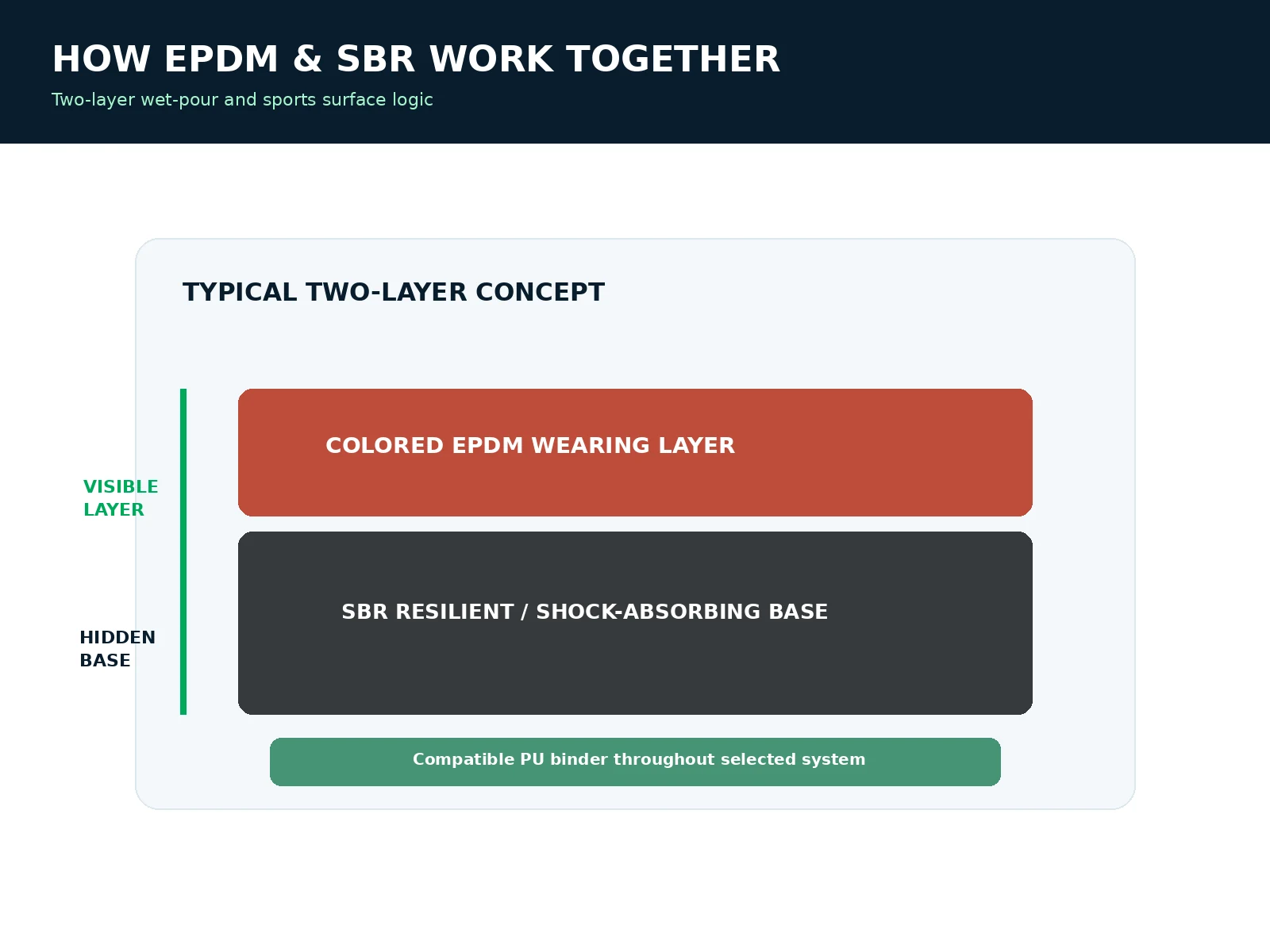
In many wet-pour and sports-flooring systems, SBR creates the lower resilient body while EPDM creates the exposed colored surface. This arrangement allows the project to use a more economical rubber material where it is hidden, while reserving the higher-value colored granule for the visible wearing layer.
The same logic appears in athletics systems: recycled or black rubber granules are commonly used in resilient base layers, while EPDM can be broadcast or sprayed into the upper track surface depending on Full PU, Sandwich or Spray Coat architecture.
Therefore, the correct question is not simply “Is EPDM better than SBR?” The better question is: Which layer are you designing, what is exposed to weather, what color is required, and what performance must that layer provide?
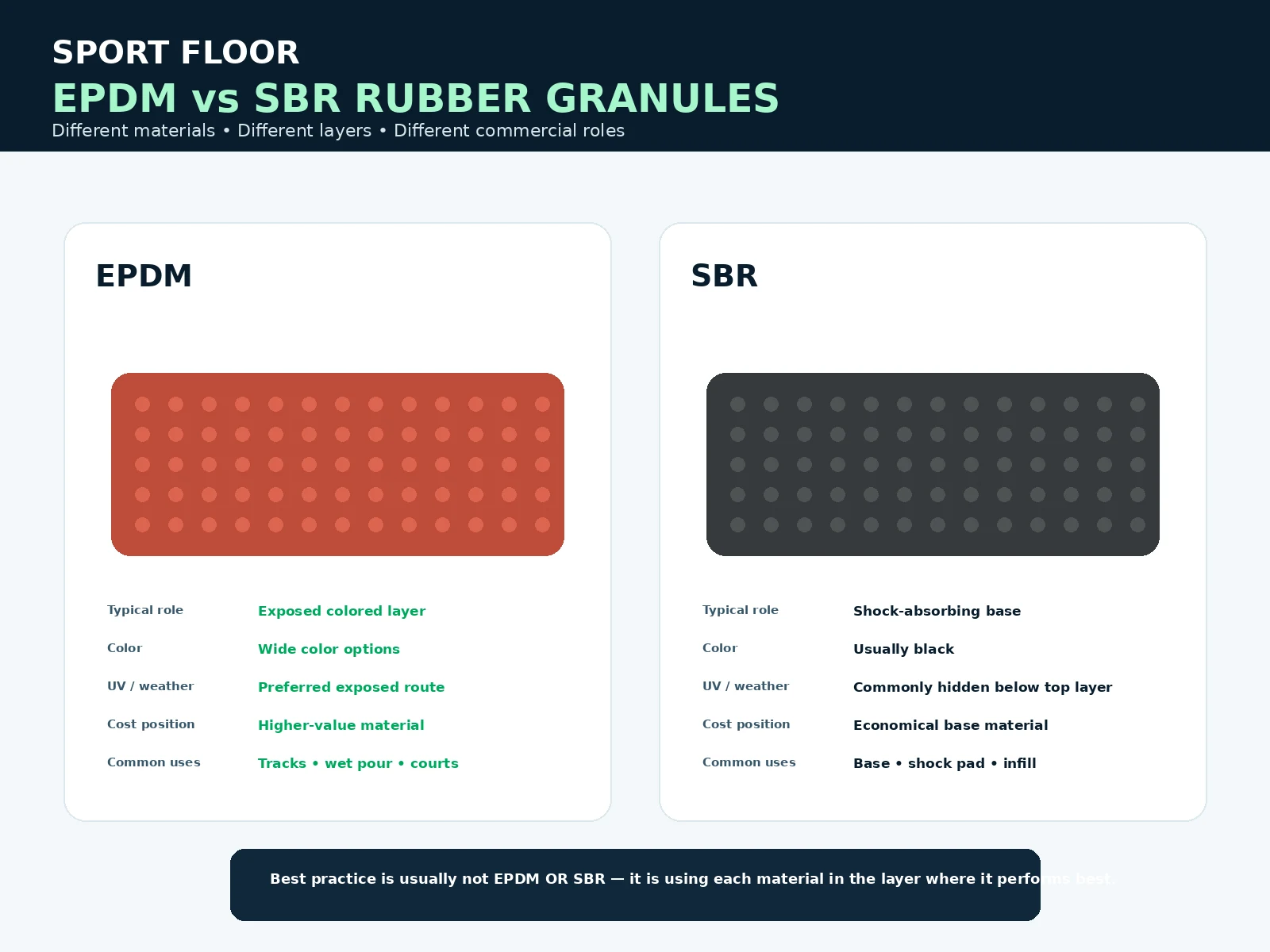
| Decision factor | EPDM Rubber Granules | SBR Rubber Granules |
|---|---|---|
| Typical system role | Exposed wearing / colored surface layer. | Resilient shock-absorbing lower/base layer. |
| Appearance | Available in colored formulations and surface-design options. | Commonly black when derived from recycled tyre rubber. |
| Outdoor exposure | Commonly selected for exposed outdoor sports and playground surfaces. | Commonly used below the exposed surface, although application depends on system. |
| UV / color priority | Preferred where visible color stability is important; actual performance depends on product formulation and testing. | Color stability is usually less commercially important in hidden base layers. |
| Relative material cost | Generally higher-value than recycled SBR. | Generally more economical for building resilient thickness. |
| Running tracks | Broadcast/surface granules in compatible Full PU, Sandwich and Spray Coat systems. | Resilient base granules and some PU-rich system layers depending on architecture. |
| Wet pour | Colored top layer. | Shock-absorbing lower layer. |
| Artificial turf | Can be used as performance infill in selected systems. | Commonly used as recycled-rubber infill where permitted/specifically selected. |
| Binder requirement | Compatible PU binder selected around granule, exposure and color requirement. | Compatible PU binder selected around rubber type, layer role and system. |
| Sport Floor route | EPDM Granules | Rubber Granules |
The lower SBR layer provides resilient depth and helps manage impact. Because it is hidden below the exposed finish, black recycled rubber can perform this structural role without paying for premium colored material through the full depth.
The upper EPDM layer then provides the visible wearing surface, color design and direct weather exposure route. Both layers are normally installed with compatible polyurethane binder selected for the actual system.
This layered approach is common in playground and recreational wet-pour systems because it separates impact function from surface appearance and exposure.
EPDM is used in exposed track surfaces, broadcast layers and spraycoat formulations depending on the selected track system.
Colored EPDM creates the visible wearing layer over the lower shock-absorbing base.
Compatible EPDM-based resilient surfaces can provide color and outdoor sports-floor functionality.
EPDM can be specified where the selected binder and complete system suit the intended environment.
Color flexibility supports landscape, park and recreational surfacing.
EPDM can be incorporated into prefabricated resilient flooring products.
Selected EPDM products can be used as premium infill where the turf system calls for it.
Projects can use contrasting colors to separate sports, routes, activity zones or design elements.
SBR is commonly used as the lower shock-absorbing layer beneath colored EPDM.
PU-bound SBR forms the resilient base in Sandwich and Spray Coat systems.
Recycled rubber granules can also appear within PU-rich track architectures depending on system design.
Recycled SBR has long been used as an infill route in compatible synthetic-turf systems.
SBR granules can be PU-bound into resilient sublayers below sports and recreational surfaces.
Recycled rubber can form the body of resilient tiles where the product specification requires it.
SBR-based materials are commonly used in impact-managing rubber flooring products and underlayers.
Using SBR below a premium surface reduces the need to build the entire resilient depth from higher-cost EPDM.
| Track system | SBR role | EPDM role | System page |
|---|---|---|---|
| Full PU | May be used in embedded/broadcast recycled-rubber layers according to exact PU-rich design. | Commonly forms the exposed upper granule surface. | Full PU Running Track |
| Sandwich | Forms the PU-bound resilient base. | Used in the dense exposed upper layer / broadcast surface. | Sandwich Running Track |
| Spray Coat | Forms the resilient base layer. | Fine EPDM can be mixed into the sprayed PU wearing coat. | Spray Coat Running Track |
A premium material in the wrong layer can waste budget without improving the system. Filling the entire resilient depth with colored EPDM is often commercially unnecessary when a hidden SBR base can provide the required bulk resilience.
Likewise, using black SBR as the exposed finished surface may not meet the project's color, aesthetics, weathering or surface-design requirements.
The best-value build-up normally assigns the most appropriate material to each layer, then selects the binder and granule size required by that exact system.
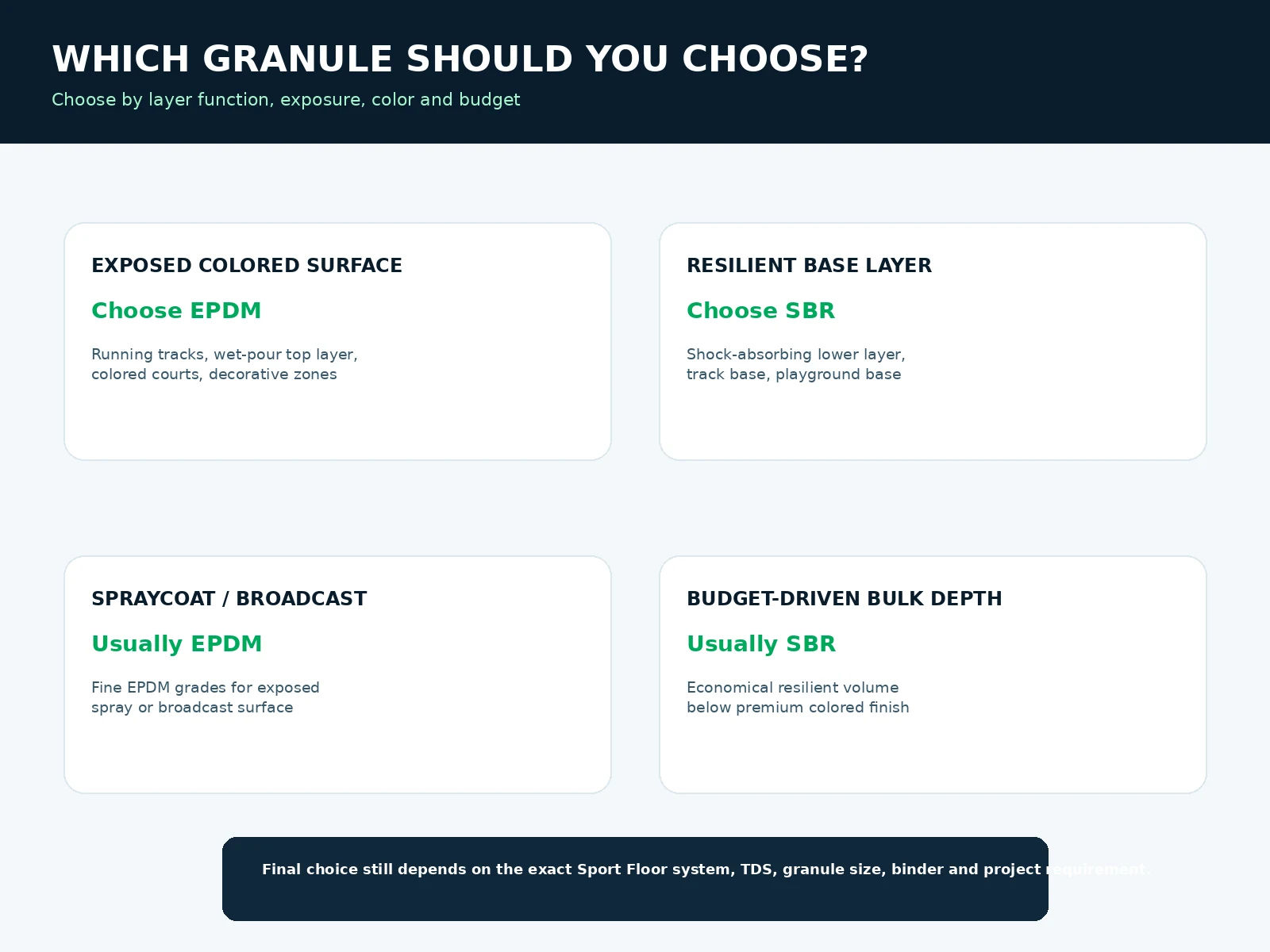
Fine granules can suit spray-applied surfaces or detailed finishing, while larger granules may be selected for wet-pour layers, resilient bases or other applications. The correct size depends on surface texture, porosity, binder demand, compaction and system design.
| Application | Typical granule-selection logic | What to verify |
|---|---|---|
| Spray Coat Track | Fine EPDM grade mixed with PU spray resin. | Current Sport Floor granule size and spray-system TDS. |
| Sandwich / Full PU Top | EPDM broadcast grade selected for the dense PU layer. | Granule size, embedment and consumption. |
| Wet-Pour EPDM Layer | Colored EPDM grade chosen for texture, appearance and system thickness. | Binder ratio and finished texture. |
| SBR Base | Rubber size selected around resilient depth, compaction and pore structure. | Binder ratio, layer density and thickness. |
| Artificial Turf Infill | Size selected to match turf system and infill specification. | Turf manufacturer/system requirement. |
A common route for resilient SBR/rubber layers and compatible granule applications. Exact suitability should follow the current Sport Floor TDS.
Useful where exposed color and UV stability carry greater priority, depending on the exact system and granule choice.
Sport Floor uses German raw materials within applicable polyurethane binder formulations supplied with rubber and EPDM systems.
SBR is commonly the more economical choice for building resilient volume because it is often produced from recycled tyre rubber. EPDM is generally positioned as a higher-value material due to its colored surface role, formulation and exposure requirements.
This does not mean SBR is “low quality” and EPDM is “high quality” in every context. A well-designed system intentionally uses SBR where SBR is technically appropriate and EPDM where EPDM adds real value.
The biggest commercial mistake is paying for premium colored granules in a hidden structural layer that does not need them—or reducing the visible surface quality simply to save on the top layer.
Confirm whether the product is EPDM, SBR/recycled rubber or another rubber composition.
Request the available granulometry appropriate to the planned surface layer.
For EPDM, confirm current standard and custom color availability before specifying a project palette.
For recycled rubber, check cleanliness and separation of unwanted metal/fiber contamination.
Use actual test data where UV, weather or color-stability performance is contractually required.
The granule and polyurethane binder should be selected as a compatible system.
Request current TDS/SDS and available supporting test documentation.
Confirm bag size, pallet/big-bag route and shipment planning for the actual order.
Sport Floor supplies EPDM and rubber granules for compatible sports, wet-pour and track applications.
Sport Floor manufactures polyurethane binders and other PU sports-flooring materials used around these granules.
Contractors, distributors and importers can source coordinated granule and PU material packages for overseas projects.
EPDM, SBR/rubber or request a system recommendation.
Running track, wet pour, playground, turf infill, tile production or another use.
Top layer, base layer, broadcast, spray or infill.
Provide the requested granulometry where specified.
For EPDM, provide required colors or project palette.
Required kilograms/tonnes or project area for calculation.
Country, city and preferred port/delivery point.
TDS, SDS, test data or tender-submittal requirements.
EPDM is commonly selected for exposed colored wearing surfaces, while SBR is commonly used as an economical resilient base or shock-absorbing layer.
Not universally. EPDM is usually better suited to exposed colored surface roles, while SBR is often better value for hidden resilient depth. The correct material depends on the layer function.
EPDM is generally a purpose-formulated colored rubber material, while SBR used in sports flooring is often produced from recycled tyre rubber. Actual pricing depends on grade, color, size, quantity and market conditions.
It can be used in some rubber applications, but two-layer playground wet-pour systems commonly use SBR below and colored EPDM above where color and exposed-surface quality are required.
EPDM can provide the exposed textured granule surface in compatible Full PU, Sandwich and Spray Coat track systems.
PU-bound SBR provides resilient depth at a more economical material position beneath the upper track layers.
Yes. Many wet-pour and athletics systems intentionally combine an SBR resilient base with an EPDM exposed upper surface.
EPDM is commonly selected for exposed outdoor colored surfaces and can offer strong weather/color performance, but any specific UV claim should come from current product test data.
The correct granulometry depends on spraycoat, broadcast, wet-pour, resilient-base or infill use. Request the current Sport Floor specification for the intended system.
Binder selection depends on the exact granule, surface exposure, color requirement and system. Aromatic and aliphatic/UV-stable routes serve different commercial and technical priorities.
Yes. Sport Floor manufactures polyurethane sports-flooring materials, including PU binder products.
Yes. German raw materials are used within applicable Sport Floor polyurethane formulations.
Yes. International contractors, distributors, importers and project buyers can request coordinated granule and PU material supply at info@sportfloor-m.com.
Send the application, layer role, granule size, color, quantity and destination. Sport Floor can prepare a coordinated EPDM, SBR/rubber and polyurethane binder package for your sports-flooring project.