
SBR Base
Typically recycled black rubber used for resilient structural layers where the approved system specifies it.
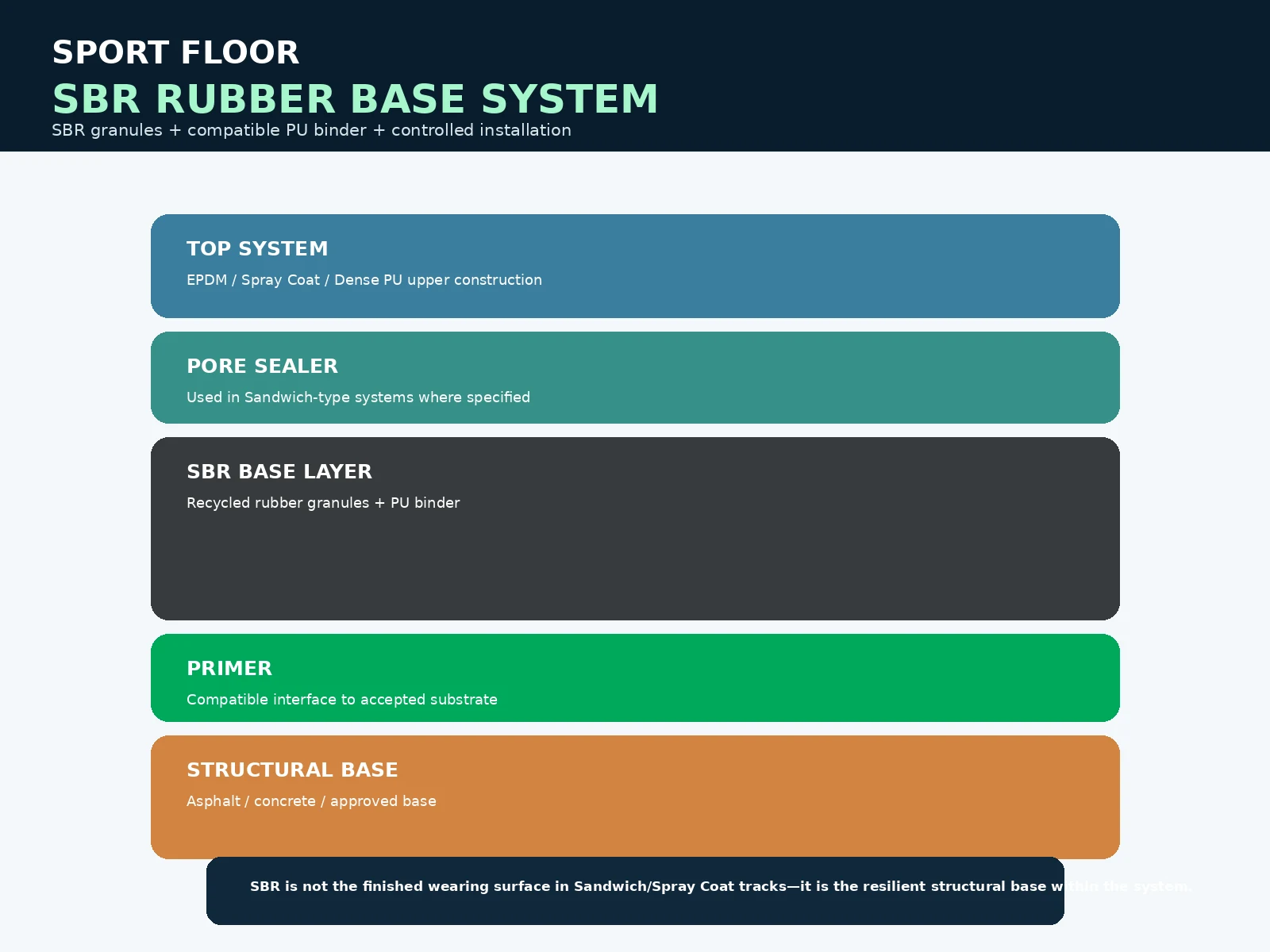
An SBR rubber base is not simply loose black granules under a sports surface. It is an engineered resilient layer made by combining the approved SBR granule grading with a compatible polyurethane binder, mixing the materials uniformly and installing them at controlled thickness, density and level before the upper track or court system is applied.
Sport Floor supplies and manufactures the material families used in compatible SBR base systems, including recycled SBR granules and polyurethane sports-flooring materials. German raw materials are used within applicable Sport Floor polyurethane formulations, creating a coordinated route from SBR and PU binder through the following Sandwich, Spray Coat or project-specific upper construction.
The exact granule size, PU binder type, binder ratio, layer thickness and consumption must come from the selected system and current technical data. Sport Floor does not recommend one universal binder percentage or kg/m² value for every SBR application.
SBR rubber granules provide the resilient granular structure. Polyurethane binder coats and connects those particles so the mixed material can be placed and compacted into a continuous elastic layer over the approved substrate.
Current global sports-surface manufacturers use this principle in running tracks, multi-purpose sports surfaces and other resilient flooring applications. The layer is then covered by the upper system required by the project—for example pore sealer and dense PU in a Sandwich track, or a spray-applied PU/EPDM wearing layer in a Spray Coat track.
This distinction matters commercially: buying SBR granules alone does not mean you have purchased a sports-floor system. The binder, layer architecture, thickness, upper finish and installation method must all be coordinated.
| System | SBR base role | What follows above it |
|---|---|---|
| Sandwich Running Track | PU-bound SBR forms the elastic/resilient base layer. | Pore sealer, dense/self-leveling PU and EPDM wearing construction. |
| Spray Coat Running Track | PU-bound SBR forms the resilient and usually porous structural base. | Spray-applied PU/fine EPDM wearing layer. |
| Hybrid / Project-Specific Systems | SBR may form part of the shock-absorbing construction. | Upper layers depend on the approved system. |
| Multi-Purpose Sports Surface | SBR can be used as an elastic base where the system is designed around it. | PU or other compatible upper construction. |
In most Sandwich and Spray Coat track systems, black SBR granules are installed below the final exposed athletics surface. They provide resilient structure and help create the required system thickness and response.
The upper system then controls the final color, texture, spike interaction, weather exposure and much of the finished surface behavior. This is why SBR and EPDM should not be treated as interchangeable simply because both are rubber granules.
Typically recycled black rubber used for resilient structural layers where the approved system specifies it.
Commonly used in exposed colored upper layers due to application-specific weathering and surface requirements.
Connects the granules and transfers the loose rubber into a coherent installed layer.
An apparently simple black-rubber layer can fail when the granule grading is inconsistent, binder is incompatible, mixing is incomplete, material is placed too dry or too wet, layer thickness varies or compaction differs across the area.
These defects can produce weak zones, excessive porosity, local hardness changes, binder-rich areas, dry pockets, uneven levels or poor bonding to the following system.
Installation control should therefore be treated with the same seriousness as material selection.
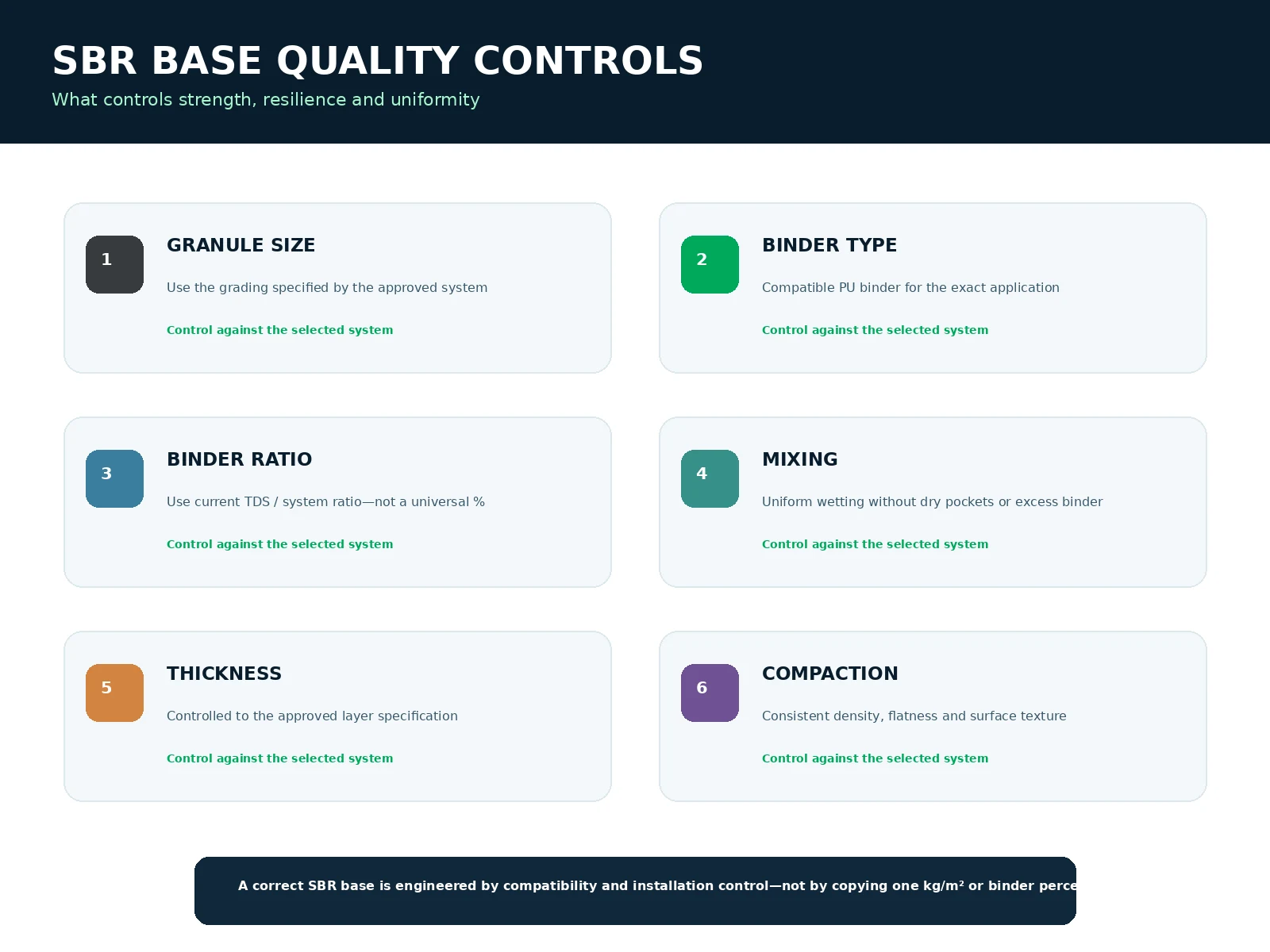
Global product data for SBR base granules shows that multiple particle-size ranges can be used depending on the intended system. For example, published manufacturer data includes 1–3 mm and 1–4 mm options for in-situ base-layer applications.
That does not mean every project should automatically use those sizes. Granule distribution influences packing, surface texture, void structure, binder demand and installed density.
Sport Floor supplies SBR granules in project-agreed particle-size ranges, and the final specification should match the current system design and product documentation.
Sports-surface manufacturers publish dedicated moisture-curing polyurethane binders for rubber granules and base mats because binder chemistry affects workability, cure, adhesion and the integrity of the finished resilient layer.
A binder selected for one rubber application should not automatically be transferred to another. Outdoor exposure, granule type, climate, layer architecture and following coatings all affect compatibility.
Sport Floor manufactures and supplies polyurethane sports-flooring materials for compatible systems, using German raw materials within applicable PU formulations.
Binder demand depends on granule size distribution, bulk density, surface area, product viscosity, installation method, required cohesion, layer thickness and the approved system.
Using too little binder can produce weak cohesion, dry pockets and raveling. Using excessive binder can change porosity, cost, density and cure behavior.
Therefore, use the current Sport Floor TDS and system recommendation for the specific project. Do not copy a binder percentage from another manufacturer, another granule size or an unrelated wet-pour application.
Use the approved batch proportions and calibrated weighing/dispensing method.
Distribute binder through the rubber until the batch is uniformly coated without dry zones.
Install within the material's workable time and under acceptable climate/substrate conditions.
Control thickness, density and surface level consistently across the area.
World Athletics certified-product records show Sandwich and Spray Coat products at multiple different absolute system thicknesses. That alone demonstrates why a buyer should not assume one fixed SBR layer thickness from the total track thickness.
The SBR layer is only one part of the complete construction. The exact share assigned to the SBR base depends on the tested system architecture, upper-layer design and required performance.
Density also matters. Two layers with the same nominal thickness can behave differently when compaction, granule grading and binder distribution differ.
A PU-bound SBR base can contain interconnected voids that allow water movement, which is one reason it is widely used in permeable Spray Coat constructions.
In Sandwich systems, the upper pore sealer and dense PU layers create a different water-management route. The same general SBR base concept can therefore sit inside either a permeable or non-porous complete system.
Do not describe “SBR” itself as automatically porous or waterproof. The complete layer sequence determines the final surface drainage behavior.
The underlying asphalt, concrete or approved base must be stable, level, correctly drained and prepared before the SBR layer is installed. Primer selection should match the actual substrate and following rubber-base construction.
Major depressions, settlement, active cracks and drainage defects should be corrected before synthetic-surface work begins. Increasing SBR thickness over a failed base is not a structural repair strategy.
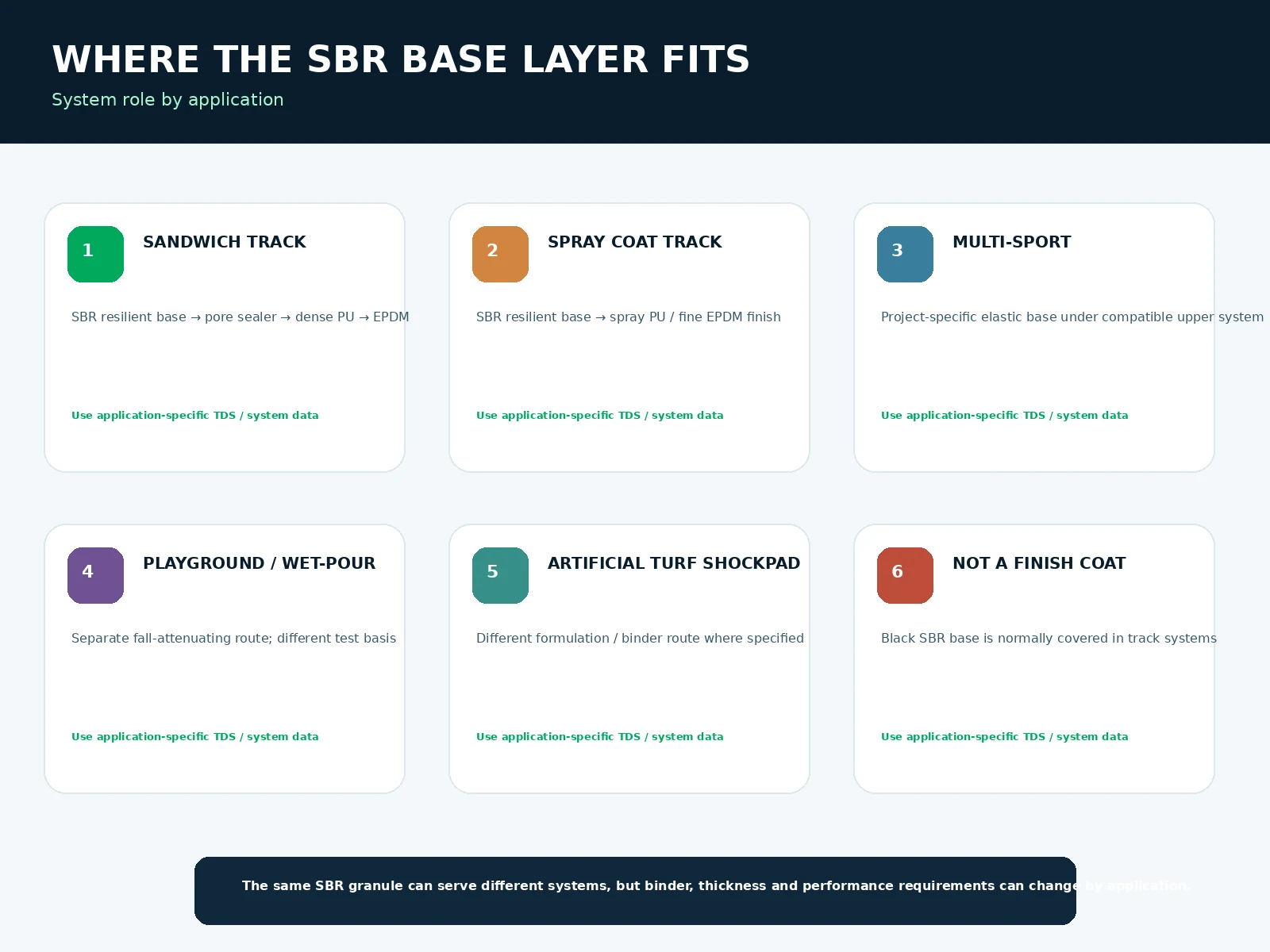
Running tracks, playground wet-pour, multi-purpose surfaces and artificial-turf shockpads can all use recycled rubber and polyurethane chemistry, but they do not share one universal specification. Fall-attenuation testing, turf-shockpad requirements and athletics-track performance are different technical scopes.
| Topic | SBR Rubber Base System | Rubberized PU Base Layer |
|---|---|---|
| Main intent | Complete resilient-base concept using SBR granules + PU binder inside tracks and sports surfaces. | Specific PU product/layer page within the Sport Floor polyurethane product family. |
| Buyer question | How should an SBR base be specified, mixed and integrated into a system? | What is this Sport Floor PU/rubberized layer product and where is it used? |
| Granules | Focuses strongly on SBR grading and rubber-base behavior. | Focuses on the formulated layer/product role. |
| System context | Sandwich, Spray Coat and other resilient-base constructions. | Compatible PU sports-floor builds where the layer is specified. |
| Related page | SBR Granules → | Rubberized PU Base Layer → |
For procurement, first determine the project area and the current approved rubber requirement for the selected layer. Then calculate the binder using the current approved binder ratio for that exact material/system combination.
Do not use a generic density or binder percentage as a substitute for the current Sport Floor system/TDS.
Sport Floor supplies black recycled rubber granules in project-agreed particle-size ranges for contractors and bulk buyers.
Sport Floor manufactures polyurethane sports-flooring materials for compatible track and resilient-base systems.
German raw materials are used within applicable Sport Floor polyurethane formulations, supporting a coordinated PU material route without implying German manufacture.
Incompatible chemistry can affect cure, adhesion and following layers.
Can leave weak cohesion, raveling and dry areas.
Can change porosity, workability, cost and installed behavior.
Creates binder-rich and binder-poor zones within the same layer.
Can change response, quantities and finished levels.
Creates local density and surface-uniformity differences.
Settlement and cracks can reflect into the synthetic system.
Temperature, moisture and rain can affect PU application and cure.
| Quotation item | What should be stated | Why it matters |
|---|---|---|
| Application | Sandwich, Spray Coat, multi-purpose, playground or another defined system. | Different applications use different technical rules. |
| SBR grading | Approved granule size range and material requirement. | Controls packing, binder demand and installed texture. |
| PU binder | Exact compatible product and current data. | Controls cohesion, cure and compatibility. |
| Binder ratio | Current system/TDS value—not a generic market percentage. | Controls both performance and material quantity. |
| Layer thickness | Approved SBR base thickness within the complete system. | Total track thickness alone is insufficient. |
| Installation method | Mixer, paver/manual method, compaction and climate requirements. | Controls uniformity and workmanship risk. |
| Upper system | Pore sealer/dense PU/EPDM or spray finish as applicable. | Defines the final complete sports surface. |
| Supply scope | SBR only, SBR + binder, complete system package or installed work. | Makes quotations commercially comparable. |
Bulk black recycled rubber granules supplied according to agreed particle-size and packaging requirements.
Compatible Sport Floor polyurethane binder supplied according to the selected rubber-base application and current product data.
Where required, Sport Floor can coordinate the SBR base together with the following track materials for international project procurement.
It is a resilient sports-floor base made by mixing approved SBR rubber granules with a compatible polyurethane binder and installing the mixture as a controlled layer over a prepared substrate.
Usually not in Sandwich and Spray Coat tracks. It is normally covered by pore sealer/dense PU/EPDM or a spray-applied PU/EPDM wearing system.
It provides a resilient rubber structure and is a material-efficient way to create elastic base thickness within compatible in-situ systems.
Sandwich and Spray Coat systems commonly use PU-bound SBR resilient base layers. Exact construction varies by product and manufacturer.
Use the grading specified by the selected system. Published global systems use multiple ranges, so there is no one universal granule size for every SBR base.
Use the current approved binder ratio for the exact Sport Floor system and granule grading. There is no responsible universal percentage for every SBR application.
The installed layer can develop weak cohesion, dry areas or raveling.
Excess binder can alter porosity, workability, cost, density and cure behavior.
Yes, in compatible systems when the asphalt is stable, correctly prepared, level and accepted for the selected primer and track construction.
Potentially, when the system permits it and moisture, cracks, joints, preparation and primer compatibility are correctly addressed.
No. An open SBR layer can be part of a permeable system, but a Sandwich track can seal that base with pore sealer and dense upper PU. The complete system determines final permeability.
No. SBR is commonly used as a black resilient base material, while EPDM is widely used in exposed colored upper layers. Their roles and specifications differ.
No. This page explains the complete SBR + PU binder base-system concept. The Rubberized PU Base Layer page describes a specific Sport Floor PU product/layer within compatible systems.
Yes. Sport Floor supplies black recycled SBR granules in agreed particle-size ranges for project and bulk orders.
Sport Floor manufactures polyurethane sports-flooring materials for compatible systems. Exact binder selection should follow the current product data and application.
Yes. German raw materials are used within applicable Sport Floor polyurethane formulations. This does not mean the finished product is necessarily manufactured in Germany.
Yes. International and local buyers can request coordinated SBR, PU and upper-system materials according to the selected project system.
Send the application, project area, selected track or court system, required SBR grading, base condition, layer specification, destination and supply scope. Sport Floor can prepare the appropriate SBR, PU binder and compatible system-material quotation.