
PU Sports Flooring Manufacturer and Polyurethane Court Supplier
Source coordinated polyurethane sports flooring systems for indoor and outdoor courts. Compare smooth, textured and cushioned project-specific build-ups, system materials, supporting-base requirements, line-marking scope, technical documentation, installation responsibilities, export packaging and commercial delivery terms.
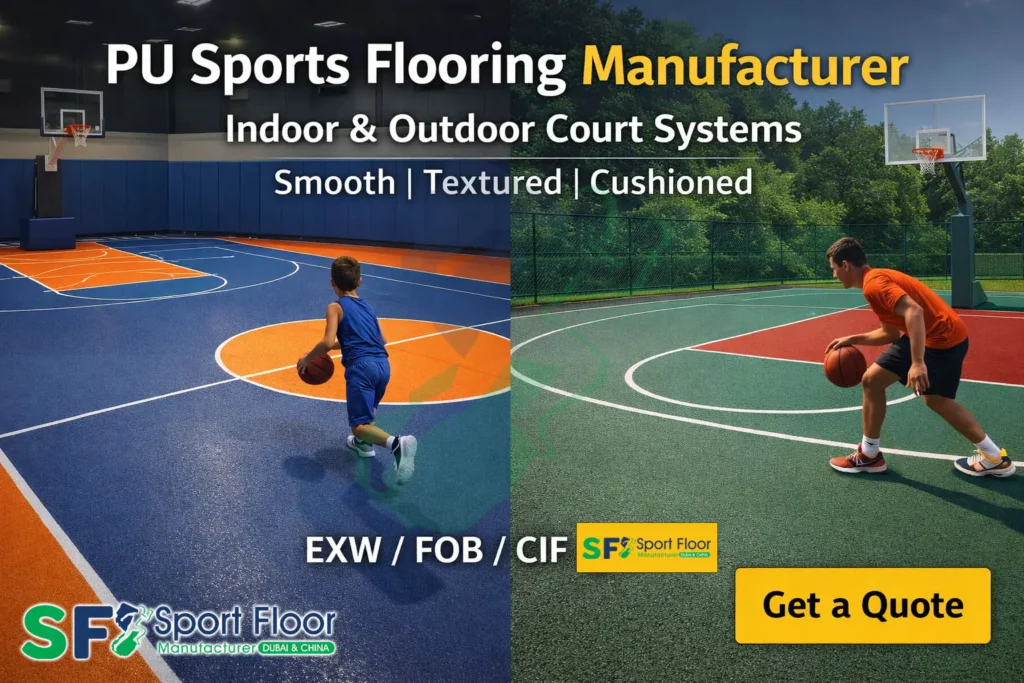
PU Sports Flooring Is a Complete Court System
Polyurethane sports flooring is constructed from compatible materials installed in a defined sequence over a prepared supporting base. It should not be purchased as one generic liquid product or one universal price per square metre.
The required construction depends on the sport, indoor or outdoor environment, base condition, surface texture, resilience, line-marking plan and project testing requirements.
A technically complete offer should show the proposed layer schedule, material references, thicknesses, planned consumption, packaging, documents and responsibilities.
Sport-Specific Selection
Surface response, texture and markings should match the intended sport or multi-sport programme.
Defined Layer Schedule
Primer, resilient layers, wearing surface and markings are identified separately.
Base Coordination
Concrete, asphalt and existing surfaces require different preparation and moisture decisions.
Documented Supply
Materials, quantities, packaging and applicable documents are traceable to the proposed system.
PU Sports Flooring for Single-Sport and Multi-Sport Facilities
Each application should be reviewed separately. A system offered for one sport should not automatically be assumed suitable for every other court.
Basketball Courts
Full, half-court, training and shared-use basketball facilities with coordinated hoops, zones and markings.
Volleyball Courts
Indoor or outdoor volleyball surfaces coordinated with posts, net systems, line layouts and free zones.
Handball Courts
Court systems coordinated with goals, goal areas, line plans and surrounding clearance.
Tennis Courts
Project-specific PU constructions selected according to court use, pace requirements, base and exposure.
Multi-Sport Courts
Shared facilities requiring a priority sport, coordinated line colors and controlled equipment locations.
School Sports Areas
Supervised sports and activity areas designed for the school’s actual programme and operating conditions.
Clubs and Academies
Training courts requiring defined usage, maintenance and performance expectations.
Community Facilities
Municipal and public-use courts requiring robust operational planning and clearly defined maintenance.
Define the Facility Before Choosing the Surface
- Identify every sport to be played.
- State the priority or governing sport.
- Confirm indoor or outdoor use.
- Estimate daily and seasonal usage.
- Identify movable and fixed equipment.
- Confirm footwear and operational restrictions.
- Provide the required court drawings.
- State the required inspection or testing scope.
Smooth, Textured and Cushioned PU Sports Flooring
These descriptions are broad surface categories rather than universal products. The final proposal must identify the complete material construction.
Smooth PU Court System
A seamless polyurethane surface using a comparatively smooth upper finish where appropriate for the intended sport and environment.
- Suitable only where the approved texture permits.
- Requires defined friction and cleaning requirements.
- May use dense PU upper layers.
- Line paint must be compatible.
- Indoor and outdoor suitability must be confirmed.
Textured PU Court System
A surface with a specified texture created through the approved material and application method.
- Texture should match the sport and project criteria.
- Application method affects uniformity.
- Dust and moisture exposure should be considered.
- Excessive roughness should be avoided.
- Performance claims require applicable testing.
Cushioned PU Court System
A project-specific system containing resilient layers beneath the final playing surface.
- Resilient layer type must be identified.
- Total and individual thicknesses must be stated.
- Base compatibility remains essential.
- Ball and player response should match the sport.
- Testing should follow the project requirement.
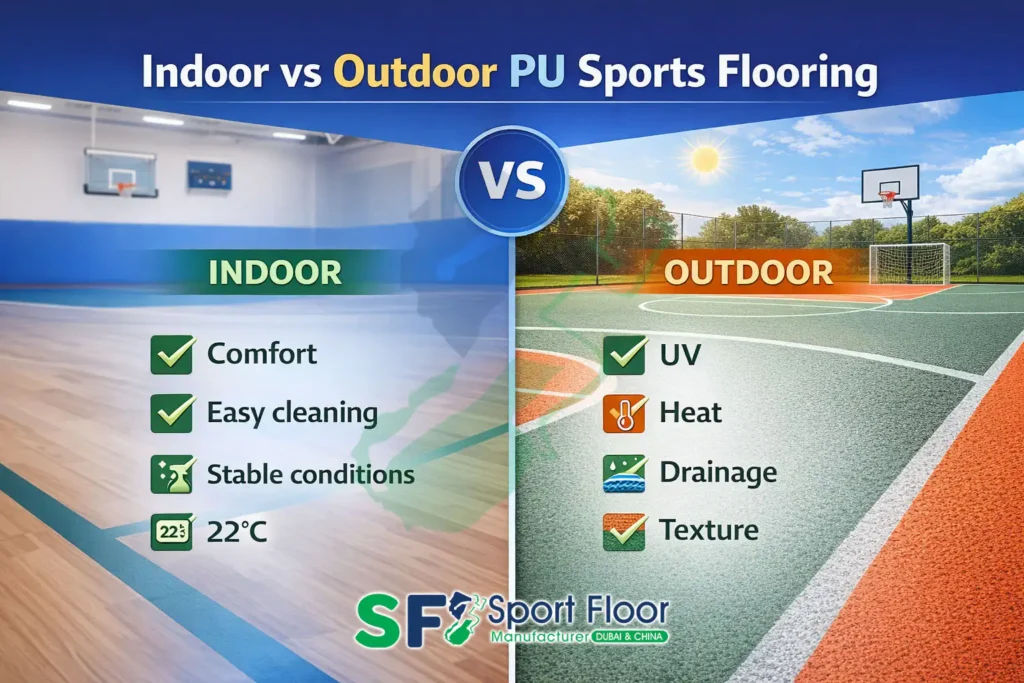
Indoor and Outdoor PU Court Systems Require Different Reviews
Indoor Projects
- Review the concrete moisture and vapour conditions.
- Coordinate the surface with the building environment.
- Define cleaning and facility-use requirements.
- Check compatibility with sports equipment and seating.
- State any required emissions or building-material documents.
Outdoor Projects
- Review heat, rainfall and local exposure.
- Confirm the base slopes and perimeter drainage.
- Define the required surface texture.
- Coordinate joints, kerbs and surrounding paving.
- Request evidence for any weather-related claims.
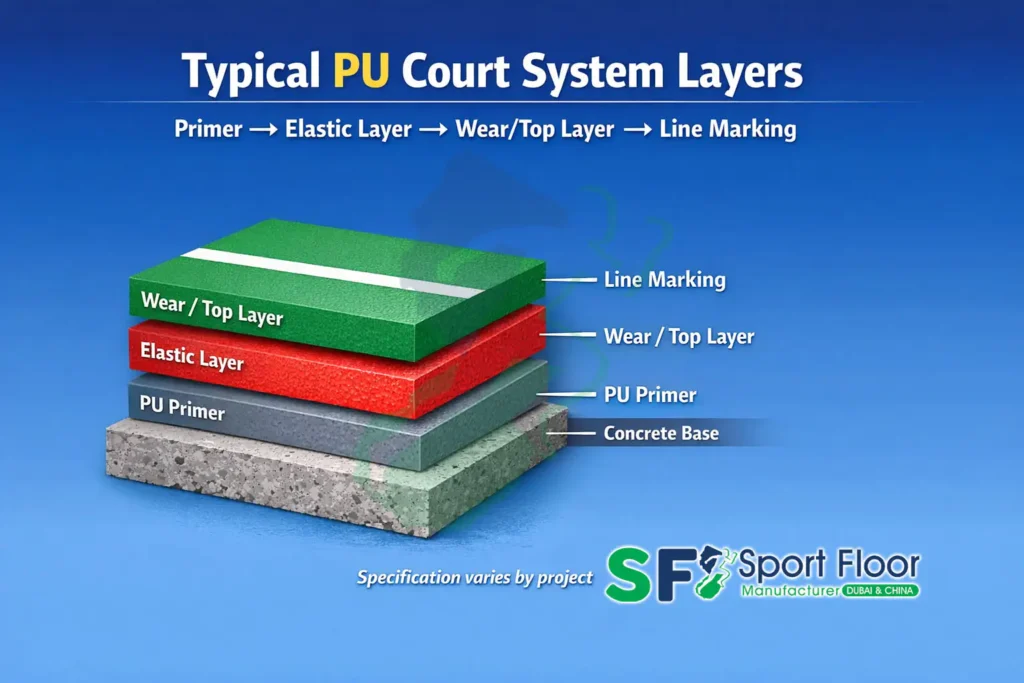
Typical Layers in a PU Sports Court
The image shows a simplified arrangement only. Final products, layer sequence and thickness must follow the approved project system.
Structural Base
Concrete or asphalt providing support, geometry and drainage.
Base Preparation
Cleaning, grinding, repairs and removal of weak material.
Compatible Primer
Adhesion layer selected for the actual substrate.
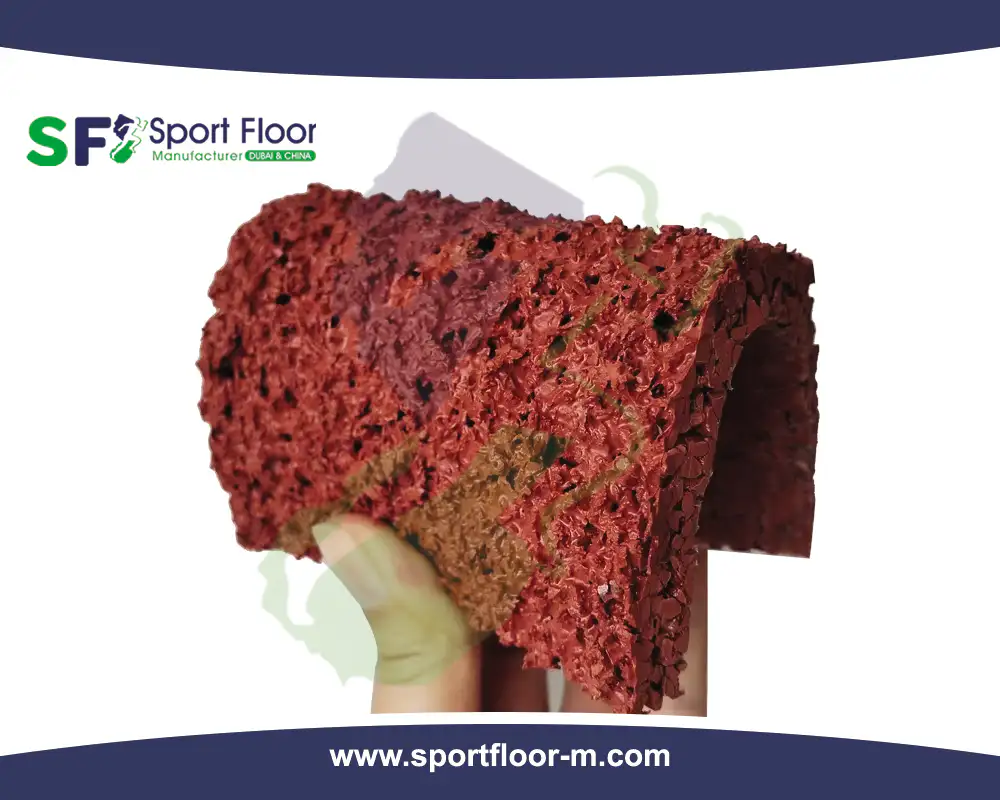
Resilient Layer
Rubber, PU or another approved resilient construction where used.
Sealing or Levelling
Pore sealing or dense levelling material where included.
PU Wearing Layer
Smooth, textured or granule-based playing surface.
Finishing Coat
Project-specific finish where required by the system.
Sports Markings
Compatible line paint applied to the approved layout.
PU Sports Flooring Materials
The exact materials must be selected as one compatible system and connected to the intended court construction.
PU Primer
Selected for concrete, asphalt or an approved existing surface.
PU Binder
Used with compatible granules in applicable resilient layers.
SBR Granules
Project-dependent material for selected resilient base layers.
EPDM Granules
Colored granules used in selected wearing or wet-pour layers.
Pore Sealer
Used where an open rubber layer must receive a dense PU layer.
Self-Levelling PU
Dense polyurethane material used in applicable systems.
Textured Finish
Material and application method selected for the required texture.
Line-Marking Paint
Compatible paint for the final court and multi-sport layout.
Material Supply Should Show
- Exact product name or code.
- Function within the layer schedule.
- Component and mixing information.
- Planned consumption.
- Total required quantity.
- Pack size and number of packs.
- Storage and shelf-life requirements.
- Corresponding TDS and SDS.
Concrete, Asphalt and Existing Court Base Requirements
Base Strength
Confirm the substrate is stable and suitable for the intended bonded system.
Moisture Condition
Review concrete moisture and vapour conditions before dense PU application.
Surface Flatness
Identify unacceptable high points, depressions and transitions.
Cracks and Joints
Assess movement and agree treatment details before surfacing.
Outdoor Drainage
Confirm surface falls, channels, outlets and perimeter levels.
Existing Coatings
Test adhesion and compatibility before retaining an old surface.
Contamination
Remove oil, dust, curing compounds and incompatible materials.
Equipment Foundations
Complete anchors, sleeves and structural fixings before the final surface.
Base Acceptance
Record the accepted condition and responsibilities before installation.
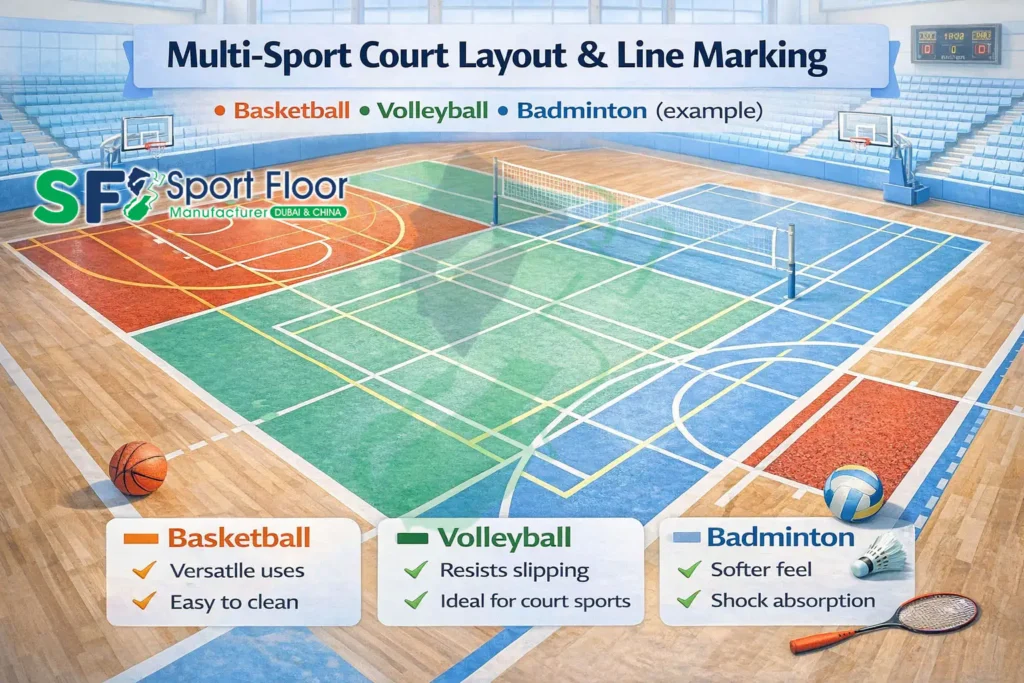
Line Markings, Zones and Sports Equipment
Multi-sport court planning should be completed before material ordering and final color approval.
- Identify the priority sport.
- Obtain the current approved court drawings.
- Allocate a distinct line color to each sport.
- Coordinate goals, hoops, posts and sockets.
- Confirm equipment foundations and anchor positions.
- Review run-off and circulation areas.
- Avoid unnecessary overlapping markings.
- Issue an approved line and color schedule.
- Use compatible line-marking material.
- Record the completed as-built layout.
Materials, Technical Support and Installed Court Scope
Materials-Only Supply
Coordinated materials supplied for installation by the buyer’s approved contractor.
Materials with Remote Support
System package supported by agreed technical communication and application guidance.
Site Supervision
Project-dependent technical supervision while the local contractor provides labour and equipment.
Installed Surface
Agreed PU installation over a technically accepted supporting base.
Turnkey Court Scope
Project-dependent civil, surface, equipment, marking and handover package.
Resurfacing Package
Repair or overlay materials selected after assessment of the existing court.
Testing Coordination
Contractually defined inspection or testing through the agreed responsible parties.
Export Material Package
Materials, pallets, shipping documents and agreed international delivery scope.
PU Sports Flooring Submittal Documents
System Build-Up
Complete layer sequence with products, functions and thicknesses.
Technical Data Sheets
Product-specific application and technical information.
Safety Data Sheets
Handling, storage, hazard and emergency information.
Material Schedule
Product codes, quantities, pack sizes and corresponding layers.
Method Statement
Preparation, mixing, application, curing and inspection process.
Color Schedule
Approved surface zones and sport-line colors.
Applicable Test Reports
Reports identifying the exact tested product or system.
Applicable Certificates
Documents identifying the product, scope, issuer and validity.
Inspection Forms
Base acceptance, mixing, consumption and application records.
Packaging List
Drums, sets, bags, pallets, net weights and gross weights.
Storage Guidance
Project-specific shelf-life and warehouse requirements.
Maintenance Guidance
Cleaning, inspection and project-dependent repair procedures.
Typical PU Sports Flooring Installation Sequence
Confirm Court Requirements
Approve sports, system, colors, lines and commercial scope.
Inspect the Base
Review strength, moisture, flatness, cracks and drainage.
Prepare the Surface
Clean, grind and remove weak or incompatible material.
Complete Repairs
Treat approved defects using compatible materials.
Apply Primer
Use the specified product and application rate.
Install Resilient Layers
Apply the approved rubber or PU construction where included.
Seal or Level
Apply pore sealer or levelling PU where required.
Install Wearing Surface
Apply the approved smooth, textured or granule finish.
Complete Court Markings
Set out and paint the approved sports layouts.
Install Equipment
Complete the agreed hoops, goals, posts and accessories.
Inspect and Test
Complete the project-defined quality and acceptance scope.
Handover
Submit agreed records, documents and maintenance guidance.
Export Packaging and Delivery of PU Court Materials
Product Identification
Label every component with the applicable product and package information.
Matched Components
Coordinate multi-component sets and total required ratios.
Drums and Pails
Protect liquid materials and inspect seals before loading.
Granule Bags
Protect SBR and EPDM from moisture and contamination.
Pallet Schedule
Record pack counts, dimensions, net weight and gross weight.
Shelf-Life Planning
Coordinate production, transport, storage and installation dates.
Transport Classification
Confirm handling requirements using the exact supplied SDS.
Commercial Documents
Confirm invoice, packing list, origin and destination requirements.
Delivery Responsibility
State the Incoterms® rule and named location clearly.
Information Required for a PU Sports Flooring Quote
| Required Information | What to Provide | Why It Matters |
|---|---|---|
| Sport and Facility Use | Basketball, volleyball, handball, tennis, multi-sport or another defined use. | Establishes playing and marking requirements. |
| Indoor or Outdoor | Building or external environment and local exposure. | Influences material and drainage decisions. |
| Area and Dimensions | Net square metres, court dimensions and number of courts. | Required for quantities and line planning. |
| Supporting Base | Concrete, asphalt or existing court, including its condition. | Influences preparation and primer selection. |
| System Preference | Smooth, textured, cushioned or consultant-defined build-up. | Establishes the proposed layer construction. |
| Performance Requirements | Project-defined friction, resilience or other criteria. | Determines documentation and testing requirements. |
| Colors and Markings | Surface zones, sport lines, logos and color references. | Required for material and layout planning. |
| Sports Equipment | Goals, hoops, posts, nets, sockets and accessories. | Clarifies interfaces and supply responsibility. |
| Supply Scope | Materials, support, supervision, installation or turnkey work. | Prevents commercial-scope differences. |
| Required Documents | Technical, tender, testing and shipping documentation. | Affects approval and delivery programme. |
| Destination | Country, city, port and final delivery location. | Required for logistics and freight. |
| Delivery Term | Incoterms® rule, named place and required date. | Defines delivery tasks, costs and risk allocation. |
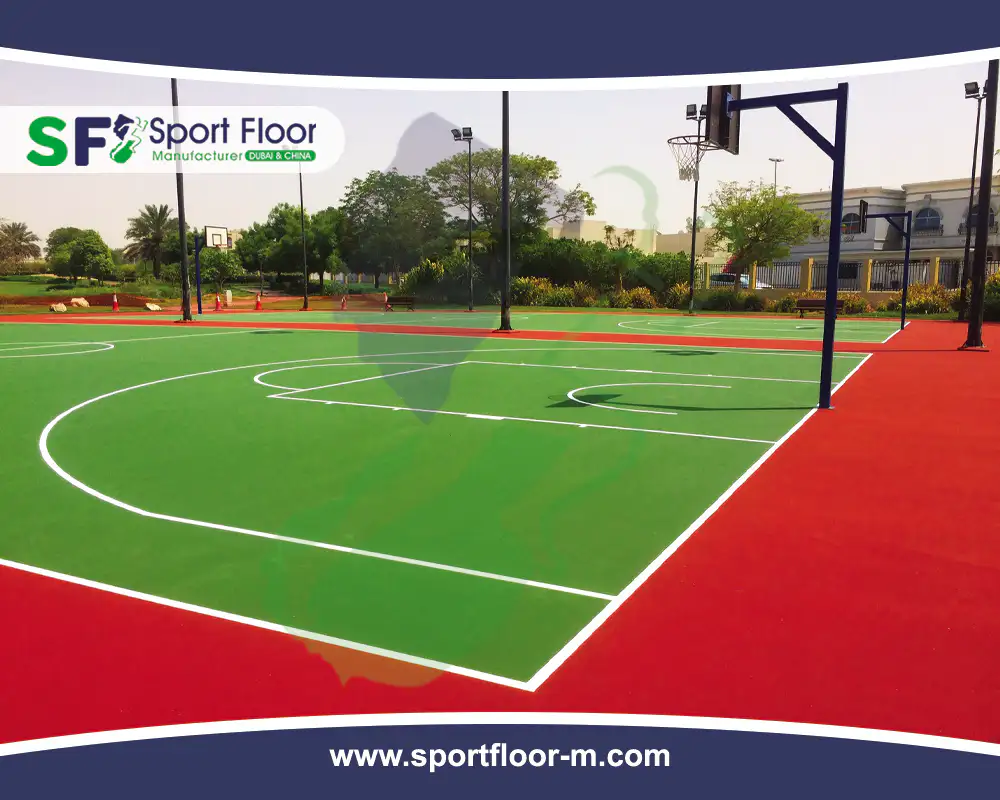
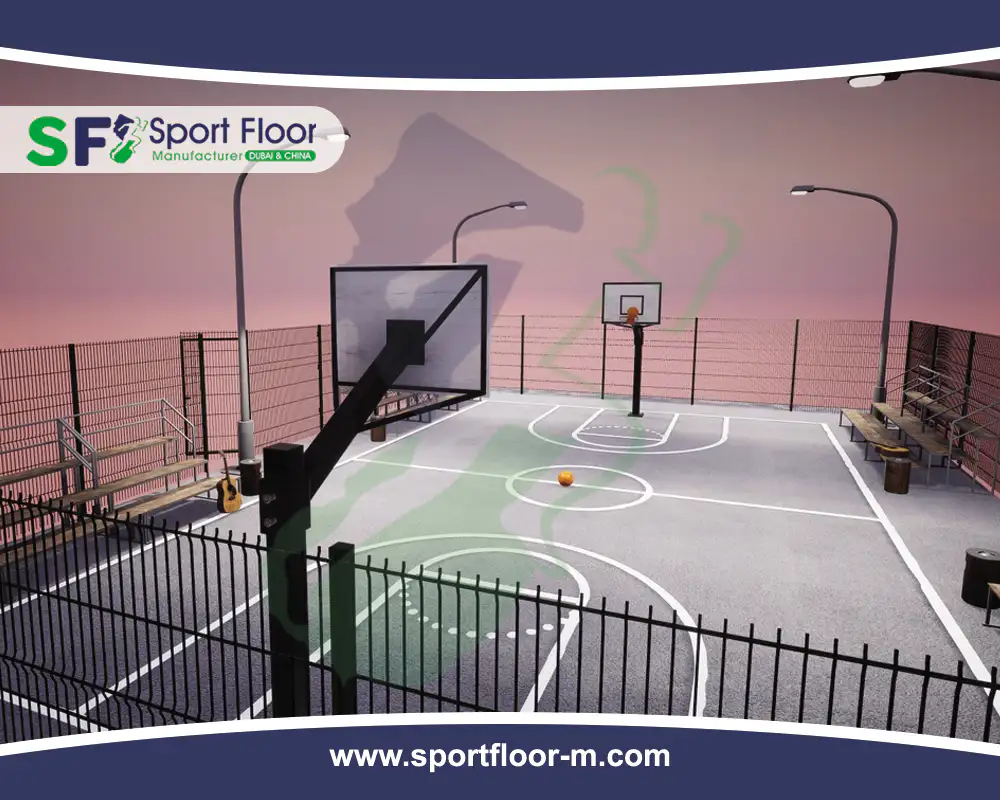
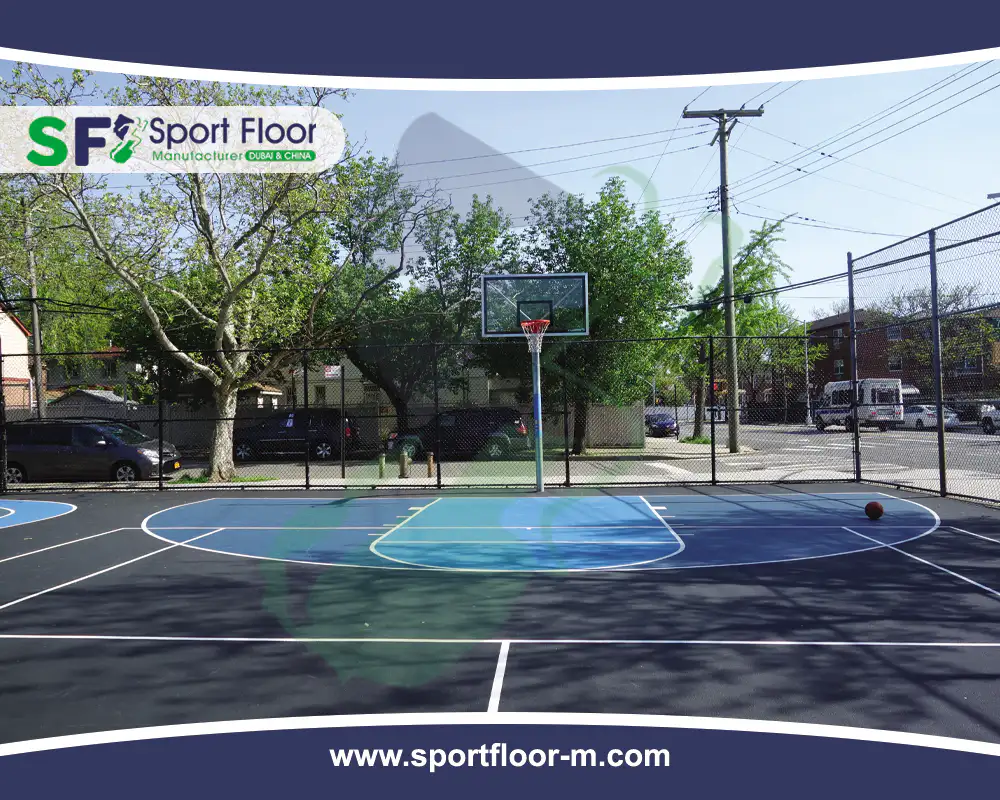
PU Court Surface and Facility Examples
The photographs illustrate court appearance, color zones and equipment arrangements. They do not prove the exact system, project location, performance or certification.
Sports Rules, System Guidance and Delivery Terms
Continue to the Required Sport or Technical Scope
PU Sports Flooring Manufacturer FAQ
What is PU sports flooring?
It is a polyurethane-based sports-surface system constructed from compatible layers over a prepared supporting base.
Which sports can use PU court flooring?
Project-specific systems may be considered for basketball, volleyball, handball, tennis, multi-sport courts and other defined applications.
Can PU sports flooring be used indoors and outdoors?
Yes, when the exact system is specified for the intended environment, base and exposure conditions.
What is the difference between smooth, textured and cushioned PU?
They describe broad surface or resilient-construction categories. Exact products, layers and thicknesses vary by system.
Which PU court system is best?
Selection depends on the sport, environment, base, required texture, resilience, testing, budget and maintenance plan.
Can PU sports flooring be installed over concrete?
Project-dependent systems may be installed over prepared concrete after reviewing strength, curing, moisture, joints and primer compatibility.
Can it be installed over asphalt?
Applicable systems may be installed over suitable asphalt after checking stability, condition, levels and drainage.
Can old PU courts be resurfaced?
Resurfacing may be possible after assessing adhesion, cracks, moisture, drainage, remaining thickness and material compatibility.
Can PU sports flooring materials be supplied without installation?
Materials-only supply may be quoted when the system, quantities, local installer, equipment and responsibilities are clearly defined.
What documents should be supplied?
Request the complete system build-up, TDS, SDS, material schedule, method statement and applicable test or certification documents.
How long does PU sports flooring last?
Service life depends on the system, base, environment, use, installation, cleaning, drainage and repair history. There is no universal fixed lifespan.
How is PU sports flooring pricing calculated?
Pricing depends on area, system, thickness, materials, base preparation, markings, equipment, documentation, installation, destination and delivery term.
Request a PU Sports Flooring Manufacturer Quotation
Send the sport, indoor or outdoor environment, total area, court dimensions, supporting base, preferred system, required performance, colors, markings, equipment, supply scope, documents, destination, Incoterms® rule and delivery programme.