
School / Community
Prioritize practical durability, maintenance, safe everyday use and realistic lifecycle cost. Spray Coat or other value-led systems may deserve early consideration where the specification permits.
The best running-track system is not automatically the thickest, most expensive or most heavily promoted option. It is the system that matches the facility level, climate, drainage strategy, base, expected traffic, maintenance capability, testing requirements, procurement model and lifecycle budget.
Sport Floor manufactures polyurethane sports-flooring materials for compatible in-situ running-track systems and supplies coordinated PU, EPDM and SBR material packages for local and international projects. German raw materials are used within applicable Sport Floor polyurethane formulations, giving buyers a manufacturer-direct route from system selection through material scheduling and export supply.
This page is designed to help owners, consultants, contractors and procurement teams decide which track family deserves detailed specification. Once the system family is selected, the final quotation should move to the exact product build-up, current technical data and project-specific testing.
International manufacturers offer multiple system families because the market does not have one universal optimum. Full PU, Sandwich, Spray Coat and prefabricated systems solve different combinations of performance, budget, permeability, installation and lifecycle priorities.
Even certified products should not be assumed to be equal. World Athletics explicitly notes that certified track surfacing products can differ in quality even though they satisfy the minimum technical requirements, and the purchaser must make their own assessment.
The correct procurement question is therefore not “Which track is best?” but “Which system best matches this facility, this climate, this base and this operational plan?”

Prioritize practical durability, maintenance, safe everyday use and realistic lifecycle cost. Spray Coat or other value-led systems may deserve early consideration where the specification permits.
Balance frequent use, athlete response, durability and the cost of future maintenance. Sandwich often becomes an important comparison route.
Evaluate performance, event load, appearance, weather, maintenance resources and required testing together rather than buying only by initial price.
Begin with the exact governing certification and testing scope, then shortlist only products and systems capable of meeting that project requirement.
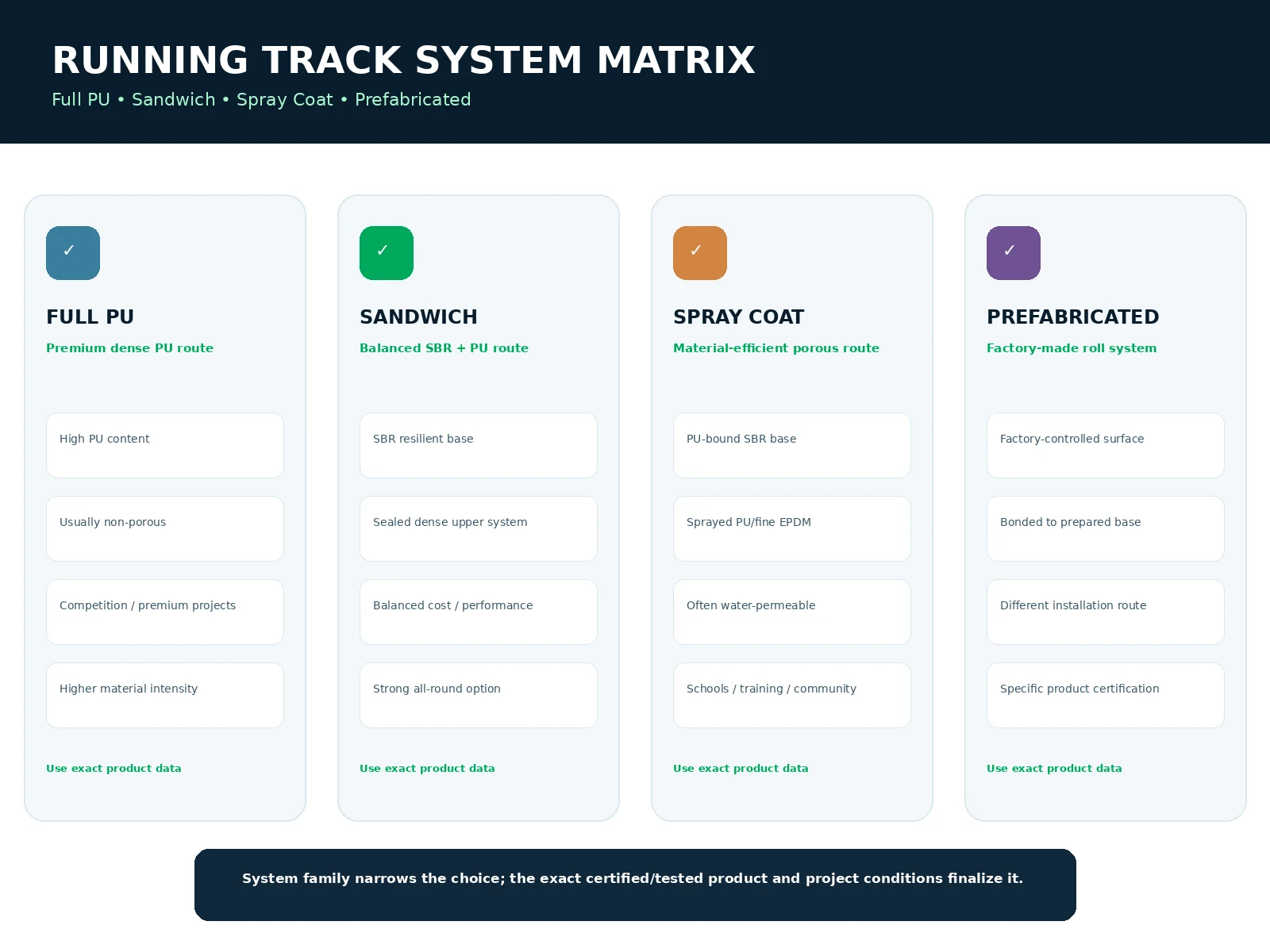
Prefabricated running-track systems are factory-manufactured surfacing products supplied in rolls or sheets and bonded to an accurately prepared substrate. They can offer strong factory control of the surfacing layer and a different installation programme from in-situ PU systems.
The decision should consider exact product certification, substrate tolerances, adhesive system, joints/seams, installation expertise, climate, logistics, repair route and lifecycle strategy.
Do not compare a prefabricated surface and an in-situ Full PU system only by total thickness or material price. Their manufacturing, installation, detailing and repair logic are fundamentally different.
| Climate factor | What it changes | Selection question |
|---|---|---|
| Strong UV | Surface aging, color stability, exposed polyurethane/EPDM performance and maintenance. | What is the exact outdoor finishing route and UV evidence? |
| Heavy Rain | Drainage capacity, surface falls, permeability and time to reopen after rain. | Should the track use a permeable or non-porous surface strategy? |
| High Heat | Installation windows, substrate temperature, curing, thermal expansion and operational comfort. | What application limits and climate precautions apply to the exact system? |
| Cold / Freeze-Thaw | Base movement, trapped water, cracking risk and seasonal construction. | How will drainage and substrate construction control freeze-related movement? |
| Dust / Sand | Cleaning frequency, traction and maintenance demand. | Can the facility maintain the surface at the required frequency? |
Full PU and classic Sandwich systems are commonly non-porous routes, making surface falls, channels and outlets especially important. Spray Coat systems are commonly water-permeable, but that only moves the water downward—the base and sub-base must still receive and discharge it safely.
A porous system over a base that traps water is not a drainage solution. Likewise, a non-porous system over poor levels can produce ponding even when the material itself is correctly installed.
Often selected for synthetic athletics surfaces when properly engineered, compacted, cured, levelled and accepted before PU installation.
May be compatible with selected systems when moisture, cracks, joints, preparation and primer requirements are correctly addressed.
Requires inspection of the old system, adhesion, cracks, remaining thickness, drainage and base stability before repair or resurfacing.
The lowest-cost system at installation is not automatically the lowest-cost system over the facility's operating life. Traffic level, climate, maintenance, drainage, repairability and resurfacing strategy all influence total value.
Spray Coat can be attractive where a material-efficient system fits the facility brief. Sandwich can provide a strong balance between resilient rubber construction and dense upper PU layers. Full PU can justify a higher material intensity where the project prioritizes a premium in-situ performance route.
Published manufacturer service-life estimates vary significantly by system and operating conditions. Sport Floor therefore does not recommend choosing a track based on one universal lifespan claim.

World Athletics certification records show Full PUR, Sandwich and Spray Coat products at different absolute thicknesses. This confirms that there is no single universal thickness that defines all track systems or certified products.
The correct thickness must be linked to the exact system architecture and tested product. Total millimetres alone do not reveal whether the construction contains dense PU, PU-bound SBR, prefabricated rubber or a sprayed wearing layer.
World Athletics maintains separate current lists for Certified Track Surfacing Products and Certified Athletics Facilities. A certified surface product and a certified completed facility are not the same thing.
A system family such as Full PUR, Sandwich or Spray Coat is also not a certificate. Certification belongs to the identified product with its manufacturer, description, absolute thickness and certificate number.
For competition projects, specify the required product certification, facility certification, field testing, geometry and laboratory scope in the tender. For school or community projects, avoid paying for unnecessary certification while still demanding a defined and documented system.
| Maintenance question | Why it affects system choice |
|---|---|
| How frequently will the track be cleaned? | Dust, debris and contamination can affect traction and drainage. |
| Can local damage be repaired promptly? | Small defects can develop into larger failures when left untreated. |
| Are drainage channels routinely maintained? | Blocked outlets can damage even a technically correct surface. |
| Will the track host events or vehicles? | Non-athletic loads can change wear and protection requirements. |
| Is resurfacing planned? | A future retopping route can materially affect lifecycle value. |
| Are compatible materials available locally or by export? | Repairability depends on access to the correct system materials. |
Sport Floor uses German raw materials within applicable polyurethane primers, binders, dense layers and finishing formulations.
Sport Floor manufactures its polyurethane sports-flooring material family for compatible in-situ track systems.
Primer, binder, SBR, EPDM, pore sealer, dense PU, spray material and line marking can be coordinated around the selected system.
| Supply model | Best fit | Critical requirement |
|---|---|---|
| Materials Only | Experienced local contractor with approved equipment and installation capability. | Exact material schedule, current TDS/SDS and clear installer responsibility. |
| Materials + Technical Support | Local execution team requiring manufacturer coordination. | Define what support is included and who controls site workmanship. |
| Materials + Supervision | Projects requiring manufacturer-side site guidance. | Clarify labour, equipment, utilities, travel and supervision limits. |
| Synthetic Surface Installation | Prepared civil base requiring specialist track installation. | Base acceptance and division of responsibility before mobilization. |
| Complete Construction | Projects seeking coordinated civil, drainage, base and surface work. | Full scope, geometry, local requirements and testing responsibilities. |
| Project priority | System to investigate first | Why |
|---|---|---|
| Premium in-situ competition / high PU intensity | Full PU | Dense PU-rich route with premium performance positioning. |
| Balanced performance, rubber resilience and dense PU upper system | Sandwich | Strong all-round balance between SBR resilient base and dense PU/EPDM construction. |
| School, training or community project with value-led material architecture | Spray Coat | Material-efficient system family commonly used for broad sports applications. |
| Factory-manufactured roll surface required by exact specification | Prefabricated | Different factory-controlled surface and bonded installation model. |
| Existing track with structurally sound base and worn surface | Resurfacing / Retopping | May avoid full reconstruction when condition assessment confirms suitability. |
| Existing track with cracks, delamination or drainage defects | Repair assessment first | Diagnose failure before selecting a new wearing system. |
Total millimetres do not reveal material architecture or tested performance.
Red or blue tells you nothing about system family, permeability or quality.
A premium surface cannot permanently repair settlement, weak asphalt or active structural cracks.
Permeable surface does not mean the sub-base can safely retain water.
Always ask for exact product and current certificate evidence.
Material quantity belongs to the exact system/TDS and project area.
Unrelated layers can create compatibility and warranty/technical-responsibility problems.
Normalize system, thickness, materials, testing, freight and installation before comparing price.
School, training, club, stadium or competition.
Total synthetic surface area and lane layout.
Temperature, rain, UV and seasonal conditions.
New asphalt, concrete or existing track condition.
Falls, channels, outlets and subsurface route.
Product/facility certification and field-testing requirements.
Target investment and lifecycle expectations.
Expected cleaning, local repair and resurfacing capability.
Materials only, support, installation or complete works.
Country, port / named place and programme.
There is no universal best system. The correct choice depends on facility level, climate, drainage, base, traffic, maintenance, testing, lifecycle budget and procurement scope.
Full PU is a more PU-intensive dense in-situ construction. Sandwich combines a PU-bound SBR resilient base with pore sealing and dense upper PU/EPDM layers.
Spray Coat is commonly investigated for schools, training and community facilities where a material-efficient, often permeable in-situ system matches the specification.
Consider it when the project specifically prefers a factory-manufactured roll system and has suitable substrate tolerances, installation expertise, logistics and certification requirements.
No. Higher PU content does not automatically make Full PU the best economic or technical choice for every facility.
No. Sandwich and Spray Coat solve different budget, permeability, performance and lifecycle requirements.
No. Certified products and system families use different absolute thicknesses. Use the exact tested/product specification.
Permeability can help surface water movement, but the base and subsurface drainage must also safely discharge the water. Climate alone does not determine the final system.
No track system should be used to hide an unstable or failed base. Correct the civil problem before the synthetic surface is installed.
No. World Athletics states that certified track products are not all of the same quality even though they meet the minimum technical requirements.
No. Product certification and completed athletics-facility certification are separate scopes.
Normalize system family, layer schedule, exact thickness, product references, quantities, installation, testing, freight, exclusions and future maintenance before comparing prices.
Yes. Sport Floor manufactures its polyurethane sports-flooring material family used in compatible in-situ running-track systems.
Yes. German raw materials are used within applicable Sport Floor polyurethane formulations. This does not mean the finished products are manufactured in Germany.
Yes. Contractors and project buyers can request coordinated PU, EPDM, SBR and related track materials for international supply according to the approved system and commercial scope.
Send facility level, area, climate, base, drainage, system preference if any, testing requirements, budget/lifecycle priorities, supply scope and destination.
Send the facility level, track area, climate, base, drainage, testing requirements, lifecycle priorities, commercial scope and destination. Sport Floor can shortlist the appropriate system family and prepare the next technical and commercial step.